

You give your dog a bully stick.
Twenty minutes later, it's gone.
Then you talk to another dog owner who says the same type of bully stick lasts their dog for hours.
What happened?
Was their bully stick better?
Is yours too soft?
Did you buy the wrong size?
Maybe.
But there's another possibility:
Your dog is simply a much more efficient chewer.
Bully-stick chew time varies enormously from dog to dog. Size matters. Thickness matters. But so do jaw strength, chewing technique, persistence, experience, and even how a dog positions the chew.
That's why asking, "How long does a bully stick last?" rarely has one reliable answer.
The bully stick is only half of the equation.
The dog is the other half.
Every Dog Has a Chewing Style
Watch several dogs chew and you'll quickly notice they don't approach the activity the same way.
One dog carefully nibbles.
Another gnaws steadily.
Another immediately positions the bully stick between the back teeth and gets serious.
Some dogs take frequent breaks.
Others don't stop until the job is finished.
These differences create dramatically different chew times even when the dogs receive similar products.
Think of chewing style as part of your dog's personality.
Some dogs are casual chewers.
Others apparently believe they're being timed.
Jaw Strength Changes the Equation
Dogs vary considerably in physical size and jaw strength.
A larger, stronger dog can often apply substantially more pressure to a bully stick than a smaller dog.
That can help them soften and work through the tissue more efficiently.
But body size doesn't tell the whole story.
A large gentle chewer may take considerably longer than a smaller dog that attacks every chew with determination.
That's why choosing bully sticks exclusively according to weight can sometimes produce unexpected results.
Size matters—but intensity matters too.
Power Chewers Have a Different Strategy
Power chewers don't simply chew harder.
They often chew more efficiently.
They may quickly figure out:
Where to position the stick.
Which teeth provide the best leverage.
Which angle works fastest.
How to hold the chew between their paws.
Where the material is easiest to work through.
Once they develop an effective technique, they repeat it.
That's why an experienced power chewer can sometimes make surprisingly quick work of natural chews.
Thickness Can Make a Major Difference
Now we get to the bully stick itself.
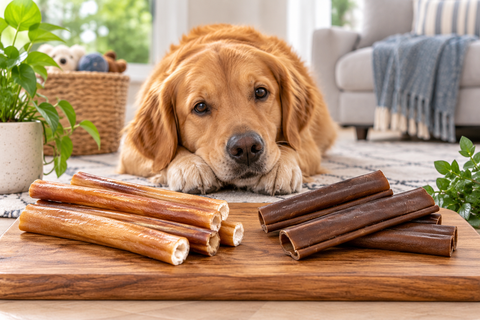
Imagine two sticks that are both six inches long.
One is thin.
The other is substantially thicker.
The power chewer has less material to work through across the diameter of the thin stick.
The thicker option presents more.
That additional material can create a more substantial chewing challenge.
This is why increasing thickness may sometimes make more sense than simply increasing length when your dog finishes bully sticks quickly.
Longer Doesn't Necessarily Mean Harder
A 12-inch bully stick gives your dog more total length than a 6-inch version.
But if both have a similar thin diameter, your dog may work through each individual section using essentially the same technique.
You've increased the amount of chew.
You haven't necessarily increased the challenge of working through each section.
That's the difference between:
More length
and
More thickness.
For enthusiastic chewers, you may need to consider both.
Natural Variation Matters Too
Bully sticks are made from real animal tissue.
They're not manufactured plastic rods.
That means individual pieces can naturally vary somewhat in:
- Thickness
- Density
- Shape
- Weight
- Texture
Even within the same general size category, one bully stick may not perform exactly like another.
That's normal with natural products.
So if one stick lasts noticeably longer than another, the difference may partly reflect the individual chew—not necessarily a change in your dog's behavior.
Saliva Helps Change the Texture
A bully stick doesn't remain exactly the same throughout the chewing session.
As your dog works, saliva moistens the surface.
The tissue gradually softens.
Once an area becomes softer, your dog may be able to work through it more quickly.
Some dogs are particularly good at concentrating on one section until it reaches exactly the texture they want.
Then progress speeds up.
The dog isn't just applying force.
They're changing the material as they go.
Some Dogs Rotate—Others Attack One Spot
Chewing technique can make a surprising difference.
A gentle chewer may rotate the bully stick constantly.
One end. Another section.
Flip it around.
Take a break.
Come back later.
A determined chewer may focus on one specific point and work continuously until they've made significant progress.
That concentration can dramatically shorten the overall chew time.
Same chew.
Different strategy.
Taking Breaks Makes Chews Last Much Longer
This sounds obvious, but it's easy to overlook.
Some dogs naturally chew for ten minutes and walk away.
They return later.
Then again tomorrow.
One bully stick might provide several sessions.
Other dogs have absolutely no concept of saving something for later.
Once the bully stick appears, they're committed until it's finished.
If your dog belongs to the second category, their bully sticks will naturally seem much shorter-lasting than those belonging to a dog that self-regulates chewing sessions.
Experience Can Make Dogs Faster
Dogs can become more efficient with familiar chews.
The first time your dog receives a bully stick, they may spend considerable time figuring out:
How to hold it.
Where to start.
What angle works.
How the texture changes.
After repeated experiences, they already know the assignment.
That familiarity can make subsequent chewing sessions faster.
Your dog may not be getting stronger.
They may simply be getting better at bully sticks.
Does Faster Mean Your Dog Needs a Different Chew?
Not automatically.
A dog finishing a bully stick quickly doesn't necessarily mean bully sticks are the wrong product.
Ask what you're trying to accomplish.
If you want a relatively short natural chewing session, the current bully stick may be doing exactly what you need.
If you specifically want longer engagement, consider changing:
Thickness
Length
or both.
You can also rotate bully sticks with other natural chews that provide different structures and challenges.
Try a Beef Cheek Roll for a Different Challenge
A dog that has become extremely efficient with stick-shaped chews may interact differently with a larger rolled product.
Beef cheek rolls provide a broad, layered structure that dogs can work from multiple angles.
That doesn't guarantee they'll last a specific amount of time. But it changes the problem.
And sometimes changing the structure is more effective than simply giving the dog another version of the same shape.
Build a Chew Rotation
If your dog genuinely loves chewing, one product doesn't need to carry the entire enrichment routine.
Rotate between different appropriate options.
For example:
Bully Stick: Familiar everyday chew.
Thicker Bully Stick: More substantial bully-stick session.
Collagen Stick: Different texture.
Beef Cheek Roll: Different shape and structure.
Cow or Pig Ear: Lighter chewing experience.
Different products ask dogs to interact in different ways.
That variety can make chewing more interesting even when your dog remains impressively efficient.
Don't Turn Chew Time Into a Competition
It's easy to become obsessed with duration.
"That chew only lasted 25 minutes."
But longer isn't automatically better.
A 25-minute chewing session where your dog is focused, engaged, and enjoying an appropriate natural chew can still provide plenty of value.
Chew duration is one measurement.
It's not the only measurement.
Ask whether the chew: Fits your dog's size.
Matches their chewing style.
Provides engagement.
Works within their overall diet.
Can be offered appropriately under supervision.
Those factors matter more than beating another dog's chew-time record.
Fast Chewers Still Need Portion Awareness
There's another reason speed matters.
Bully sticks are edible.
If your dog consumes an entire bully stick quickly, they've still consumed the entire chew—even if the enrichment session didn't last very long.
That contributes to overall calorie and treat intake.
Don't automatically hand over another bully stick because the first one disappeared faster than expected.
A short chew time doesn't mean the calories disappeared too.
Supervise From Beginning to End
Fast chewers can change the size of a bully stick quickly.
Monitor the chew throughout the session rather than assuming it's still substantial because it was large fifteen minutes ago.
As the remaining piece becomes shorter, remove it before it reaches a size your dog could attempt to swallow whole.
Supervision becomes especially important with dogs that chew efficiently because the transition from "large chew" to "small remainder" can happen surprisingly fast.
Your Dog Is the Biggest Variable
At Raw Paws Pet Food, we offer bully sticks across different sizes and thicknesses because dogs simply don't chew identically.
A bully stick that becomes an afternoon project for one dog may be a warm-up exercise for another.
That's not necessarily a problem with the chew.
It's a reminder to match the product to the individual animal.
Watch your dog.
Learn their technique. Notice how quickly they work.
Experiment with thickness and length.
Try different natural chew structures.
Because when two dogs finish the same bully stick at completely different speeds, the answer isn't always hiding inside the treat bag.
Sometimes it's sitting right in front of you—
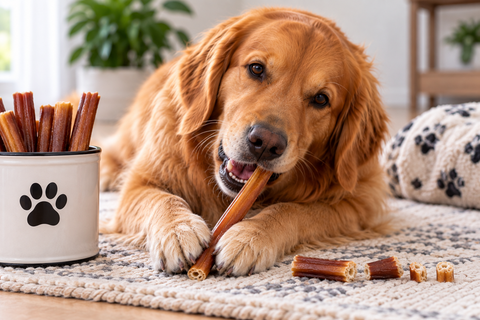
holding the bully stick between its paws and chewing like there's a trophy waiting at the finish line.
Comments (0)
There are no comments for this article. Be the first one to leave a message!