

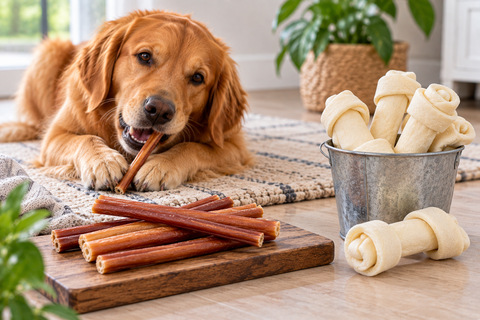
Your dog has been happily working on a bully stick.
Twelve inches becomes eight.
Eight becomes five.
Eventually, you're left watching your dog chew a small remaining piece and wondering:
Is it time to take this away?
This is one of the most important parts of giving dogs edible chews.
A bully stick begins as a substantial chew that's easy for a dog to hold between their paws. As it gets shorter, however, the way your dog can interact with it changes.
Eventually, that remaining piece may become small enough that your dog tries to swallow it instead of continuing to chew.
That's the point owners want to avoid.
There isn't one universal measurement where every bully stick suddenly becomes too small. The right time to remove it depends on the size of the remaining piece relative to your individual dog's mouth and swallowing behavior.
The safest approach is simple:
Watch the chew.
Watch the dog.
And don't wait until the final bite to make the decision.
The Bully Stick Changes Throughout the Session
A fresh bully stick and the final remaining piece aren't really the same chewing experience.
At the beginning, your dog can:
Hold it between their paws.
Work from one end.
Reposition it.
Change chewing angles.
Gradually soften different sections.
As the stick becomes shorter, there's less material available to grip and control.
Eventually, your dog may stop treating it like a long chew and begin treating the remainder like something they can simply finish.
That's when closer supervision becomes especially important.
Don't Wait for a Magic Number
You may see recommendations based on a specific number of inches.
The problem is that dogs aren't one size.
A piece that looks substantial beside a Chihuahua may look tiny beside a Great Dane.
Thickness matters too.
A short jumbo bully-stick remainder isn't physically identical to a short thin bully-stick remainder.
Instead of relying exclusively on a ruler, ask:
Could my dog reasonably attempt to swallow this remaining piece whole?
If the answer is yes—or you're uncertain—the chew should come away.
Your Dog's Behavior Is One of the Best Clues
Some dogs methodically chew everything.
Others eventually decide:
"This is small enough. I'll just swallow it."
Knowing which dog you have matters.
Watch for changes in technique as the bully stick gets shorter.
Your dog may:
Stop holding it between their paws.
Move the entire remaining piece farther into the mouth.
Begin chewing more rapidly.
Try to reposition the whole piece toward the back teeth.
Attempt to gulp the remainder.
Those behaviors tell you the chewing session may be approaching its end.
Power Chewers Deserve Extra Attention
Power chewers can change a bully stick quickly.
A substantial chew can become a small remainder much faster than expected.
That means you shouldn't assume:
"It was large when I gave it to him, so we're fine."
The relevant question is what the chew looks like right now.
For determined chewers, check the bully stick periodically throughout the session rather than waiting until your dog is nearly finished.
Smaller Dogs Need the Same Rule—Applied to a Smaller Mouth
It's tempting to think swallowing concerns are mainly a large-dog issue.
They're not.
A smaller dog simply reaches the concerning size at a different point.
The remaining bully stick should always be considered relative to the dog receiving it.
That's why appropriate sizing matters from the beginning.
A chew that's properly sized gives the dog something substantial to hold and work through while allowing the owner to monitor how it changes throughout the session.
Thickness Doesn't Eliminate the Need to Remove the End
Choosing a thicker bully stick can provide more material and often a more substantial chewing experience.
But eventually, even a thick bully stick gets shorter.
The same supervision rule applies.
Thin.
Standard.
Thick.
Jumbo.
Six inches.
Twelve inches.
Every edible chew changes as it's consumed.
Sizing helps create the right starting point.
Supervision determines the appropriate ending point.
A Bully Stick Holder Can Help
Bully-stick holders are designed to secure part of the chew and make it more difficult for a dog to access or swallow the final section whole.
For some dogs and compatible bully sticks, they can provide an additional layer of management.
But a holder doesn't turn an edible chew into an unsupervised activity.
Make sure the product is appropriately sized, secured according to the manufacturer's instructions, and used under supervision.
A tool can help manage the chew.
It doesn't replace watching the dog.
You Don't Have to Let Your Dog Finish the Bully Stick
Dogs strongly disagree with this concept.
But it's true.
A bully stick doesn't have to disappear completely during every session.
Maybe your dog has been chewing for a while.
Maybe they've consumed enough of their treat allowance for the day.
Maybe the remaining piece is getting smaller than you're comfortable with.
You can end the session.
A natural chew is supposed to provide an enjoyable activity.
Finishing every last piece isn't the objective.
What About Saving a Partially Chewed Bully Stick?
If you remove a bully stick before it's finished, remember that your dog has introduced saliva and moisture into the product.
That changes how it should be handled compared with an untouched dry chew.
Follow the manufacturer's instructions for storing partially chewed bully sticks and discard the product if its condition becomes questionable.
Don't simply seal a wet chew in a container and forget about it.
Moisture matters.
When Else Should You Take the Bully Stick Away?
Size isn't the only reason to end a chewing session.
Remove the chew if you notice something concerning, such as:
- Your dog repeatedly attempting to swallow a large portion whole
- Pieces separating in a way that concerns you
- The chew becoming damaged or otherwise unsuitable
- Your dog showing discomfort
- Any behavior that makes continued chewing seem unsafe
Owners know their dogs' normal chewing patterns.
If something looks different or concerning, there's no reason to wait.
What If My Dog Gets Upset When I Take It Away?
For some dogs, high-value chews are extremely important resources.
Avoid turning removal into a confrontation.
Teaching a positive trade or drop it behavior can make chew management much easier.
Instead of grabbing the bully stick unexpectedly, exchange it for another appropriate high-value reward and calmly remove the chew.
Practice these skills outside high-stakes situations so your dog learns that giving something up doesn't automatically mean something bad happens.
If your dog displays resource guarding or aggression around food or chews, work with a qualified behavior professional rather than attempting to forcefully remove items.
Supervision Means More Than Being in the Same House
Giving your dog a bully stick and going upstairs isn't really supervision.
Neither is handing over a chew before leaving for work.
Active supervision means you're able to periodically see:
How much remains.
How your dog is chewing.
Whether the technique has changed.
Whether the product is still appropriately sized.
You don't have to stare at your dog every second.
But you should be close enough to intervene when necessary.
Start With the Right Size and the Ending Becomes Easier
Choosing an appropriately sized bully stick from the beginning gives you a better margin for managing the chewing session.
Consider both:
Length
and
Thickness.
A larger dog or determined chewer may benefit from more substantial dimensions.
A smaller or gentler chewer may be comfortable with something lighter.
At Raw Paws Pet Food, different bully-stick sizes and thicknesses make it easier to match the starting chew to the individual dog.
The Last Piece Isn't a Prize
It's easy to think that taking away the final portion somehow wastes part of the bully stick.
But the purpose of the chew isn't making sure every millimeter gets consumed.
The purpose is providing an appropriate, satisfying chewing experience.
If your dog enjoyed twenty, thirty, or sixty minutes of chewing and you remove the remaining piece because it's becoming too small, the bully stick did its job.
You didn't waste the ending.
You ended the session responsibly.
Know When the Chewing Session Is Over
So, when should you take a bully stick away from your dog?
Not at one universal length. Not after one universal number of minutes.
Take it away before the remaining piece becomes small enough for your individual dog to attempt to swallow whole, or anytime the chew or your dog's behavior gives you reason for concern.
At Raw Paws, we always recommend supervising dogs while they enjoy natural chews.
Start with an appropriate size.
Monitor how the chew changes.
Pay attention to your dog's technique.
And don't be afraid to call the session finished while there's still a little bully stick left.
Your dog may disagree with the decision.
Strongly.
Fortunately, responsible chew management isn't decided by committee.
Comments (0)
There are no comments for this article. Be the first one to leave a message!