

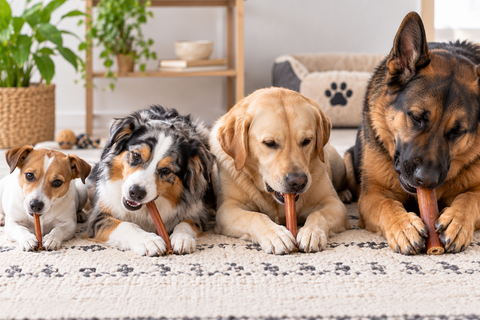
Your dog doesn't know whether you just handed them a bully stick or a collagen stick.
They know something much more important:
It's time to chew.
For owners, however, there's a meaningful difference between these two popular natural dog chews.
Both are beef-based. Both provide an alternative to traditional biscuits and quick treats.
Both can keep dogs occupied with a satisfying chewing activity.
But they're made from different parts of the animal, and that creates differences in texture, structure, and the overall chewing experience.
So which should you choose?
The answer doesn't have to be one or the other.
Understanding what makes each chew unique can help you decide which fits your dog—or when it makes sense to rotate between both.
Start With What They're Made From
This is the biggest distinction.
Bully sticks are made from beef pizzle.
They're a single-ingredient animal-based chew with a naturally firm structure that gradually softens as a dog works through it.
Collagen sticks are made from collagen-rich beef tissue, commonly sourced from layers of beef hide.
Rather than being identical products with different names, they begin with different animal tissues.
That difference influences how each chew feels and behaves once your dog gets to work.
Bully Sticks: A Familiar, Gradually Softening Chew
Bully sticks have become one of the most recognizable natural dog chews.
They begin relatively firm.
Then your dog starts chewing.
Saliva gradually softens the surface, allowing the dog to work through the stick section by section.
That changing texture is part of the appeal.
Dogs may:
Hold the stick between their paws.
Work one end.
Rotate it.
Change chewing angles.
Soften another section.
Continue until the chew becomes smaller.
The experience evolves as the bully stick is consumed.
Collagen Sticks: A Different Kind of Texture
Collagen sticks create their own chewing experience.
Because they're made from collagen-rich tissue rather than pizzle, their structure feels different from a bully stick.
Dogs still need to gnaw and work through the chew, but the texture and way the material breaks down can provide a noticeable change for dogs accustomed to bully sticks.
That's useful because enrichment doesn't always require introducing an entirely new protein.
Sometimes changing the animal tissue and texture is enough to make the experience feel new.
So, Which One Lasts Longer?
This is usually the first question owners ask.
Unfortunately, dogs refuse to make the answer simple.
Chew duration depends on:
Chew thickness
- Length
- Density
- Dog size
- Jaw strength
- Chewing intensity
- Individual technique
A thick collagen stick may outlast a thin bully stick for one dog.
A substantial bully stick may last longer for another.
A power chewer may work through both faster than expected.
Instead of assuming one category universally lasts longer, compare products of similar size and watch how your dog handles each.
Your dog's mouth is ultimately the best durability test.
Thickness Matters With Both
Two chews can have the same length and provide dramatically different experiences depending on diameter.
A thin stick gives the dog less material to work through.
A thicker version provides more.
That's why simply comparing a 6-inch bully stick with a 6-inch collagen stick doesn't tell you everything.
Look at:
Length + Thickness + Dog
Together, those three factors provide a much better idea of the chewing experience than product name alone.
What About Protein?
Both bully sticks and beef collagen sticks come from cattle.
So if your goal is introducing a completely different animal protein, switching between these two doesn't accomplish that.
What you're changing is the type of beef tissue and chewing experience.
That's an important distinction.
Protein rotation and chew rotation aren't necessarily the same thing.
You can keep beef as the protein while still introducing variety through:
Bully sticks.
Collagen sticks.
Beef cheek rolls.
Other beef-based natural chews.
The animal stays the same.
The experience changes.
Which Is Better for a Power Chewer?
Power chewers need to be evaluated individually.
Some determined dogs work through thinner bully sticks quickly and benefit from moving to a thicker option.
Others may enjoy the different structure of a substantial collagen stick.
Instead of asking which category is automatically "for power chewers," focus on the actual product dimensions and how your dog interacts with it.
A thicker, appropriately sized chew is generally going to provide more material than a thin version of the same type.
The Best Bully Sticks for Every Dog Size & Chewing Style – Raw Paws Pet Food
Which Is Better for a Gentle Chewer?
Gentle chewers give owners more flexibility because they tend to work through natural chews gradually.
A bully stick may last through a long chewing session.
A collagen stick may provide another satisfying texture without needing to be extremely large.
For these dogs, the choice may come down almost entirely to preference.
Offer both at different times.
Watch which one your dog carries away first.
Sometimes the dog makes the purchasing decision surprisingly easy.
What About Odor?
Bully sticks can have a noticeable natural animal-based aroma, particularly as saliva rehydrates the chew during use.
Odor levels can vary between individual bully sticks and processing methods.
Collagen sticks can have their own natural aroma, but the sensory experience isn't necessarily identical because the products originate from different tissues and are processed differently.
If odor is particularly important in your household, evaluate the specific products rather than assuming every bully or collagen stick will smell exactly the same.
Both Are Edible Chews
This distinction separates bully sticks and collagen sticks from non-edible chew toys.
Dogs gradually consume them.
That means they contribute to overall food and calorie intake.
A natural chew isn't calorie-free simply because it's being used for enrichment.
Consider the chew alongside:
Training treats.
Meal toppers.
Other snacks.
The dog's complete and balanced diet. The larger and more substantial the chew, the more important that overall perspective becomes.
Neither Needs to Be Finished in One Sitting
Your dog may disagree strongly with this section.
But a chewing session doesn't always need to continue until the entire chew disappears.
For dogs that work slowly, one appropriately handled chew may provide more than one supervised session if the product remains suitable for reuse and is stored according to its instructions.
This can help owners manage both treat intake and chewing duration.
The goal is providing the experience—not necessarily reaching the end of the stick every time.
Think About the Type of Experience You Want
Here's a simpler way to choose.
Choose a Bully Stick When:
You want the familiar pizzle-based chewing experience.
Your dog already loves bully sticks.
You want multiple thickness and length options.
You enjoy having a chew that gradually softens as the dog works through it.
Choose a Collagen Stick When:
You want another natural beef-based chew.
You'd like to introduce a different animal tissue and texture.
Your dog enjoys variety in the chew rotation.
You want to see how your dog responds to a different style of edible chew.
Neither list declares a winner.
That's intentional.
The Better Answer May Be Rotation
Dogs don't necessarily need one permanent favorite.
A natural chew rotation might include:
Bully Stick: Familiar everyday chew.
Collagen Stick: Different texture.
Beef Cheek Roll: Another substantial beef-based experience.
Cow Ear: Lighter crunchy option.
Yak Chew: Different density and ingredient profile.
Now chewing doesn't become the same activity repeated every time.
The shapes change.
Textures change.
Densities change.
The challenge changes.
That's enrichment.
Watch What Your Dog Does With Each One
Instead of deciding which chew is better based entirely on descriptions, run the most useful test available.
Give your dog each option at different supervised sessions.
Watch.
Do they immediately settle down?
How do they hold it?
How quickly do they work through it?
Do they rotate it frequently?
Does one maintain attention longer?
Which one generates more excitement when it appears again?
Your dog's behavior provides information no comparison chart can completely capture.
Supervision Matters With Both
Bully sticks and collagen sticks should be offered under appropriate supervision.
As an edible chew becomes smaller, monitor the remaining portion and remove it when it becomes small enough that swallowing it whole could become a concern.
Also select a size appropriate for your dog's mouth, body size, and chewing style.
No natural chew becomes completely hands-off simply because your dog has enjoyed it before.
Two Beef Chews, Two Different Experiences
At Raw Paws Pet Food, we don't think choosing natural chews needs to become a competition.
Bully sticks and collagen sticks can both earn a place in the chew cabinet because they don't provide exactly the same experience.
Bully sticks bring the familiar texture of dried beef pizzle.
Collagen sticks introduce collagen-rich beef tissue with a different structure.
Both give dogs something natural to hold, investigate, gnaw, and gradually work through.
So which one is right for your dog?
Maybe bully sticks.
Maybe collagen.
Quite possibly both.
Because sometimes the best chew isn't the one that wins a comparison.
It's the one that keeps your dog interested when it comes up next in the rotation.
Comments (0)
There are no comments for this article. Be the first one to leave a message!