

Bully sticks and rawhide often end up beside each other in the dog-chew aisle. Both are animal-based.
Both give dogs something to gnaw.
Both can last considerably longer than an ordinary treat.
But that's about where the simple comparison ends.
Bully sticks and rawhide are made from completely different animal tissues and create different chewing experiences.
A bully stick is made from beef pizzle.
Rawhide is made from the inner layer of animal hide, most commonly cattle hide.
And even within the rawhide category, construction matters. A traditional rolled rawhide chew isn't necessarily the same experience as a dense compressed rawhide bone.
So before deciding which belongs in your dog's chew rotation, it helps to understand what you're actually holding.
Start With the Biggest Difference: The Ingredient
A bully stick begins with beef pizzle.
The tissue is cleaned, prepared, dried, and cut into the familiar stick-shaped chew.
Rawhide starts somewhere completely different.
It is produced from animal hide, with the inner hide layer processed and formed into a chew.
That means these aren't two manufacturing methods for the same ingredient.
They're different parts of the animal.
Bully Stick: Beef pizzle
Rawhide: Inner layer of animal hide
That distinction influences nearly everything that follows.
Why Does Rawhide Look So Different?
Rawhide can be formed into many shapes.
You've probably seen:
- Rolled sticks
- Knotted bones
- Chips
- Twists
- Compressed bones
Traditional rawhide products may use pieces or sheets of hide that are shaped into the finished chew.
Compressed rawhide takes another approach.
Layers or pieces of prepared hide are compressed under pressure into a dense, solid form.
That creates a different physical structure from many traditional rolled rawhide products.
So even asking "bully stick or rawhide?" doesn't quite tell the whole story.
You also need to know what kind of rawhide you're comparing.
What Is Compressed Rawhide?
Compressed rawhide is designed to create a dense chewing experience by pressing prepared hide material tightly together.
Instead of easily separating into larger layers like some traditional rawhide constructions can, compression creates a more solid structure for the dog to gradually work through.
At Raw Paws Pet Food, our compressed rawhide chews are made using quality hides sourced from India, a region known for its hide supply. The hides come from free-range cattle raised without added hormones or antibiotics, and the finished chews are inspected and hand-packed in Indianapolis.
For owners considering rawhide, understanding the construction method is just as important as recognizing the ingredient itself.
Bully Sticks Behave Differently During Chewing
A bully stick begins firm and gradually changes as your dog works through it.
Saliva softens the surface.
The dog gnaws.
Turns the stick.
Changes angles.
Works through another section.
Eventually, the chew is consumed.
Because bully sticks are made from pizzle rather than layers of hide, the physical experience is noticeably different from rawhide.
That's one reason a dog that loves bully sticks won't necessarily interact with rawhide in exactly the same way.
Rawhide Creates Its Own Kind of Challenge
Rawhide generally becomes softer as moisture from chewing works into the material.
The dog may gnaw, scrape, soften, and gradually work through the chew.
Compressed rawhide adds density to that experience because the hide has been pressed into a tighter structure.
For dogs that enjoy persistent chewing, that can create a very different activity from working through a narrow bully stick.
Neither experience is identical.
That's what makes them useful to compare.
Which One Lasts Longer?
There's no universal winner.
Chew duration depends on:
- Product size
- Thickness
- Density
- Construction
- Dog size
- Jaw strength
- Chewing intensity
A thin bully stick may disappear faster than a substantial compressed rawhide bone.
A thick bully stick may last considerably longer than a lightweight rawhide chew for another dog.
And a determined power chewer can make almost any prediction unreliable.
Instead of choosing based on category alone, compare the actual dimensions and construction of the products.
Digestibility Is an Important Difference
Bully sticks are animal tissue that dogs gradually consume and digest.
Rawhide behaves differently.
Small pieces of rawhide may be swallowed and generally pass through the digestive tract rather than being digested in the same way as a bully stick.
That's one reason supervision is particularly important with rawhide.
With Raw Paws compressed rawhide, the dense construction is intended to reduce the likelihood of large pieces separating compared with less densely constructed rawhide, but dogs should still always be monitored while chewing.
Any pieces that become torn or unsuitable should be removed.
Why Compression Matters With Rawhide
Picture two structures made from similar material.
One is loosely layered.
The other is pressed tightly together.
Even before chewing begins, you would expect them to behave differently.
That's the idea behind compressed rawhide.
The pressure creates a dense chew that dogs have to gradually work through rather than simply interacting with loosely arranged layers.
For owners who want to offer rawhide, this construction difference is worth understanding rather than treating every rawhide product as identical.
Bully Sticks Usually Provide More Natural Variation
Bully sticks are made from individual animal tissue, so natural variation is expected.
One may be slightly thicker.
Another may differ in shape. Color and aroma can vary.
Rawhide products—particularly compressed forms—may have a more uniform finished shape because the material is processed and formed into a specific design.
Neither appearance automatically determines quality.
It simply reflects how differently the two products are produced.
What About Odor?
Bully sticks can have a noticeable natural animal-based aroma.
That scent can become stronger during chewing as saliva rehydrates the surface.
Rawhide has its own characteristic smell, but it doesn't necessarily produce the same aroma because you're dealing with different animal tissue and different processing.
For households particularly sensitive to bully-stick odor, that difference may influence which chew they prefer.
Which Is Better for Power Chewers?
Don't decide based only on the words bully stick or rawhide.
Look at the actual chew.
A thick bully stick gives a power chewer more pizzle tissue to work through at each section.
A substantial compressed rawhide bone provides a dense structure that creates a different chewing challenge.
Your dog's technique matters too.
Some dogs methodically gnaw.
Others attack edges.
Some soften one area before moving forward.
The better match depends on how your dog actually chews.
Which Is Better for Smaller Dogs?
Again, sizing matters more than category.
Bully sticks are available in different lengths and thicknesses, making it relatively easy to select a manageable option for smaller dogs.
Rawhide products also come in different dimensions.
Whichever category you choose, the chew should be appropriately sized for the individual dog and large enough that it isn't easily swallowed whole.
A Chihuahua and a German Shepherd shouldn't automatically receive the same chew simply because both products say "for dogs."
Neither Is a Hands-Off Chew
This is the rule that doesn't change.
Always supervise.
With bully sticks, monitor the remaining piece as the chew becomes shorter and remove it when it becomes small enough to present a swallowing concern.
With rawhide, watch for pieces that become torn or otherwise unsuitable for continued chewing and remove them.
Raw Paws specifically recommends supervising dogs with compressed rawhide and removing separated pieces as necessary.
The chew may be designed for the dog.
Supervision is still the owner's job.
You Don't Necessarily Have to Pick One Forever
Dog owners often approach comparisons as though one product needs to eliminate the other.
But natural chew routines can include variety.
One day:
Another:
Another:
Another:
Each presents a different:
Texture.
Shape.
Density.
Challenge.
Chewing technique.
For dogs that love to chew, that variety can make enrichment considerably more interesting.
Let the Dog Help With the Decision
Your dog won't explain which chew they prefer.
They'll demonstrate it.
Watch:
How quickly do they settle down?
How do they hold the chew?
How long does it maintain attention?
Do they gnaw steadily or try to tear pieces?
How quickly does the product change?
Those observations help you understand whether a particular chew matches your dog's individual style.
The product label provides information.
Your dog provides the field test.
Two Chews, Two Very Different Structures
So, what's the difference between bully sticks and rawhide?
It starts with the animal tissue.
Bully sticks are made from beef pizzle.
Rawhide is made from animal hide.
From there, processing and construction create even more differences—particularly when comparing traditional rawhide with dense compressed rawhide.
At Raw Paws, we believe owners should understand what their dog's chews are made from rather than treating every brown stick or bone-shaped product as interchangeable.
Choose an appropriate size.
Understand the construction.
Supervise the session.
Watch how your dog interacts with it.
Because the best way to choose between bully sticks and rawhide isn't deciding which category wins.
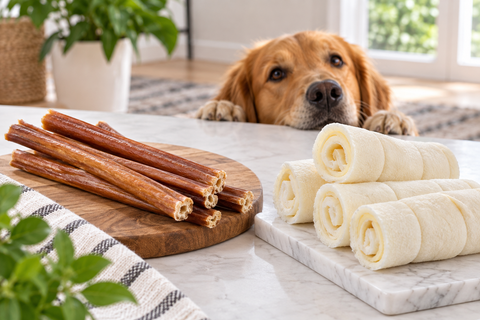
It's understanding exactly what each chew is—and deciding which experience makes sense for the dog waiting beside you.

Comments (0)
There are no comments for this article. Be the first one to leave a message!