

Some dogs love a chew they can gradually eat.
Others want something they can gnaw, scrape, investigate, and return to again.
That's where water buffalo horns and cow hooves enter the conversation.
Both are natural animal-derived chews known for their extremely hard structures.
Both can provide extended gnawing opportunities.
And both look very different from traditional edible chews like bully sticks, collagen sticks, or beef cheek rolls.
But are water buffalo horns and cow hooves basically the same thing?
Not exactly. Although both are made primarily from keratin, their natural shapes, structures, and potential enrichment uses create different experiences.
The bigger question isn't which one is tougher.
It's whether either chew is appropriate for your dog's teeth, chewing habits, and preferred activities.
Let's explore the differences.
Two Natural Chews, Two Different Animal Structures
Water buffalo horns and cow hooves come from different parts of different animals.
Water Buffalo Horns are made from the natural horn sheath of water buffalo.
Cow Hooves come from the hard outer hoof structure of cattle.
Both contain keratin, a tough structural protein also found in animal hair, claws, and nails.
That explains why these products are so firm.
But the similarities don't make them interchangeable.
A horn has a different natural shape and structure from a hoof, which influences how dogs hold and interact with each product.
Water Buffalo Horns: A Curved Gnawing Experience
Water buffalo horns often have a naturally curved or tapered shape.
Depending on the individual horn and how it's prepared, the chew may have:
- A broad opening
- A hollow interior
- A curved outer surface
- A narrower end
- Natural variations in thickness
That shape creates several potential areas for a dog to investigate.
Some dogs may focus on the broader end.
Others may scrape along the outer surface.
The curved structure can also change how the dog positions the horn between their paws.
Unlike a straight bully stick, a buffalo horn doesn't necessarily encourage one simple chewing pattern.
Cow Hooves: Compact, Hollow, and Easy to Recognize
Cow hooves have a very different shape.
They're generally shorter and more compact than many water buffalo horns.
Their hollow center is one of their most recognizable features.
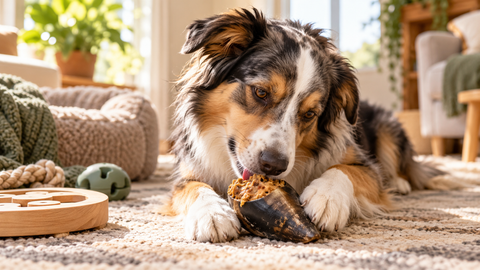
That opening creates opportunities for dogs to investigate the inside as well as the outer shell.
A cow hoof may encourage:
Licking.
Sniffing.
Repositioning.
Exploring the hollow center.
Gnawing around the edges.
For food-motivated dogs, the hollow structure can become especially interesting when paired with an edible filling.
However, the hoof's extreme hardness remains an important safety consideration.
The Biggest Similarity: Hardness
This is where the comparison becomes especially important.
Both water buffalo horns and cow hooves are extremely hard.
Their keratin-based structures don't soften like ordinary edible animal-tissue chews.
A bully stick gradually becomes softer as saliva works into the material.
A collagen stick also changes as the dog gnaws.
Horns and hooves generally remain much more rigid.
That resistance can make them long-lasting.
But it can also increase the risk of dental injury.
The fact that a chew lasts a long time doesn't automatically mean it's a good match for your dog.
Can Water Buffalo Horns Damage a Dog's Teeth?
Yes.
Water buffalo horns are hard enough to create a risk of chipped or fractured teeth, particularly when dogs bite down forcefully.
A dog that repeatedly attempts to crack a horn may place substantial pressure on its teeth.
That's why veterinary dental guidance commonly recommends avoiding extremely hard chewing materials.
If your dog has dental disease, worn teeth, previous fractures, or a tendency to crush hard objects, water buffalo horns may be inappropriate.
A more forgiving chew is often the better choice.
Can Cow Hooves Damage a Dog's Teeth?
Yes, and for similar reasons.
Cow hooves are extremely rigid.
Dogs that attempt to crack or crush them can damage their teeth.
Even a hoof that's appropriately sized can still create dental concerns because sizing doesn't change the hardness of the material.
That's why choosing a cow hoof shouldn't be based solely on how long it might last.
Dental health and chewing technique matter just as much.
Are Cow Hooves Good for Dogs? Benefits, Risks & Safety – Raw Paws Pet Food
Water Buffalo Horns vs. Cow Hooves: Quick Comparison
| Feature | Water Buffalo | Cow Hooves |
| Animal source | Water buffalo | Cattle |
| Material | Keratin-rich horn sheath | Keratin-rich hoof |
| Shape | Often curved or tapered | Compact, hoof-shaped Interior |
| Interior | May have a hollow opening | Naturally hollow |
| Texture | Extremely hard | Extremely hard |
| Primary activity | Persistent gnawing and exploration | Gnawing, licking, and food exploration |
| Edible? | Not intended to be consumed whole | Not intended to be consumed whole |
| Dental concerns | Risk of tooth fractures | Risk of tooth fractures |
| Best consideration | Shape and chewing behavior | Hollow shape and food-enrichment potential |
Neither product should be considered risk-free simply because it's natural.
Which One Lasts Longer?
Both products can remain intact through multiple sessions because of their hard keratin structures.
But there's no universal winner.
Duration depends on:
- Product size
- Thickness
- Shape
- Dog size
- Jaw strength
- Chewing behavior
- Whether the material cracks or breaks
A large water buffalo horn may provide more material than a smaller cow hoof.
But a hoof may remain interesting longer for a dog that's motivated by an edible filling.
That highlights an important distinction.
How long a chew physically lasts isn't necessarily the same as how long it holds your dog's attention.
Which One Is Better for Power Chewers?
This is where owners should be especially cautious.
A power chewer may finish bully sticks or other edible chews quickly.
That can make horns and hooves seem appealing because they're much harder.
But a dog that applies tremendous bite force may also be more likely to fracture a tooth on these rigid materials.
Power chewers aren't automatically good candidates for water buffalo horns or cow hooves.
If your dog aggressively bites down on hard objects, consider a more forgiving edible chew or appropriately designed rubber enrichment toy instead.
The goal isn't finding a chew that your dog cannot destroy. It's finding an activity that doesn't require unnecessary dental risk.
What About Gentle Chewers?
Gentle chewers may approach horns and hooves differently.
Instead of attempting to crack the material, they may lightly gnaw, lick, or investigate the surface.
That can create a less forceful interaction.
However, it doesn't eliminate the risk of tooth damage, sharp fragments, or swallowing concerns.
Even for gentle chewers, owners should consider whether the same enrichment could be provided using a softer material.
A dog doesn't need an extremely hard object to enjoy a meaningful chewing activity.
Cow Hooves Have an Interesting Advantage: Stuffing
One of the most distinctive things about cow hooves is their hollow center.
That opening allows certain products to be offered with edible fillings.
At Raw Paws Pet Food, our stuffed hoof options include:
These products combine the natural hoof structure with a food reward inside.
Instead of focusing exclusively on gnawing, some dogs may spend time licking and working to reach the filling.
That creates another type of enrichment.
But it's important to remember that adding a filling doesn't make the hard hoof shell safer for aggressive chewing.
Water Buffalo Horns Offer a Different Shape to Explore
Water buffalo horns can also have hollow sections, depending on the individual product.
Their curved or tapered shape creates a different physical experience from the compact structure of a hoof.
Dogs may investigate:
The broad end.
The narrower tip.
The curved surface.
The interior opening.
However, narrow tips and broken edges deserve particular attention because they may become sharp or unsuitable during use.
Shape variety can be interesting, but it shouldn't override safety considerations.
Food Enrichment Doesn't Require a Hard Shell
One of the most useful lessons from stuffed cow hooves is that the enrichment value often comes from the food-retrieval activity.
The dog smells the filling.
Investigates.
Licks.
Changes position.
Works to reach the reward.
Those same behaviors can be encouraged with appropriately designed rubber food-stuffable toys or food puzzles.
For dogs with vulnerable teeth, those alternatives may provide similar enrichment without the same rigid outer structure.
Do Horns and Hooves Break Apart?
They can.
Although both are extremely hard, neither is indestructible.
Depending on the product and chewing behavior, pieces may crack, chip, or separate.
Those fragments can create concerns involving:
Choking.
Mouth injuries.
Dental damage.
Digestive obstruction.
If a horn or hoof develops cracks, sharp edges, or loose fragments, remove it.
Don't continue offering a damaged chew simply because plenty of material remains.
Are Water Buffalo Horns and Cow Hooves Digestible?
Both are primarily keratin-based structures rather than conventional edible treats.
Dogs aren't intended to consume an entire horn or hoof the way they gradually consume a bully stick.
Although keratin is a protein, the hard material is resistant to digestion in its natural form.
Swallowing substantial pieces can create gastrointestinal complications.
That's why horns and hooves are better understood as recreational gnawing products rather than fully consumable chews.
What About Puppies and Senior Dogs?
Extremely hard chews deserve extra caution with puppies and older dogs.
Puppies have developing teeth and jaws, making very rigid chewing materials inappropriate for many young dogs.
Senior dogs may have worn teeth, dental disease, or other oral-health concerns that increase the risks associated with hard chews.
For both groups, softer and more forgiving options are generally preferable.
If you're uncertain about your dog's dental health, consult your veterinarian before introducing either product.
When Should You Take a Horn or Hoof Away?
Remove the product if:
- Your dog begins aggressively crushing or cracking it
- Sharp edges develop
- Pieces break away
- The chew becomes small enough to swallow whole
- Your dog shows discomfort
- You notice bleeding or signs of mouth injury
- The product becomes unsuitable for continued use
Supervision should continue throughout every session.
A horn or hoof that appears intact at the beginning may change as your dog works on it.
What Are Some Softer Alternatives?
If your dog enjoys chewing but horns and hooves seem too rigid, consider other textures.
Bully Sticks: Beef-pizzle chews that gradually soften.
Collagen Sticks: Edible collagen-rich chews with a different structure.
Beef Cheek Rolls: Broad, rolled chews that provide a substantial activity.
Cow Ears: Lighter, crunchy animal-based chews.
Food-Stuffable Rubber Toys: Reusable options for licking and food retrieval.
These alternatives still require appropriate sizing and supervision, but they may be more suitable for dogs that shouldn't chew extremely hard materials.
The Best Choice Depends on the Activity
Instead of choosing based on which product looks toughest, think about what your dog actually enjoys.
Do they prefer:
Licking food from a hollow object?
Manipulating different shapes?
Gradually consuming an edible chew?
Persistent gnawing?
Searching for hidden food?
Those preferences can help you choose an enrichment activity without assuming that harder is always better.
Sometimes a softer product can provide just as much enjoyment.
Two Hard Chews, Different Experiences
At Raw Paws Pet Food, water buffalo horns and cow hooves represent two distinctive natural animal structures.
Water buffalo horns offer a curved, keratin-rich surface with a different shape for dogs to investigate.
Cow hooves provide a compact, hollow structure that can also be paired with edible fillings.
Both may appeal to dogs interested in persistent gnawing.
But both are extremely hard, and that hardness creates meaningful dental and swallowing risks.
So, water buffalo horn or cow hoof?
Neither should automatically be the first choice simply because your dog is a strong chewer.
Consider your dog's dental health.
Watch how they chew.
Choose an appropriate size.
Supervise every session.
And don't hesitate to select a softer alternative when appropriate.
Because the best chewing experience isn't determined by which natural product is hardest.
It's determined by what your dog can enjoy comfortably, appropriately, and safely.

Comments (0)
There are no comments for this article. Be the first one to leave a message!