

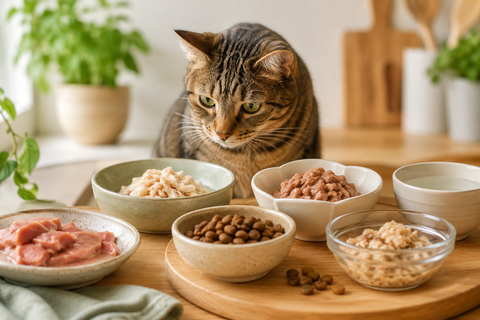
Put a bowl of frozen raw food beside a bowl of kibble and the differences seem obvious.
One is moist and meat-forward.
The other is dry, compact, and convenient. But the real differences go much deeper than appearance.
Raw food and kibble represent two fundamentally different approaches to feeding cats—from how ingredients are processed and preserved to moisture content, texture, storage, and the overall eating experience.
That doesn't mean every raw food is automatically superior to every kibble.
And it doesn't mean a cat eating kibble can't receive complete nutrition.
The useful question isn't:
"Which side wins?"
It's:
"How are these foods actually different, and what should cat owners understand about each?"
The Biggest Difference Starts Before the Food Reaches the Bowl
Kibble is designed to be dry and shelf-stable.
Ingredients are typically combined and processed using heat, pressure, and extrusion to create the familiar uniform pieces found in the bag.
Frozen raw food takes a different approach.
Rather than transforming ingredients into a dry product, frozen raw feeding emphasizes animal-based ingredients that remain closer to their original physical state and are preserved through freezing.
That difference in processing affects nearly everything that follows.
Texture.
Moisture.
Storage.
Ingredient appearance.
Even the way your cat interacts with the meal.
Raw Food Contains Much More Moisture
This may be the most visually obvious difference—and one of the most meaningful for cats.
Fresh animal tissues naturally contain substantial water.
Frozen raw food retains much of that moisture.
Kibble intentionally removes most moisture to create a stable dry food.
That means a cat eating moisture-rich food receives water with every bite, while a cat eating kibble must obtain a larger share of daily fluid intake separately.
Fresh drinking water should always be available regardless of diet, but the food itself can make a significant difference in how much moisture enters the feeding routine.
Why Moisture Matters in a Cat's Diet – Raw Paws Pet Food
Don't Compare Protein Percentages Without Considering Water
This is where labels can become confusing.
Suppose a kibble lists 40% crude protein while a frozen raw food shows a considerably smaller number.
It may look like the kibble contains dramatically more protein.
But remember:
The raw food contains much more water.
Moisture dilutes nutrient percentages when they're displayed on an as-fed basis.
A more meaningful comparison between foods with dramatically different moisture levels uses dry matter basis, which mathematically removes the water before comparing nutrient concentrations.
Without that adjustment, you're not really comparing equivalent numbers.
Kibble Is Built for Convenience
There's a reason dry food became enormously popular.
It's remarkably convenient.
Open the bag.
Scoop.
Serve.
Unused food stores easily, requires no freezer space, and can generally remain in the bowl longer than fresh animal foods.
For busy households, those characteristics matter.
Frozen raw food requires more planning.
It needs:
- Freezer storage
- Refrigerated thawing
- Appropriate handling
- Bowl cleanup
- Attention to how long food remains at room temperature
The tradeoff is a food format that retains much more of the moisture and physical characteristics associated with fresh animal ingredients.
The Ingredients Can Look Completely Different
With kibble, the original ingredients generally aren't visually identifiable in the finished piece.
Beef kibble doesn't look like beef.
Chicken kibble doesn't resemble chicken breast.
The ingredients have been combined and transformed into a consistent final product.
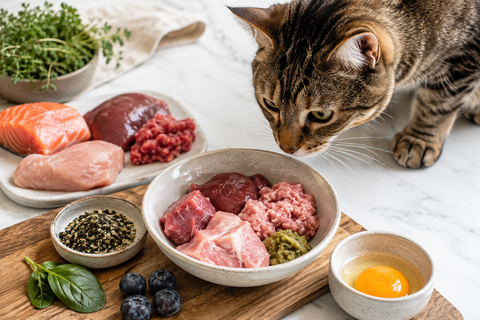
Whole-food raw feeding can look very different.
Meat remains meat.
Organs remain recognizable animal tissues.
The food retains a texture and appearance much closer to the ingredients that went into the recipe.
For pet owners who value ingredient transparency, that difference can be particularly appealing.
But Raw Doesn't Simply Mean "Meat"
This distinction is essential.
Cats need more than animal protein alone.
A bowl of raw ground beef isn't automatically a complete feline diet.
Neither is chicken breast.
A complete raw cat food needs to provide essential nutrients in appropriate amounts and relationships.
That can involve carefully balanced combinations of:
- Muscle meat
- Organs
- Bone or another appropriate mineral source
- Animal fats
- Other nutrients necessary for complete nutrition
The word raw describes how the food is handled and processed
It doesn't automatically tell you whether the diet is nutritionally complete.
Always evaluate the actual product.
Complete and Balanced Matters on Both Sides
This is one area where the raw-versus-kibble debate can become unnecessarily polarized.
Regardless of format, your cat's primary diet needs to meet their nutritional requirements.
A properly formulated kibble can be complete and balanced.
A properly formulated raw food can be complete and balanced.
A poorly planned homemade raw diet may not be.
A treat—whether raw, freeze-dried, or cooked—generally shouldn't be assumed to provide complete nutrition unless it's specifically formulated and labeled for that purpose.
The format matters.
But nutritional adequacy matters more.
Cats Experience the Textures Differently
Cats can be remarkably sensitive to food texture.
Kibble provides a consistent dry crunch.
Frozen raw food offers a moist, softer eating experience that varies according to the ingredients and grind.
For cats raised exclusively on one format, switching can sometimes require patience.
A cat accustomed to crunchy kibble may not immediately recognize a soft raw meal as familiar food.
Likewise, a cat accustomed to moisture-rich meals may interact differently with dry food.
That's one reason gradual transitions can be especially helpful for selective cats.
Raw Food Requires More Attention to Food Safety
Frozen raw animal food should be handled with the same care you'd use for raw meat in your own kitchen.
That means:
- Washing hands after handling
- Cleaning bowls and surfaces
- Keeping food properly frozen before use
- Thawing under refrigeration Avoiding cross-contamination
- Discarding food that has remained out too long
Kibble has different handling requirements because its low moisture makes it much more shelf-stable.
That convenience is a genuine difference between the formats and something every household should consider when deciding what fits its routine.
Where Freeze-Dried Foods Fit Into the Picture
Freeze-dried foods create an interesting middle ground in terms of convenience.
They begin with food that's frozen, but most moisture is subsequently removed during freeze-drying.
The result is lightweight and shelf-stable.
At Raw Paws Pet Food, single-ingredient freeze-dried treats such as Chicken Breast, Chicken Hearts, Beef Liver, and Whole Minnows can complement either raw-fed or traditionally fed cats.
They're treats rather than substitutes for a complete diet unless a specific product is formulated and labeled otherwise.
But they make it easy to introduce recognizable animal ingredients regardless of what your cat eats for their primary meal.
Does Feeding Raw Have to Be All or Nothing?
Not necessarily.
Pet owners sometimes assume exploring raw food requires immediately abandoning everything else.
Real households are often more flexible.
Some cats eat frozen raw as their primary diet.
Others receive whole-food treats while continuing their existing complete food.
Some owners begin by learning more about ingredients and food formats before making any larger changes.
What's important is maintaining nutritional adequacy and making dietary transitions thoughtfully rather than feeling pressured to fit into one feeding identity.
Which One Fits Your Household?
Consider the practical differences.
Frozen Raw May Appeal to Owners Who Value:
- Moisture-rich meals
- Recognizable animal ingredients
- Minimal processing
- Whole-food textures
- Frozen preservation
Kibble May Appeal to Owners Who Value:
- Easy storage
- Fast serving
- Shelf stability
- Consistent portions
- Minimal preparation
Neither list tells you whether a particular product is high quality.
For that, you still need to evaluate the actual food.
Look Beyond "Raw vs. Kibble"
The most productive conversation about cat food probably isn't a battle between two formats.
It's an evaluation.
What ingredients are being used?
Where does the protein come from?
How much moisture does the food contain?
How was it processed?
Is it complete and balanced for the appropriate life stage?
Does it fit your cat?
Can your household safely and consistently manage the feeding routine?
Those questions tell you much more than simply knowing whether the food came from a freezer or a bag.
At Raw Paws Pet Food, our philosophy centers on whole, recognizable animal ingredients and minimally processed nutrition. But we also believe informed feeding starts with understanding the differences—not turning pet nutrition into teams.
Because your cat doesn't care which feeding philosophy wins an argument.
Your cat needs a diet that works.
Comments (0)
There are no comments for this article. Be the first one to leave a message!