


Your cat comes running when they hear the treat bag.
They know exactly when dinner is supposed to happen.
And somehow, they've learned that sitting beside the food bowl and staring at you long enough usually gets results.
So why do so many people believe cats can't be trained?
The truth is, cats are constantly learning from their environment.
They learn which sounds predict food, which activities lead to attention, and which behaviors get a response from their owners.
And with the right approach, you can use that natural ability to teach useful behaviors.
From coming when called to entering a carrier voluntarily, cat training doesn't have to be complicated.
You don't need expensive equipment.
You don't need hours of free time.
And you certainly don't need your cat to behave like a dog.
All you need is patience, consistency, and a reward your cat genuinely enjoys.
Here's how to train a cat with treats, including seven beginner-friendly behaviors you can start practicing at home.
Can You Really Train a Cat With Treats?
Absolutely.
Cats can learn through positive reinforcement, which involves rewarding a behavior to increase the likelihood that it happens again.
For example, imagine your cat walks toward you when you call their name. You immediately offer a small treat.
Over time, your cat may begin associating that action with a positive outcome.
The behavior becomes more likely to happen again.
This same basic principle can be used to teach a variety of useful skills.
The key is making the reward worthwhile from your cat's perspective.
Unlike dogs, which may be particularly motivated by social interaction or working alongside their owners, some cats require a little more experimentation to discover what makes training rewarding.
But once you find the right motivation, the possibilities expand considerably.
Start With the Right Cat Training Treats
Before teaching anything, find a reward your cat enjoys.
This matters more than having a complicated training plan.
Some cats respond enthusiastically to chicken.
Others prefer fish.
Some are especially interested in organ meats.
And certain cats are motivated more by texture than by the animal protein itself.
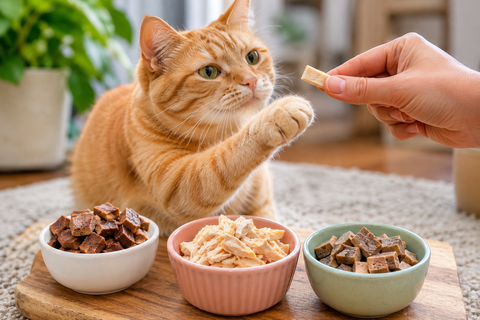
At Raw Paws Pet Food, our freeze-dried animal treats provide several options worth exploring.
Freeze-Dried Chicken Breast: A familiar muscle-meat option that can often be broken into tiny rewards.
Freeze-Dried Chicken Hearts: A different poultry tissue with its own aroma and texture.
Freeze-Dried Beef Liver: A richly aromatic organ treat best offered in small, controlled amounts.
Freeze-Dried Whole Minnows: A distinctive fish-based option for cats that enjoy seafood.
For training, choose pieces that your cat can eat comfortably and quickly.
A reward doesn't need to be large to be motivating.
The Best Cat Treats for Enrichment, Training & Everyday Rewards – Raw Paws Pet Food
Three Things to Do Before Your First Training Session
A little preparation makes training much easier.
Choose a quiet location.
Start somewhere familiar, away from loud noises, other pets, and unnecessary distractions.
Prepare small rewards. Break suitable treats into tiny pieces before you begin so you can reward promptly.
Keep sessions short. Start with approximately one to three minutes.
You can gradually increase the duration if your cat remains interested.
Train when your cat is awake, relaxed, and willing to participate.
You don't need to withhold meals or make your cat unusually hungry.
And if your cat walks away, that's useful feedback.
End the session and try again later.
1. Teach Your Cat to Respond to Their Name
Difficulty: Beginner
Why it's useful: Builds attention and creates a foundation for other behaviors.
Before asking your cat to perform complicated tasks, start by teaching them that paying attention to you can lead to something rewarding.
How to teach it
- Sit near your cat in a quiet room.
- Say their name once in a friendly, consistent tone.
- When they look toward you, immediately say "Yes!" and offer a tiny treat.
- Repeat a few times, allowing your cat to reset between repetitions.
- Gradually practice when your cat is a little farther away.
If your cat doesn't respond at first, begin by rewarding any voluntary glance toward you.
Once they understand that looking at you earns a reward, introduce their name just before the behavior.
Avoid repeatedly calling their name until they respond.
You want the name to become a meaningful cue, not background noise.
Training tip: Use the same marker word, such as "Yes!", throughout your training sessions. It helps identify the exact moment your cat performs the desired behavior.
2. Teach Your Cat to Touch Your Hand
Difficulty: Beginner
Why it's useful: Helps guide movement without physically moving your cat.
Hand targeting is one of the most versatile behaviors you can teach. The idea is simple.
Your cat learns to touch your hand with their nose.
Once they understand the behavior, you can use it to encourage movement toward a location, onto a mat, or through an enrichment activity.
How to teach it
- Hold your open hand a few inches from your cat's nose.
- Wait for them to investigate.
- The moment their nose touches your hand, say "Yes!" and give a treat.
- Repeat until your cat begins touching your hand consistently.
- Gradually move your hand slightly farther away.
Add a cue such as "Touch" once the behavior is reliable.
Avoid pushing your hand toward your cat's face.
Let them choose to investigate.
Training tip: This is an excellent behavior to practice with tiny pieces of freeze-dried chicken breast because you may reward several repetitions in a short session.
3. Teach Your Cat to Sit on Cue
Difficulty: Beginner to intermediate
Why it's useful: Encourages calm, predictable behavior before meals or rewards.
Many cats naturally sit when they're waiting for something.
You can use that behavior as a starting point.
How to teach it
- Stand or sit in front of your cat with a small treat ready.
- Wait for your cat to sit naturally.
- Immediately mark the behavior with "Yes!" and reward.
- Repeat whenever your cat voluntarily sits.
- Once the behavior is happening reliably, say "Sit" just before you expect them to sit.
- Gradually practice in different quiet locations.
Some owners use a treat held slightly above the cat's nose to encourage sitting.
If you try this, keep the movement gentle and avoid forcing your cat into position.
Don't push down on their hindquarters.
The goal is voluntary behavior.
Training tip: Reward the moment your cat sits, not several seconds afterward. Prompt timing makes it easier for them to understand what earned the treat.
4. Teach Your Cat to Come When Called
Difficulty: Intermediate
Why it's useful: Helps you locate and guide your cat around the home.
Imagine being able to call your cat from another room and have them come toward you.
That can be useful when it's time for dinner, when you need to close a door, or when you want your cat to move away from an area.
Recall training begins with short distances and highly rewarding outcomes.
How to teach it
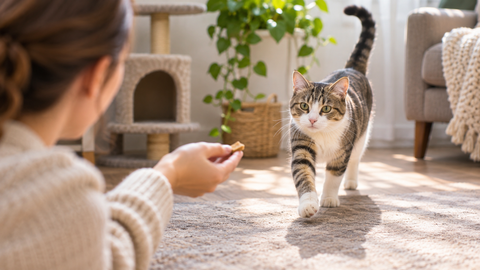
- Start when your cat is only a few feet away.
- Say their name followed by a consistent cue, such as "Come!"
- When they approach, mark the behavior and offer a favorite treat.
- Repeat several times across short sessions.
- Gradually increase the distance.
- Practice from different rooms once your cat understands the cue.
Avoid calling your cat for something they strongly dislike immediately after training recall.
You want coming when called to predict positive experiences.
Training tip: Consider reserving a particularly motivating treat, such as a tiny piece of freeze-dried beef liver or a favorite fish treat, for successful recall practice.
Recall is useful, but it should never be relied upon as the sole way to keep a cat safe outdoors.
5. Teach Your Cat to Go to a Mat
Difficulty: Intermediate
Why it's useful: Creates a designated place for calm activities and cooperative care.
Mat training teaches your cat to move onto a specific surface, such as a small rug or towel.
This can become a useful foundation for grooming, weighing, or simply encouraging your cat to settle in a particular location.
How to teach it
- Place a small mat on the floor.
- Reward your cat for looking at or approaching it.
- Next, reward them for placing one paw on the mat.
- Gradually reward two paws, then all four paws.
- Once your cat consistently steps onto the mat, add a cue such as "Mat."
- Begin rewarding brief moments of remaining on the mat.
Don't rush the progression.
Some cats will immediately investigate a new mat.
Others may need several sessions before stepping onto it.
Training tip: Use a familiar, non-slip surface and keep the mat in the same location during early training.
6. Teach Your Cat to Enter Their Carrier Voluntarily
Difficulty: Intermediate
Why it's useful: Can make veterinary visits and necessary travel less stressful.
For many cats, the carrier only appears before something unfamiliar or unpleasant.
That can create a negative association.
Carrier training works by changing what the carrier predicts.
Instead of only appearing before a veterinary appointment, it becomes a familiar place associated with comfortable experiences and rewards.
How to teach it
- Leave the carrier open in a quiet, familiar location.
- Place a comfortable towel or blanket inside.
- Reward your cat for approaching the carrier.
- Gradually place small treats near the entrance.
- As your cat becomes comfortable, reward them for stepping inside.
- Practice allowing them to enter and leave voluntarily.
- Only after they're relaxed inside should you begin practicing brief door closures.
Start with the door closed for just a moment, then reopen it and reward calm behavior.
Gradually build duration over multiple sessions.
Avoid trapping your cat inside unexpectedly during early training.
Training tip: A small amount of a favorite freeze-dried treat can make carrier exploration more appealing, but don't use food to lure a frightened cat beyond what they're comfortable doing.
7. Teach Your Cat to Offer a Paw for Gentle Handling
Difficulty: Intermediate
Why it's useful: Builds a foundation for nail care and cooperative handling.
This behavior is about more than teaching a cute trick.
It can help your cat become more comfortable voluntarily participating in gentle paw handling.
The process should be gradual and always respect your cat's comfort.
How to teach it
- Begin with your cat relaxed and comfortable near you.
- Reward any voluntary paw movement toward your hand or a small target.
- Gradually reinforce placing a paw onto your hand.
- Once the behavior is consistent, add a cue such as "Paw."
- Reward brief, gentle contact.
- Over time, practice very short periods of comfortable paw handling.
If your cat pulls away, stop and make the exercise easier next time. Don't hold their paw in place against their wishes.
Nail trimming should be introduced separately and gradually, rather than assuming that learning "Paw" means your cat is ready for a full nail trim.
Training tip: Keep the rewards especially appealing and the sessions brief. Cooperative care is about building trust and predictability, not forcing compliance.
Cat Training at a Glance: Which Behavior Should You Start With?
| Behavior | Difficulty | Main Benefit |
| Respond to name | Beginner | Builds attention |
| Touch your hand | Beginner | Guides movement |
| Sit | Beginner–Intermediate | Reinforces calm behavior |
| Come when called | Intermediate | Encourages recall |
| Go to a mat | Intermediate | Creates a designated station |
| Enter a carrier | Intermediate | Supports easier travel |
| Offer a paw | Intermediate | Builds handling confidence |
You don't need to teach all seven behaviors in one week.
Start with one or two.
Build confidence.
Then gradually introduce something new.
How Long Does It Take to Train a Cat?
There's no universal timeline.
Some cats learn a simple behavior within a few short sessions.
Others need days or weeks of practice.
Progress depends on factors such as:
- The cat's motivation
- Previous experiences
- Training consistency
- Environmental distractions
- Difficulty of the behavior
- Comfort with the activity
A cat learning to touch your hand may progress quickly.
A cat that's afraid of carriers may need considerably more time.
Neither situation means the cat is incapable of learning.
Training progress should be measured by growing understanding and comfort, not by how quickly you finish a checklist.
Should You Use a Clicker for Cat Training?
A clicker can be useful, but it isn't required.
Clicker training uses a consistent sound to mark the exact moment your cat performs a desired behavior.
You can achieve a similar effect with a short verbal marker such as "Yes!"
The important part is consistency.
To introduce a marker, make the sound or say the word, then immediately offer a small reward.
Repeat a few times so your cat begins associating the marker with something positive.
Once the association is established, use it to identify successful behaviors.
For cats that are sensitive to noise, a soft verbal marker may be preferable to a loud clicker.
What If Your Cat Isn't Interested in Training?
Sometimes the problem isn't the behavior.
It's the reward.
A treat your cat enjoys during ordinary snack time may not be motivating enough during a new activity.
Try experimenting with different appropriate proteins or textures.
For example:
Chicken Breast: Familiar, easy-to-portion rewards.
Chicken Hearts: A different poultry-organ experience.
Beef Liver: A rich, aromatic reward for occasional use.
Whole Minnows: Fish-based variety for cats that enjoy seafood.
You can also try training in a quieter environment or at a different time of day.
And remember that not every cat is primarily motivated by food.
Some respond better to play, petting, or other preferred activities.
The Best Cat Treats for Enrichment, Training & Everyday Rewards – Raw Paws Pet Food
Five Common Cat Training Mistakes to Avoid
Even well-intentioned owners can accidentally make training harder.
1. Making sessions too long
Cats may lose interest when training becomes repetitive.
Begin with short sessions and stop while your cat is still engaged.
2. Using rewards that aren't motivating
If your cat doesn't particularly enjoy the treat, it may not reinforce the behavior effectively.
Try a different suitable reward.
3. Rewarding too late
If several seconds pass between the behavior and the reward, your cat may struggle to identify what earned it.
Use consistent timing and a marker when helpful.
4. Increasing difficulty too quickly
Moving from a simple behavior to a complicated one can create frustration.
Build gradually and reward small improvements.
5. Forcing participation
Physical pressure, punishment, or intimidation can create fear and damage the training experience.
Allow your cat to participate voluntarily and adjust the activity when they show discomfort.
How Many Treats Should You Use During Cat Training?
Training can involve numerous rewards, so portion size matters.
A commonly used guideline is to keep treats and other nutritionally unbalanced extras within approximately 10% of daily calories unless your veterinarian recommends otherwise.
That allowance includes training treats, snacks, and meal toppers.
For example, a cat with a veterinarian-established daily calorie target of 200 calories would have an approximate maximum allowance of 20 calories for treats and other extras under the 10% guideline.
That doesn't mean every cat should receive 20 treat calories.
It's simply an example of how the calculation works.
You can also use part of your cat's regular complete and balanced food allowance as training rewards when practical.
For nutrient-dense treats such as beef liver, moderation is important beyond calorie content because of concentrated vitamin A and copper.
How Many Treats Should a Cat Have a Day? Portion Guide – Raw Paws Pet Food
Turn Training Into Everyday Enrichment
Cat training isn't only about teaching commands.
It's also an opportunity for mental engagement.
When your cat learns a new behavior, they're investigating a problem, responding to cues, and discovering how their actions influence outcomes.
You can combine training with other enrichment activities.
For example, practice hand targeting before a play session.
Use recall to invite your cat toward a food puzzle.
Reward voluntary carrier exploration.
Or practice mat training near a favorite window.
These activities can fit naturally into everyday life without requiring long sessions.
Food Enrichment for Cats: How to Turn Treats Into an Activity – Raw Paws Pet Food
A Simple Seven-Day Cat Training Starter Plan
If you're unsure where to begin, try this flexible introduction.
| Day | Focus | Goal |
| Monday | Name response | Reward looking toward you |
| Tuesday | Hand targeting | Encourage a gentle nose touch |
| Wednesday | Sit | Capture a naturally occurring sit |
| Thursday | Recall | Practice coming from a short distance |
| Friday | Mat training | Reward approaching or stepping onto a mat |
| Saturday | Carrier exploration | Reward calm interest in an open carrier |
| Sunday | Paw targeting | Reward voluntary paw contact |
This is an introduction, not a deadline.
If your cat needs several days to learn one behavior, stay with it.
Progress at their pace.
Training Treats Should Support a Balanced Diet
Cats are obligate carnivores with specific nutritional requirements.
Animal-based treats can provide protein and other naturally occurring nutrients, but single-ingredient treats aren't necessarily complete and balanced foods.
Chicken breast alone doesn't provide everything a cat needs.
Neither do chicken hearts, beef liver, or whole minnows.
Keep your cat's complete and balanced primary diet as the nutritional foundation.
Treats should complement that diet.
If your cat has food allergies, a prescribed diet, or another medical condition, check with your veterinarian before introducing new treats.
And remember that freeze-drying doesn't reliably eliminate all harmful microorganisms. Follow product storage and handling directions, wash hands after handling animal-based treats, and keep food-contact surfaces clean.
You Don't Need a Perfectly Trained Cat to Enjoy the Process
At Raw Paws Pet Food, we believe treats can do more than provide a tasty snack.
They can become part of everyday training, enrichment, and positive interactions with your pet.
Our freeze-dried animal treats offer several ways to discover what motivates your cat.
Freeze-Dried Chicken Breast can be divided into small rewards for repeated practice.
Freeze-Dried Chicken Hearts introduce another animal tissue and texture.
Freeze-Dried Beef Liver provides a richly aromatic option for occasional high-value rewards.
Freeze-Dried Whole Minnows offer distinctive fish-based variety.
But successful cat training isn't about finding one magical treat.
It's about understanding your cat, rewarding behaviors consistently, and making learning enjoyable.
Start with something simple.
Reward a glance.
Celebrate a nose touch.
Encourage a voluntary step into the carrier.
And build from there.
Because your cat doesn't need to learn every trick in the book to benefit from training.
Sometimes the most meaningful progress begins with one tiny treat and one small success.
Comments (0)
There are no comments for this article. Be the first one to leave a message!