


You call your cat's name.
Nothing.
You try again.
One ear moves, but your cat stays exactly where they are.
Sound familiar?
Cats have a reputation for ignoring their owners, but that doesn't mean they can't learn to respond when called.
Yes, you can train a cat to come when called using positive reinforcement, patience, and rewards they genuinely enjoy.
The key is teaching your cat that responding to a particular word or sound leads to something good.
Whether you're hoping to call your cat into another room, encourage them toward their carrier, or simply make everyday interactions easier, recall training is a useful skill worth practicing.
Here's how to get started.
Why Teaching Your Cat to Come Is Worthwhile
Recall training isn't just a fun trick. It can make everyday life more convenient while providing an opportunity for positive interaction.
A cat that understands a recall cue may be easier to call for mealtime, invite into another room, or encourage toward a familiar location.
Training also provides mental stimulation by allowing your cat to learn that their actions produce rewarding outcomes.
However, even well-trained cats won't necessarily respond every time. Distractions, fear, and individual preferences can affect their response.
The goal is to build a reliable, positive association—not expect perfect obedience.
Recall should also never replace physical safety measures, particularly outdoors.
Choose a Treat Your Cat Loves
Before beginning, find a reward your cat considers worth coming over for.
Some cats love chicken, while others prefer fish or organ meats. The most effective reward is the one that consistently captures your individual cat's attention.
At Raw Paws Pet Food, our freeze-dried animal treats provide several options:
- Freeze-Dried Chicken Breast: Familiar poultry that can often be broken into tiny training rewards.
- Freeze-Dried Chicken Hearts: A different poultry-organ aroma and texture.
- Freeze-Dried Beef Liver: A rich, aromatic treat for occasional high-value rewards.
- Freeze-Dried Whole Minnows: A distinctive fish-based option for seafood-loving cats.
Keep rewards small enough for your cat to consume quickly. This allows you to repeat exercises without interrupting the training session.
If you're unsure which treat to use, experiment with a few suitable options and observe your cat's response.
Suggested Internal Link: Best High-Value Cat Treats for Training, Enrichment & Picky Eaters
How to Train Your Cat to Come When Called: 5 Simple Steps
You don't need complicated equipment or long sessions. Start in a quiet room with a few small treats and work through these steps at your cat's pace.
Step 1: Choose a consistent recall cue
Pick a short word or sound, such as "Come," "Here," or a distinctive whistle.
Use the same cue every time so your cat learns exactly what it means.
Avoid repeatedly calling their name without reinforcing a response.
Step 2: Associate the cue with a reward
Begin when your cat is already nearby.
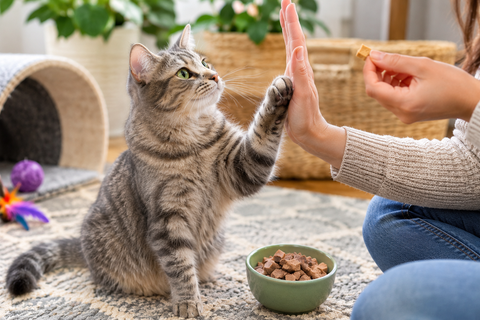
Say your chosen cue once and immediately offer a small treat.
Repeat several times across short sessions.
At this stage, your cat doesn't need to travel anywhere. You're simply teaching them that the sound predicts something enjoyable.
Step 3: Reward your cat for approaching
Once your cat recognizes the cue, move a few feet away.
Say the cue once.
When your cat approaches, immediately reward them.
You can also use a consistent marker word, such as "Yes!", to identify the successful behavior.
If your cat doesn't respond, move closer and try an easier repetition rather than repeatedly calling.
Step 4: Gradually increase the distance
When your cat consistently approaches from a few feet away, begin practicing from farther across the room.
Eventually, try calling from a nearby doorway or an adjacent room.
Increase the distance gradually.
If your cat stops responding, shorten the distance and rebuild their confidence.
Step 5: Practice with mild distractions
Once recall works in a quiet environment, try practicing in other familiar rooms.
Gradually introduce mild distractions, such as a nearby toy.
Avoid immediately calling your cat away from something extremely interesting.
Continue rewarding successful responses, especially when the exercise becomes more challenging.
Remember: Several short, successful training sessions are usually more productive than one long, frustrating session.
Why Does My Cat Ignore Me When I Call?
If your cat doesn't respond, it doesn't necessarily mean they're being stubborn.
Several factors may be involved.
The cue isn't fully learned. Your cat may recognize your voice without understanding the behavior you're requesting.
The reward isn't motivating enough. A cat relaxing in a sunny window may not consider an ordinary treat worth the effort.
There are too many distractions. Birds, toys, unfamiliar sounds, or other activities may capture their attention.
The cue has lost its meaning. Repeatedly calling without reinforcing successful responses can weaken the association.
Coming to you predicts something unpleasant. If recall regularly leads to unwanted handling or confinement, your cat may become hesitant.
The solution is to make the exercise easier, use an appropriate reward, and rebuild positive associations.
Avoid using your recall cue only when it's time for something your cat dislikes.
How Long Does It Take to Train a Cat?
Every cat learns at a different pace.
Some begin responding after a few short sessions. Others need several weeks of consistent practice.
Progress depends on motivation, previous experiences, distractions, and how consistently you train.
Start with sessions lasting approximately one to three minutes.
You might practice a few recalls before mealtime or during a quiet part of the day.
If your cat loses interest, stop and try again later.
Kittens and senior cats can also learn recall, although training should be adapted to their age, mobility, hearing, and individual needs.
The most important thing is making each session enjoyable.
How Many Treats Should You Use?
Recall training often involves repeated rewards, making portion size important.
A commonly used guideline is to keep treats and other nutritionally unbalanced extras within approximately 10% of your cat's daily calories, unless your veterinarian recommends otherwise.
Break suitable freeze-dried treats into tiny pieces so you can reward several successful behaviors without offering large portions.
You can also use part of your cat's regular complete and balanced food allowance for training.
Be especially conservative with beef liver, which contains concentrated vitamin A and copper.
If your cat has food allergies or follows a prescription diet, choose only veterinarian-approved rewards.
Follow the product's storage and handling instructions, and wash your hands after handling animal-based freeze-dried treats.
Suggested Internal Link: How Many Treats Should a Cat Have a Day? A Practical Guide to Portions
Make Recall Part of Your Cat's Everyday Routine
Once your cat understands the basics, incorporate recall into ordinary activities.
Call them from a short distance before offering a food puzzle.
Invite them toward you before an interactive play session.
Practice between familiar rooms.
Or use recall as the beginning of another simple training exercise.
You can eventually reward some successful recalls with play, attention, or other activities your cat enjoys, while continuing to use food rewards regularly enough to maintain motivation.
These everyday opportunities help reinforce the behavior without requiring lengthy training sessions.
Suggested Internal Link: How to Train a Cat With Treats: 7 Easy Behaviors to Start With
A Little Patience Can Go a Long Way
Teaching your cat to come when called is about building a positive habit.
Choose one consistent cue, start with short distances, reward successful approaches, and gradually increase the challenge.
At Raw Paws Pet Food, our freeze-dried chicken breast, chicken hearts, beef liver, and whole minnows offer different animal-based rewards to help you discover what motivates your cat.
But the most important ingredient in successful recall training isn't the treat itself.
It's consistency.
Your cat may not come every single time, and that's okay.
With patient practice, many cats can learn that hearing your cue means something enjoyable is about to happen.
Sometimes all it takes is one familiar word, one tiny treat, and a reason to come running.
Comments (0)
There are no comments for this article. Be the first one to leave a message!