

You set up an elaborate game for your cat.
Hide toys around the room.
Arrange boxes.
Prepare treats.
Call them over.
Your cat looks at everything for approximately three seconds...
...and walks away.
Very cat.
The problem usually isn't that cats dislike enrichment.
It's that we sometimes design enrichment like humans instead of designing it like cats.
A good indoor hunting game doesn't need complicated equipment. It needs a few things cats naturally find interesting:
Something to notice.
Something that moves.
Somewhere to hide.
An opportunity to stalk.
A chance to catch.
And, for food-motivated cats, a reward worth finding at the end.
Here's how to put those pieces together.
Step 1: Pick Your "Prey"
Start with an interactive toy your cat already finds interesting.
A wand-style toy works particularly well because you control exactly how the target moves.
The attachment might resemble:
A feather
A mouse
An insect
A strip of fabric
Another prey-like object
You don't need the newest toy.
In fact, an old favorite can work perfectly.
The important part isn't what the prey looks like.
It's what you make it do.
Step 2: Stop Waving It in Your Cat's Face
This is the easiest way to improve the game immediately.
Prey generally doesn't run toward the predator.
It escapes.
Start several feet away from your cat and move the toy away.
Drag it slowly across the floor.
Pause.
Move again.
Let it disappear behind something.
Now your cat has a reason to pursue it.
You're not asking them to swat at an object.
You're giving them something to hunt.
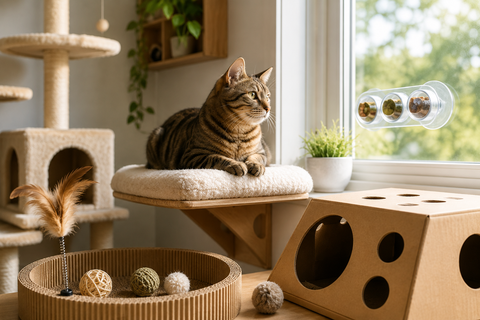
Step 3: Give Your Cat Somewhere to Stalk From
An open room isn't always the most interesting hunting environment.
Add visual barriers using safe things you already have.
A cardboard box.
A chair.
A cat tunnel.
The side of the couch.
A doorway.
Move the toy past these objects so it occasionally disappears from view.
Your cat may crouch behind one of them and wait.
That's exactly what you want.
The game isn't supposed to be one continuous chase.
Waiting is part of hunting too.
Step 4: Slow Down
This may feel counterintuitive.
If your cat isn't chasing, your instinct may be to move the toy faster.
Try the opposite.
Move slowly.
Stop completely.
Wait.
Give the toy one tiny twitch.
Then stop again.
Watch your cat.
If they're staring intensely, lowering their body, repositioning their paws, or preparing to pounce, they're engaged.
They simply haven't attacked yet.
A cat that's stalking isn't bored.
They're planning.
Step 5: Create the Escape
Once your cat is focused, let the prey make a break for it.
Move the toy quickly across the floor.
Around a chair.
Through a doorway.
Behind a box.
Then stop.
Your cat now has to respond to changing movement rather than simply following something traveling predictably back and forth.
Try varying the speed.
Slow → Pause → Fast → Hide → Pause
That unpredictability makes the game much more interesting.
Step 6: Let the Pounce Happen
Your cat has watched.
Stalked.
Waited.
Chased.
Now give them an opportunity to attack.
Don't yank the toy away every time they're about to reach it.
Let your cat pounce successfully.
For many cats, this is the payoff for everything that happened beforehand.
And once they make contact, don't immediately restart the chase.
There's another important step first.
Step 7: Let Your Cat Catch the Toy
Your cat caught the prey.
Let them have it.
For a moment.
They may:
Grab it.
Hold it between their paws.
Kick it.
Bite at it.
Investigate it.
That successful capture is part of the hunting sequence.
If the toy escapes every single time your cat gets close, the game can become frustrating.
A good hunt needs wins.
Step 8: Restart the Hunt
Once your cat releases the toy or begins losing interest in the catch, make the prey "come back to life."
A tiny movement.
Pause. Another movement.
Then escape.
You've started another round.
This creates a series of short hunting opportunities rather than one exhausting continuous chase.
Your cat gets repeated chances to:
Observe.
Plan.
Pursue.
Succeed.
That's much closer to how feline play naturally unfolds.
Step 9: Add Height for Cats That Love to Climb
If your cat enjoys vertical space, incorporate appropriate levels into the game.
Move the toy:
Around the base of a cat tree.
Onto a low platform.
Behind a scratching post.
Across an accessible perch.
Let your cat decide whether to follow upward or wait for the prey to return.
Don't encourage unsafe jumps or difficult climbs.
The goal is simply to make the environment more interesting by adding another dimension.
Step 10: Finish With Something Worth Finding
For food-motivated cats, a small treat can provide a satisfying finale.
After your cat successfully catches the toy, offer an appropriately sized animal-based reward.
At Raw Paws Pet Food, options such as:
- Freeze-Dried Chicken Breast
- Freeze-Dried Chicken Hearts
- Freeze-Dried Beef Liver
- Freeze-Dried Whole Minnows
can be divided into small rewards for enrichment.
You can hand over the treat.
Or make the final step another miniature search.
Place the reward somewhere nearby and allow your cat to discover it.
Now the game finishes with food instead of simply ending because you put the wand away.
Try a Treat-Only Hunting Game
Not every hunting activity needs a wand toy.
For cats motivated by food, create a simple search game.
Start with several tiny treats.
Allow your cat to watch you place them in easy locations around a room.
Once they understand the concept, make the locations gradually less obvious.
Try:
Beside a chair leg.
Near a scratcher.
On an accessible cat-tree platform.
Near a cardboard box.
Your cat now has to move through the environment and investigate rather than receiving every reward directly from your hand.
Whole Minnows Can Create a Completely Different Experience
A Freeze-Dried Whole Minnow is especially interesting because it doesn't resemble a uniform manufactured treat.
It still looks like a small fish.
Some cats may immediately eat it.
Others may sniff it.
Paw at it.
Carry it.
Investigate it before eating.
That interaction can become part of supervised food enrichment.
The treat isn't simply the prize.
The whole-food structure itself provides something to explore.
Start Ridiculously Easy
One of the fastest ways to ruin enrichment is making it too difficult too soon.
Your first hunting game doesn't need to challenge a tiger.
Let your cat succeed.
Make the prey easy to follow.
Make hidden treats easy to locate.
Allow frequent catches.
Once your cat understands the game, increase complexity gradually.
Good enrichment creates this feeling:
"I can figure this out."
Not:
"Apparently my chicken heart has vanished into another dimension."
Follow Your Cat's Hunting Style
Every cat plays differently.
Some want to chase.
Some want to ambush.
Some prefer stalking for two minutes before one dramatic pounce.
Some barely care about toys but become incredibly focused during food searches.
Your job isn't convincing your cat to play the "correct" way.
It's identifying which parts of the game naturally capture their attention.
If your cat loves stalking, create more hiding opportunities.
If they love chasing, provide safe open movement.
If food is the strongest motivator, build more searching into the activity.
Your cat's behavior is the instruction manual.
Keep Sessions Short
A successful hunting game doesn't need to last thirty minutes.
Cats often engage in bursts.
Five focused minutes can provide a surprisingly rich experience when the session includes:
Watching.
Stalking.
Chasing.
Pouncing.
Catching.
Searching.
Reward.
Several short sessions throughout the day may be more appealing than one long session that continues until your cat completely loses interest.
Know When the Hunt Is Over
Cats are very good at ending meetings without formally announcing it.
Your cat may:
Walk away.
Start grooming.
Lie down.
Stop following the toy.
Turn attention toward something else.
That's okay.
Don't keep pushing the activity because your planned fifteen-minute session has only lasted eight.
The goal is engagement.
Once the engagement disappears, the game is finished.
End on a good note and try again later.
Keep Interactive Toys Interactive
Wand toys, strings, ribbons, and toys with components that could be chewed off, swallowed, or become tangled should be used according to their safety instructions and stored securely when supervision ends.
The fact that the wand disappears after play can actually make it more interesting.
When it comes out again, your cat recognizes that something different is about to happen.
Some toys are better when they aren't part of the everyday scenery.
You Don't Need to Recreate the Wild
An indoor hunting game isn't about pretending your cat has to capture dinner to survive.
They don't.
That's one of the advantages of living with us.
The purpose is giving deeply rooted feline behaviors an appropriate outlet.
Notice.
Stalk.
Chase.
Pounce.
Catch.
Search.
Eat.
Those behaviors already exist inside your cat.
A good enrichment game simply creates a safe place for them to happen.
And that's why the best indoor hunting setup isn't necessarily the most elaborate one.
It's the one your cat sees...
crouches...
waits...
and decides is absolutely worth chasing.
Comments (0)
There are no comments for this article. Be the first one to leave a message!