

Your cat walks toward you.
Head bump.
Cheek rub.
Then they move on to the corner of the couch.
Rub.
The cardboard box.
Rub.
A favorite toy.
Rub.
To us, it can look like a collection of random affectionate little gestures.
To your cat, there's more going on.
Cats experience their environment through scent in ways humans can't easily perceive. When they rub their face against people and objects, they can deposit chemical scent signals from glands located around areas of the face.
So that adorable cheek rub isn't necessarily just a request for attention.
Your cat may also be doing something deeply feline:
Making the world smell familiar.
Your Cat's Face Carries Information
Cats have scent-producing glands in several areas of the body, including around the face.
Areas associated with facial scent marking include the:
- Cheeks
- Chin
- Lips
- Forehead area
When a cat presses or rubs these areas against an object, scent can be transferred onto that surface.
Humans generally don't notice it.
Another cat can.
This creates an invisible layer of information throughout the environment that exists alongside everything we can see.
Why Rub Against Furniture?
Look at where your cat tends to rub.
The corner of a couch.
A doorway.
A table leg.
The edge of a cardboard box.
These are often objects positioned along routes the cat regularly travels.
By rubbing against familiar objects, cats can deposit their scent within spaces they use frequently.
The furniture isn't necessarily itchy.
It's part of their environment.
And rubbing helps make that environment more familiar in a way that matters to a scent-oriented animal.
Why Does My Cat Rub Their Face on Me?
This is the behavior cat owners really want explained.
Your cat approaches.
Pushes their forehead or cheek against you.
Then rubs along your hand, leg, or face.
Is it affection?
It certainly can occur during friendly social interaction, but scent communication is part of the picture too.
Cats can exchange and deposit familiar scents during social rubbing.
So when your cat rubs against you, they're interacting with you both physically and chemically.
In very cat-like fashion, affection and communication can happen at the same time.
The Head Bump Has a Name
That deliberate head-first bump cats sometimes give people or familiar animals is commonly called bunting.
It may begin with the forehead and transition into a cheek rub as the cat moves past.
You'll often see it when a cat:
Greets a familiar person.
Approaches another friendly cat.
Seeks interaction.
Moves through familiar territory.
The behavior can look casual, but it reflects the importance of physical contact and scent in feline social communication.
Toys Can Become Part of Their Scent World Too
Ever introduce a new toy and watch your cat sniff it extensively before rubbing their face against it?
They're investigating something unfamiliar.
Over time, toys can accumulate familiar household and feline scents.
That may help explain why an old favorite sometimes seems especially comfortable and familiar.
A toy isn't only something your cat sees.
It's something they smell.
Touch.
Rub against.
Carry.
Play with.
Those sensory layers help turn an ordinary object into part of your cat's environment.
This Helps Explain Why New Things Get Inspected
Bring home a new cat bed.
Your cat doesn't immediately lie in it.
First comes the inspection.
Sniff.
Walk around.
Maybe rub.
Maybe leave.
Maybe return six hours later and finally decide it belongs to them.
Cats often investigate unfamiliar objects before incorporating them into their normal routine.
Scent is part of that process.
This is one reason cats sometimes need time to accept new:
- Beds
- Toys
- Scratchers
- Cat trees
- Furniture
- Carriers
We see a new object.
Your cat sees—and smells—a change in the environment.
Scratching Communicates in a Different Way
Face rubbing isn't the only way cats leave information behind.
Scratching can create both visual marks and scent signals.
That makes scratching surfaces especially interesting from an enrichment perspective.
Your cat can physically modify the object while repeatedly returning to a familiar location.
A well-used cardboard scratcher may look worn out to you. To your cat, it may be one of the most thoroughly personalized objects in the house.
Why Cats Love Cardboard Scratchers: There's More Going On Than Claw Care
Familiar Scent May Be One Reason Cats Love Their Favorite Spots
Have you noticed how cats repeatedly return to the same:
Blanket.
Chair.
Cat bed.
Cardboard box.
Section of the couch.
Those places don't just provide familiar textures and locations.
They also accumulate familiar scents.
Every nap, cheek rub, paw placement, and grooming session contributes to an environment that increasingly smells like home.
That's one reason constantly washing or replacing every familiar object at once may temporarily make an environment feel different to a scent-sensitive cat.
Cleanliness matters, of course.
But it's useful to remember that your cat experiences "familiar" partly through a sense we barely use by comparison.
Why Does My Cat Rub Against Something and Then Scratch It?
Because feline behaviors don't always exist in isolation.
A cat may investigate an object.
Rub against it.
Scratch nearby.
Sit on it.
Return later.
From our perspective, those may look like unrelated activities. From the cat's perspective, they're all ways of interacting with and gathering information about the environment.
Good enrichment supports these natural behaviors rather than expecting every product to have only one purpose.
A cardboard scratcher may become a scratching surface, rubbing spot, play area, and eventually a bed.
Cats aren't particularly interested in product instructions.
Face Rubbing Can Be Part of a Greeting Routine
Some cats greet their owners at the door with vocalization.
Others rub against legs.
Some combine both.
If your cat routinely greets you with cheek rubbing or bunting, that behavior may be part of a familiar social ritual.
The interaction includes:
Physical contact.
Familiar scent.
Recognition.
Attention.
It's one of the many subtle ways cats communicate without needing to meow.
Don't Confuse Normal Rubbing With Persistent Irritation
Normal facial rubbing is generally relaxed and appears as part of exploration or social interaction.
Persistent or unusually forceful rubbing can be different. If your cat suddenly begins repeatedly rubbing or pawing at the face, ears, eyes, or mouth—especially alongside redness, discharge, swelling, hair loss, head shaking, apparent discomfort, or other changes—contact your veterinarian.
Not every rub is communication.
Behavior should always be considered in context.
Scent Is an Important Part of Cat Enrichment
We often design enrichment around what cats can see.
Moving toys.
Window views.
Climbing structures.
But cats experience their environment through several senses.
Scent adds another dimension.
Familiar objects.
New objects to investigate.
Animal-based foods.
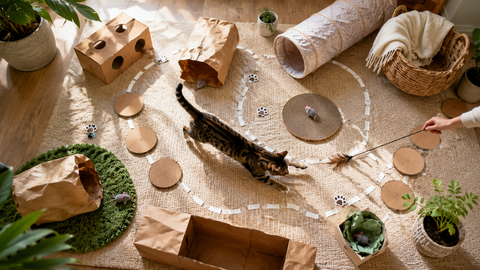
Even a cardboard box that recently arrived can introduce new scents worth exploring.
The Ultimate Indoor Cat Enrichment Guide
Enrichment becomes much richer when we stop designing exclusively for human senses.
Your Cat Lives in an Invisible Version of Your House
You see:
A couch.
A doorway.
A toy.
A cardboard box.
Your cat experiences all of those things too—but with layers of scent information you can't perceive.
That's what makes face rubbing so fascinating.
A cheek against the couch isn't necessarily random.
A head bump against your hand isn't simply cute.
A rub against a new toy may be part investigation, part communication, and part making something unfamiliar feel familiar. Cats don't only occupy their environment.
They interact with it constantly.
They scratch it.
Climb it.
Watch it.
Sniff it.
And sometimes they rub their face all over it.
Including you.
Which, in the complicated language of cats, is a pretty nice group to belong to.
Comments (0)
There are no comments for this article. Be the first one to leave a message!