

You leave for work.
Your cat watches from the window.
Eight hours later, you come home and find them sleeping in almost exactly the same spot.
It raises an obvious question:
What does an indoor cat actually do all day when nobody's home?
Sleeping is completely normal.
Cats naturally spend a large portion of their day resting.
But an indoor environment should also provide opportunities to wake up and do something.
Watch.
Climb.
Scratch.
Search.
Explore.
Play.
The challenge is that many of the best cat activities—like wand toys—require a person on the other end.
So when your cat spends time home alone, enrichment needs to work differently.
The goal isn't keeping your cat entertained every minute you're gone.
It's creating an environment where interesting choices are available whenever they decide to get up.
Start With the Window
One of the easiest enrichment tools may already be built into your house.
A secure window provides an environment that changes constantly.
Birds appear.
People walk past.
Leaves move.
Squirrels visit.
Weather changes.
Cars come and go.
Unlike a toy that remains exactly where you left it, the view outside creates new information throughout the day.
If possible, provide a comfortable perch near a securely closed or properly screened window so your cat has somewhere to observe.
For many cats, a good window is better than television.
Give Your Cat Somewhere High to Watch From
Cats don't experience a home only at floor level.
An elevated perch allows them to observe the environment from a completely different perspective.
Cat trees, secure shelves, window perches, and other stable climbing areas can create multiple levels within the same room.
Now your cat can choose:
Floor.
Couch.
Mid-level perch.
High lookout.
That choice alone makes an indoor environment richer.
And unlike interactive toys, vertical space remains useful whether you're home or not.
Leave Out a Small Selection of Safe Independent Toys
The key word is selection.
You don't need twenty toys covering the floor.
Choose a few safe toys designed for independent use and rotate them periodically.
Depending on your cat's preferences, that might include:
- Balls
- Springs
- Toy mice
- Kicker toys
- Other toys intended for unsupervised independent play
Your cat may ignore them for hours.
Then suddenly decide at 2:17 p.m. that one particular ball must be chased across the entire house.
That's fine.
Enrichment doesn't have to happen on your schedule.
Rotate Those Toys
If the same toys remain available every day, they can gradually become part of the furniture.
Try putting some away.
Every few days, swap the selection.
Now a toy that hasn't appeared recently returns to the environment.
Your cat may sniff it.
Bat it.
Carry it.
Chase it.
The toy isn't actually new. But its absence helped restore some novelty.
Create Safe Scratching Stations
Scratching is something cats can do completely independently.
That's one reason scratching surfaces are such useful daytime enrichment.
Consider offering different options, such as:
- Horizontal cardboard scratchers
- Vertical scratching posts
- Different textures
- Scratchers in multiple frequently used areas
Location matters.
A scratcher hidden in a room your cat rarely visits isn't providing much opportunity.
Place scratching surfaces where your cat naturally spends time.
Now scratching becomes something they can choose whenever the instinct appears.
Give Them a Cardboard Box
Sometimes the cheapest enrichment wins.
A sturdy, appropriately sized cardboard box can become:
A hiding place.
A lookout.
A nap spot.
An ambush location.
Something to investigate.
Place one somewhere different occasionally.
A box that appears in a new room changes the environment without requiring an elaborate new product.
Just remove packaging materials, staples, tape, handles, or other components that could present a hazard before giving your cat access.
Use Food Puzzles Designed for Independent Use
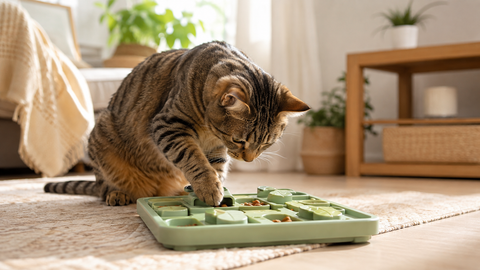
For food-motivated cats, puzzle feeders can make part of the day's food more interesting.
Instead of immediately accessing the reward, your cat may need to:
Push.
Paw.
Roll.
Investigate.
Solve.
Start with easy puzzles so the activity remains achievable.
If your cat can't figure out how to access the food, enrichment quickly becomes frustration.
Also make sure the specific feeder is appropriate for independent use before leaving it available while you're away.
Make Breakfast Last a Little Longer
If your cat eats an appropriate food that works with a puzzle or enrichment feeder, consider using part of breakfast for an activity before you leave.
Now the morning becomes:
Wake up. Interact with you.
Investigate food puzzle.
Eat.
Explore.
Rest.
You've added another event to the day without increasing the amount of food offered.
The calories didn't change.
The experience did.
Create Multiple Resting Locations
Rest itself is part of a cat's day.
Enrichment doesn't mean preventing your cat from sleeping.
Instead, provide choices about where to sleep.
A cat may prefer:
A sunny window in the morning.
An elevated perch in the afternoon.
A covered bed later. The back of the couch when household activity begins again.
Different resting locations allow cats to respond to changing light, temperature, noise, and activity throughout the day.
Even relaxation benefits from choice.
Let Sunlight Become Enrichment
Cats are remarkably good at locating the warmest patch of sunlight in a house.
If your home has safe sunny areas, accessible resting spots can create changing environments throughout the day as sunlight moves from one location to another.
The sun itself creates novelty.
Morning spot.
Afternoon spot.
Different temperature.
Different view.
Sometimes environmental enrichment doesn't require an object at all.
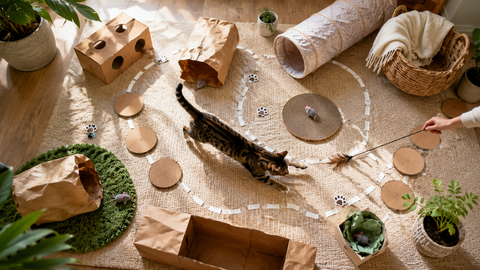
Give Your Cat Something Safe to Explore
Cats are naturally curious.
Small environmental changes can encourage investigation.
A new cardboard box.
A familiar tunnel moved to another room.
A safe object placed somewhere unexpected.
You don't need to dramatically rearrange the house.
Occasional small changes can create new information within an otherwise predictable environment.
The home stays familiar.
But it doesn't stay completely identical.
Don't Leave Wand Toys Out Unattended
Some of the best interactive toys are not appropriate for unsupervised play.
Wands, strings, ribbons, feathers, and toys containing components that could become tangled, detached, or swallowed may require supervision.
Use those toys when you're home.
Then store them securely when the session ends.
This actually creates a useful distinction:
Independent toys belong to the daytime environment.
Interactive toys appear when you return.
Now your arrival means something interesting is about to happen.
Save the Best Hunting Game for When You Get Home
Your cat doesn't need every form of enrichment while alone.
Some experiences are better shared.
When you return, use an interactive wand toy to encourage:
Watch → Stalk → Chase → Pounce → Catch
That gives your cat an activity that simply can't be replicated by a motionless toy.
A short interactive session can also become a predictable part of your reunion routine.
You come home.
The wand comes out.
The hunt begins.
Finish Evening Play With a Small Reward
After a hunting-style play session, a small animal-based treat can create a rewarding finale.
At Raw Paws Pet Food, options such as Freeze-Dried Chicken Breast, Chicken Hearts, Beef Liver, and Whole Minnows can be broken into appropriately sized pieces for rewards or supervised food enrichment.
Now your cat's day contains both kinds of experiences: Independent enrichment while you're away.
Interactive enrichment when you're together.
That's a much richer balance than trying to make toys replace human interaction entirely.
Consider the Sounds of the Environment
Some cats enjoy a quiet house.
Others appear interested in normal background sounds.
The right environment depends on the individual cat.
If your cat is accustomed to household sound, suddenly leaving the home completely silent may feel different. Some owners leave familiar low-level background audio available.
The important thing is avoiding excessive volume or unpredictable noise.
Enrichment should make the environment more comfortable and interesting—not overwhelming.
Multi-Cat Homes Need Choices, Not Just More Stuff
If several cats share the home, enrichment resources should reduce unnecessary competition rather than create it.
Consider whether cats have access to multiple:
- Resting areas
- Elevated spaces
- Scratching locations
- Observation spots
- Appropriate toys
One perfect perch isn't especially useful if three cats all want it at the same time.
More usable locations can be more valuable than simply adding more toys.
Your Cat Doesn't Need Eight Hours of Entertainment
This is important.
Don't judge your enrichment setup because your cat sleeps while you're gone.
Cats sleep.
A lot.
That's normal.
The goal isn't creating nonstop activity from the moment you leave until the moment you return.
It's making sure that when your cat wakes up, the environment offers options. They can climb.
Watch.
Scratch.
Explore.
Play.
Eat.
Move somewhere else.
Then take another nap.
That's a perfectly respectable feline workday.
Build a Day With Different Opportunities
A simple routine might look like this:
Before You Leave: Short interactive play session and breakfast.
Morning: Window watching and resting.
Midday: Independent toy exploration or food puzzle.
Afternoon: Climbing, scratching, observation, more sleeping.
When You Return: Interactive wand play.
Evening: Food enrichment or a small whole-food reward.
You don't need to control every step.
You're simply creating possibilities.
Your cat decides which ones to use.
The Best Home-Alone Enrichment Is an Environment, Not a Toy
It's tempting to search for one magical product that will entertain your cat all day.
That's rarely how good enrichment works.
The better goal is creating a home that offers several kinds of experiences:
Something to watch.
Something to climb.
Something to scratch.
Something safe to play with.
Something to investigate.
Somewhere comfortable to sleep.
Then, when you return, add the one enrichment ingredient your cat couldn't access while you were gone:
You.
Because independent enrichment shouldn't replace interaction.
It should make the hours between those interactions a little more interesting.
Comments (0)
There are no comments for this article. Be the first one to leave a message!