

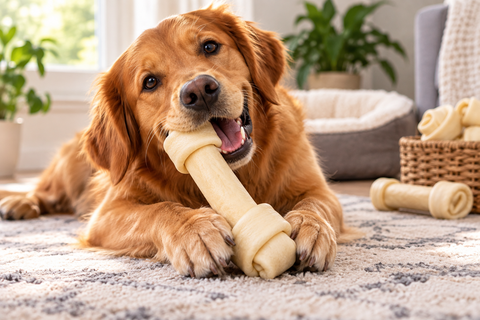
A compressed rawhide bone doesn't start out looking anything like the chew your dog eventually receives.
It begins as cattle hide.
From there, the hide has to be cleaned, de-haired, prepared, formed, compressed, dried, inspected, and packaged before it becomes the dense chew sitting in your dog's paws.
That process is important because compressed rawhide isn't simply traditional rawhide shaped into a different bone.
The defining difference is how the prepared hide is constructed.
Instead of relying primarily on rolled, folded, or knotted layers, compressed rawhide uses pressure to create a tightly packed, dense structure.
So what actually happens between cattle hide and finished dog chew?
Let's follow the process.
It Starts With the Hide
Rawhide is made from animal hide, most commonly cattle hide.
Hide contains multiple layers, and the material used for rawhide chews comes from the inner portion after appropriate processing and separation.
That means the starting material isn't an artificial chew compound.
It's animal tissue.
But before that material can become something suitable for producing dog chews, considerable preparation has to take place.
Step 1: The Hide Is Cleaned and Prepared
The first stages involve preparing the original hide for further processing.
The hide needs to be cleaned so unwanted material can be removed and the appropriate layer can be worked with during production.
This creates the foundation for everything that happens next.
And because manufacturing processes can vary between suppliers, understanding how a specific rawhide product is made provides much more useful information than assuming every product labeled "rawhide" went through an identical process.
Step 2: The Hair Has to Come Off
Cattle hide naturally contains hair.
Before the hide can become rawhide, that hair needs to be removed.
These processing agents help remove the hair from the hide so the material can continue through preparation.
It's a step owners never see when looking at the finished bone, but it's part of the journey from natural hide to finished chew.
Step 3: No Bleach Is Used
Rawhide processing is sometimes associated with bleaching, so this is worth clarifying.
Raw Paws compressed rawhide is not bleached.
Our process uses sodium sulphide and lime during hair removal rather than bleach.
That's one reason it's helpful to ask how a particular rawhide product is produced instead of treating every rawhide chew on the market as though it's made exactly the same way.
The word rawhide identifies the general material.
It doesn't explain the entire manufacturing process.
Step 4: The Hide Material Is Prepared for the Chew
After cleaning and hair removal, the hide continues through preparation so it can be formed into the finished product.
This is where compressed rawhide begins heading down a different path from many traditional rawhide chews.
Traditional rawhide may be constructed by:
- Rolling
- Folding
- Twisting
- Knotting
- Layering
Compressed rawhide uses pressure instead.
The prepared hide material is arranged so it can be packed tightly together into a much denser structure.
Step 5: Compression Creates the Difference
This is the defining step.
Prepared rawhide is compressed tightly together under pressure.
Imagine taking layers of material and pressing them together until they form a dense, solid structure.
That's fundamentally different from simply rolling the material into a tube or tying it into a bone shape.
Compression creates a chew with fewer obvious loose layers and a more tightly packed structure for the dog to work through.
That's why compressed rawhide feels and behaves differently once chewing begins.
Step 6: The Rawhide Is Formed Into Its Final Shape
Once the prepared material is compressed, it can be formed into the desired chew shape.
For compressed rawhide bones, that means creating a solid shape dogs can comfortably hold and work from different angles.
Shape isn't purely cosmetic.
Watch a dog with a natural chew and you'll see how much they physically manipulate it.
They may:
Grip one end.
Hold it between their paws.
Work an edge.
Rotate it.
Flip it over.
Change chewing angles.
The final shape becomes part of the chewing experience.
Step 7: The Chew Is Dried
After forming, moisture needs to be removed so the rawhide develops its characteristic firm structure.
Proper drying is an important part of producing the finished chew.
This stage also helps explain a rare variation that can sometimes appear inside rawhide. If an internal area isn't completely dried, a small section can occasionally develop a somewhat gelatinized appearance.
Because the product begins with natural animal material, occasional variation can occur.
If a chew ever looks unusual enough that you're uncertain about its condition, stop using it and contact the manufacturer before offering it again.
Step 8: The Finished Chew Is Inspected
Once production and drying are complete, the finished product needs another look.
At Raw Paws Pet Food, our compressed rawhide chews are inspected before they're packed.
That provides an opportunity to evaluate the finished chew after it has moved through the production process.
Natural animal products can have some variation in appearance, texture, and shape.
Inspection is an important part of evaluating the final product before it reaches customers.
Step 9: Raw Paws Compressed Rawhide Is Hand-Packed in Indianapolis
After production and inspection, our compressed rawhide products are hand-packed in Indianapolis.
That final step brings the chew from production into the package that eventually arrives at your home.
For us, the product story isn't simply:
Hide → Bone.
It includes sourcing, preparation, processing, inspection, and final packing.
Those details matter when you're trying to understand what you're actually giving your dog.
Where Does the Hide Come From?
Raw Paws compressed rawhide is sourced from India.
We source there because the region provides a consistent supply of high-quality hides and is recognized for hide quality.
The cattle used for our rawhide are:
Free-range
Raised without antibiotics
Raised without added hormones
The finished chews are then inspected and hand-packed here in Indianapolis.
Sourcing is part of the product—not something separate from it.
Why Does Compression Matter to the Dog?
Your dog doesn't care about manufacturing terminology.
They care about what happens when the chew reaches their mouth.
The compressed structure creates density.
That gives the dog something they have to gradually work through.
During a chewing session, your dog may:
Gnaw the surface.
Scrape an area.
Allow saliva to soften the hide.
Change angles.
Rotate the chew.
Return to softened sections.
As the session continues, the material gradually changes.
That evolving experience is part of what makes compressed rawhide engaging for dogs that genuinely enjoy chewing.
Why Doesn't It Peel Like Some Traditional Rawhide?
Construction is the reason.
Some traditional rawhide products are created from rolled or folded material that can produce more obvious layers.
Compressed rawhide is designed to reduce the tendency for large layers to separate by pressing the hide tightly together.
That doesn't mean pieces can never come off.
They can.
But the dense construction creates a different structure for the dog to work through.
What Happens When a Dog Swallows Small Pieces?
As dogs gradually work through compressed rawhide, small pieces may sometimes be swallowed.
Rawhide isn't digested in the same way as a highly digestible animal-tissue chew such as a bully stick.
Small pieces may pass through the digestive tract.
This is one reason supervision is important.
Remove torn pieces when appropriate, and don't allow your dog to attempt to swallow substantial sections of the chew.
The intended experience is gradual gnawing—not gulping.
Why Does Every Bone Look Slightly Different?
Compressed rawhide is made from natural animal hide.
Natural materials vary.
You may notice slight differences in:
- Shape
- Texture
- Surface appearance
- Density
Compression creates a more consistent structure, but it doesn't transform animal hide into a perfectly molded synthetic product.
Some variation is expected.
That's true across many natural animal-based chews.
From Cattle Hide to Compressed Rawhide Bone
The entire journey looks something like this:
Cattle Hide
↓
Cleaning & Preparation
↓
Hair Removal
↓
Hide Processing
↓
Compression Under Pressure
↓
Forming
↓
Drying
↓
Inspection
↓
Hand-Packing
↓
Supervised Chewing
That last step matters just as much as everything before it.
The Manufacturing Process Doesn't Replace Supervision
A dense compressed structure is designed to change the way dogs work through rawhide.
It doesn't make the product indestructible.
As your dog chews:
The surface softens.
Material wears away.
Pieces may separate.
The bone becomes smaller.
Always supervise.
Remove torn pieces.
Take the chew away once the remaining portion becomes too small for your dog to continue chewing appropriately.
And if your dog consistently attempts to tear off and swallow substantial pieces rather than gradually gnawing the product, compressed rawhide may not be the right chew for that individual dog.
Understanding What's Behind the Finished Chew
It's easy to look at a compressed rawhide bone and see one simple product.
But there's an entire process behind it.
The cattle hide has to be sourced.
Cleaned.
De-haired.
Prepared.
Compressed.
Formed.
Dried.
Inspected.
Packed.
Understanding those steps makes it easier to understand what makes compressed rawhide different.
It isn't simply another shape of traditional rawhide.
The construction is the difference.
And once your dog starts working through that dense compressed structure, that difference becomes much easier to see.
Comments (0)
There are no comments for this article. Be the first one to leave a message!