

Some dog treats are gone before you finish closing the bag.
Others become a project.
Compressed rawhide belongs much closer to the second category.
Its long-lasting nature isn't accidental. It's largely the result of how the chew is constructed.
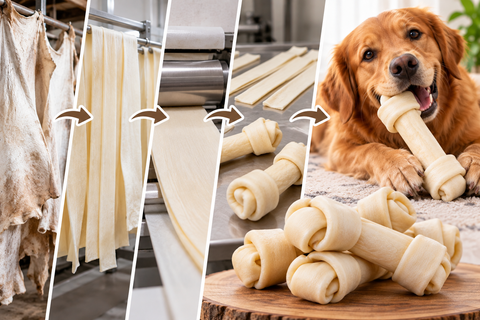
Instead of simply rolling, folding, or knotting prepared hide into shape, compressed rawhide uses pressure to pack hide material tightly together into a dense structure.
That gives dogs more resistance to work through as they gnaw, scrape, soften, and reposition the chew.
So when a compressed rawhide bone seems to keep your dog occupied longer than many lighter chews, there's a simple explanation:
Density takes work.
Chew Time Starts With Construction
Two dog chews can be roughly the same size and still last dramatically different amounts of time.
Why?
Because dimensions don't tell you everything.
Construction matters.
Imagine the difference between chewing through something loosely layered and something made from similar material that's been tightly pressed together.
The compressed version presents more resistance.
That's the basic principle behind compressed rawhide.
Prepared hide is pressed tightly together, creating a solid structure dogs have to gradually work through rather than quickly breaking apart.
Traditional Rawhide Can Be Built Differently
Rawhide isn't one universal product.
Traditional rawhide chews may be:
- Rolled
- Folded
- Twisted
- Knotted
- Layered
Those designs create different edges and structures.
Compressed rawhide takes a different approach.
Instead of relying primarily on layers or folds to hold the chew together, pressure creates density throughout the product.
That construction is one reason compressed rawhide can provide a more substantial chewing experience than many lighter traditional rawhide designs.
Compressed Rawhide vs. Regular Rawhide: What's the Difference? – Raw Paws Pet Food
Dogs Have to Work Through the Surface Gradually
A compressed rawhide bone doesn't simply disappear when the dog bites into it.
The process happens gradually.
Your dog may:
Gnaw one area.
Scrape the surface.
Apply pressure.
Allow saliva to soften the hide.
Change chewing angles.
Rotate the bone.
Return to the softened area.
Every one of those actions takes time.
For dogs that enjoy methodical chewing, that gradual process can turn a compressed rawhide bone into a longer enrichment activity rather than a quick snack.
Saliva Changes the Chew Slowly
Moisture plays an important role in how dogs work through rawhide.
When the chew first comes out of the package, it's dry and firm.
As your dog begins gnawing, saliva gradually moistens the surface.
The material softens.
The dog can begin making more progress.
But with compressed rawhide, they're still dealing with tightly packed material underneath.
They soften one section.
Work through it.
Then encounter more dense material.
That cycle can repeat throughout the chewing session.
More Density Means More Work
This is really the heart of the answer.
Compressed rawhide isn't long-lasting because of a special flavor or coating.
It's the physical structure.
Tightly compressed hide provides more resistance than many lighter chews.
That means dogs often need more:
Time.
Jaw movement.
Repositioning.
Gnawing.
Persistence.
to make progress.
For a dog that genuinely enjoys chewing, those aren't disadvantages.
They're the activity.
Long-Lasting Doesn't Mean Indestructible
This distinction is important.
Compressed rawhide is designed to provide a substantial chewing experience.
It's still meant to change.
Over time:
The surface softens.
Material wears away.
The bone becomes smaller.
Pieces can separate.
Eventually, the chew needs to be removed.
A product can be long-lasting without being permanent.
In fact, the gradual change is part of what keeps the experience interesting.
How Long Does Compressed Rawhide Actually Last?
There's no honest universal answer.
A compressed rawhide bone could last one dog significantly longer than another.
Chew duration depends on:
- Size of the chew
- Thickness
- Density
- Dog size
- Jaw strength
- Chewing intensity
- Individual technique
A gentle chewer may return to the same bone across several supervised sessions.
A power chewer may make much faster progress.
So while compressed construction can contribute to longer chew time, the dog remains the biggest variable.
Power Chewers Can Change the Equation
Give almost any chew to a determined power chewer and durability predictions become difficult.
These dogs often know exactly how to maximize leverage.
They may:
Position the chew between the back teeth.
Focus intensely on one section.
Apply consistent pressure.
Soften an area before moving forward.
A compressed structure gives them more material to work through, but it doesn't make the chew immune to determined jaws.
That's why matching the chew to the individual dog matters.
Size Matters Too
A larger compressed rawhide bone generally gives the dog more material than a smaller one.
But bigger isn't automatically appropriate for every dog.
Choose a chew that matches your dog's:
Body size.
Mouth size.
Jaw strength.
Chewing behavior.
The product should be substantial enough for your dog to comfortably hold and work through without being easily swallowed whole.
A longer-lasting chew only has value when it's appropriately sized for the dog using it.
Long Chew Time Creates an Enrichment Opportunity
Why do owners want longer-lasting chews in the first place?
Usually because they're looking for more than food.
They want an activity.
Chewing gives dogs opportunities to:
Focus.
Use their jaws.
Explore texture.
Manipulate an object.
Work through a challenge.
Settle into an independent activity.
Compressed rawhide can fit naturally into that type of enrichment because its dense structure requires ongoing interaction.
The dog isn't simply waiting for the next treat.
They have something meaningful to do.
One Chew May Provide Multiple Sessions
Some dogs naturally take breaks while chewing.
They work for a while.
Stop.
Return later.
For these dogs, a substantial compressed rawhide chew may potentially provide more than one supervised session when the product remains suitable for continued use and is handled according to its storage instructions.
This can make the chewing experience feel even longer without requiring the dog to work continuously.
Not every dog understands the concept of saving something for later.
But some absolutely do.
Compressed Rawhide Isn't the Same as a Bully Stick
Bully sticks can also provide longer chewing experiences, but they achieve that through a different animal tissue and structure.
A bully stick is made from beef pizzle.
Compressed rawhide is made from prepared animal hide pressed into a dense form.
Both may keep a dog engaged.
They simply create different chewing experiences.
A dog that methodically works through compressed rawhide may interact very differently with a bully stick, collagen stick, or beef cheek roll.
That's why chew rotation can be so useful.
Dense Construction Can Help Reduce Large Layers Separating
One reason compression matters isn't only duration.
Traditional rawhide products constructed from rolled or folded material may create more obvious layers as the chew softens.
Compressed rawhide is designed to reduce the tendency for large layers to separate by packing the hide tightly together.
That doesn't mean pieces can never come loose.
They can.
Small pieces may be swallowed, while torn pieces should be removed when appropriate.
Supervision remains essential regardless of how dense the chew is.
Longer-Lasting Still Requires Supervision
A chew lasting longer means your dog has more time to interact with it.
It also means owners need to continue monitoring the product as it changes.
Watch for:
Pieces becoming torn.
The chew becoming too small.
Attempts to swallow substantial portions.
Changes in your dog's chewing technique.
Remove torn pieces when appropriate and take the remaining chew away once it becomes small enough that your dog could attempt to swallow it whole.
Long-lasting should never be confused with hands-off.
Don't Judge a Chew Only by the Clock
It's tempting to evaluate every dog chew with one measurement:
How many minutes did it last?
But chew time isn't the only value.
Ask what happened during those minutes.
Did your dog:
Stay focused?
Work through different sections?
Rotate the chew?
Use different chewing angles?
Settle into the activity?
Those behaviors are part of enrichment.
A good chew doesn't simply occupy time.
It gives the dog something to actively engage with during that time.
Density Is What Creates the Challenge
So why does compressed rawhide often last longer than many traditional dog chews?
It comes back to one word:
Density.
Prepared hide is packed tightly together under pressure, creating a solid structure that dogs have to gradually soften and work through.
More resistance means more work.
More work can mean a longer chewing experience.
At Raw Paws, that's exactly what makes compressed rawhide interesting as part of a varied chew rotation.
It doesn't need to be the only chew your dog receives.
It simply offers a different kind of challenge.
Because for dogs that genuinely love chewing, sometimes the best treat isn't the one they can finish fastest.
It's the one that gives them something worth working on.
Comments (0)
There are no comments for this article. Be the first one to leave a message!