

Few dog chews generate as many questions as rawhide.
Is it okay for dogs?
Does it digest?
What happens if they swallow a piece?
And does compressed rawhide change any of those answers?
Those are good questions because not every product labeled rawhide is constructed the same way.
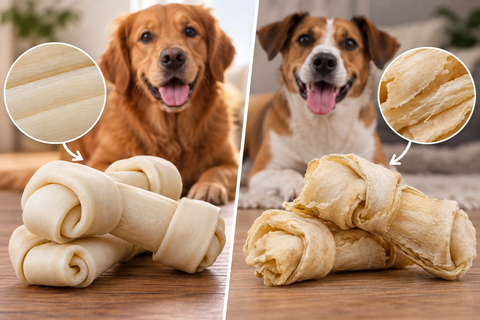
Compressed rawhide takes prepared animal hide and presses it tightly together to create a dense chew rather than relying on the looser rolled, folded, or knotted construction commonly associated with traditional rawhide.
So, are compressed rawhide bones good for dogs?
They can be an appropriate chewing option for dogs that work through them gradually when the chew is properly sized and the dog is supervised.
But compressed rawhide isn't a hands-off chew, and it isn't automatically appropriate for every dog.
Understanding how it works is the best place to start.
What Exactly Is a Compressed Rawhide Bone?
Rawhide is made from the inner layer of animal hide, commonly cattle hide.
Compressed rawhide uses that prepared hide differently.
Instead of simply rolling sheets or forming loose layers, the hide material is compressed tightly under pressure into a dense structure.
That density creates the defining characteristic of the chew.
Your dog has to gradually:
Gnaw.
Scrape.
Soften.
Reposition.
Work through the material.
The goal isn't making rawhide indestructible.
It's creating a more solid structure for the dog to work through.
Why Do Dogs Like Compressed Rawhide?
Dogs have a natural drive to chew.
A compressed rawhide bone gives that instinct something substantial to work on.
Watch a dog during a chewing session and you'll often see much more than repetitive biting.
They may:
Hold the bone between their paws.
Work one section.
Rotate it.
Change angles.
Soften an area.
Return to another side.
That interaction turns the chew into an activity.
For dogs that enjoy persistent gnawing, the process itself can be rewarding.
Compression Changes the Structure
This is the key difference from many traditional rawhide chews.
Some regular rawhide products use sheets or pieces that are rolled, folded, twisted, or knotted into shape.
Compressed rawhide presses prepared hide material together to create a denser structure.
Why does that matter?
The compressed construction is designed to reduce the tendency for large layers to separate compared with less densely constructed rawhide.
That doesn't mean pieces can never come loose.
They can.
But the dog has to work through a different physical structure.
Compressed Rawhide Can Provide Longer Engagement
A quick biscuit may disappear in seconds.
Compressed rawhide is designed for a very different purpose.
Its density can create a more extended chewing activity, depending on the individual dog.
That can provide an outlet for natural chewing behavior while encouraging the dog to stay focused on one activity.
But chew duration varies enormously.
A gentle chewer may return to the same bone across multiple sessions.
A determined power chewer may progress much faster.
The product matters.
The dog matters even more.
Rawhide Isn't Digested Like a Bully Stick
This is an important distinction for owners to understand.
A bully stick is made from beef pizzle and is gradually consumed and digested as animal tissue.
Rawhide behaves differently.
Small pieces of rawhide may be swallowed and generally pass through the digestive tract rather than being digested in the same way as a bully stick.
That's why owners need to pay attention to the size of any pieces their dog separates.
Compressed construction can help reduce large-piece separation compared with some traditional rawhide designs, but supervision remains essential.
Small Pieces May Be Swallowed
Dogs may swallow small pieces as they work through a compressed rawhide chew.
Those pieces aren't expected to digest like ordinary meat tissue but may pass through the digestive tract.
The concern increases when a dog tears off or attempts to swallow pieces that are too large.
That's why you should monitor the chew throughout the session.
If a piece becomes torn, remove it.
If the remaining bone becomes small enough that your dog could attempt to swallow it whole, take it away.
The goal is gradual chewing—not gulping.
Which Dogs May Be a Better Fit?
Compressed rawhide tends to make more sense for dogs that gnaw methodically.
These dogs work through the surface gradually rather than aggressively tearing large pieces away.
Watch your dog's technique.
Do they:
Scrape and gnaw?
Take time working one section?
Reposition the chew?
Gradually soften the material?
Those behaviors are very different from a dog that immediately tries to tear off and swallow substantial pieces.
The dog's behavior should influence whether compressed rawhide belongs in the chew rotation.
Which Dogs May Not Be a Good Fit?
No chew is appropriate for every dog.
Compressed rawhide may not be a good choice for a dog that consistently:
- Attempts to swallow large pieces
- Aggressively tears material instead of gnawing
- Tries to gulp chews
- Has difficulty safely managing the product
If your dog repeatedly uses a chew in a way that concerns you, take it away.
Don't try to force a particular chew to work simply because another dog handles it well.
Dogs have individual chewing styles.
Chews should be selected accordingly.
Proper Sizing Makes a Difference
A compressed rawhide bone should be appropriately sized for the dog receiving it.
Consider:
- Body size
- Mouth size
- Jaw strength
- Chewing intensity
A chew that's too small may be easier for a dog to attempt to swallow whole.
A more substantial size can give the dog something they can comfortably hold between the paws and gradually work through.
Sizing doesn't eliminate risk. It helps create a more appropriate starting point.
What Is That Occasional Gelatinized-Looking Spot?
Because rawhide is a natural processed material, occasional variation can occur.
In rare cases, an internal area may appear somewhat gelatinized if that section wasn't fully dried during processing.
That appearance can look unusual to an owner accustomed to a uniformly dry chew.
Natural products don't always have the visual consistency of synthetic materials.
If you're ever uncertain about the condition of a particular chew, stop using it and contact the manufacturer before continuing.
Supervision Is the Most Important Rule
Compressed rawhide should always be offered under supervision.
That means being close enough to periodically observe:
How the chew is changing.
Whether pieces are separating.
How your dog is chewing.
How large the remaining bone is.
Whether your dog is trying to swallow pieces rather than gradually work through them.
Remove torn pieces.
Take away the remaining chew when it becomes too small.
And discontinue the session anytime your dog's behavior makes you uncomfortable.
Supervision isn't an optional extra.
It's part of using the product appropriately.
Compressed Rawhide Isn't the Only Chew Option
Your dog doesn't need to receive the same chew every time.
A varied natural chew routine might include:
Compressed Rawhide: Dense hide-based chewing.
Bully Sticks: Gradually consumable beef-pizzle chew.
Collagen Sticks: Another beef-based texture.
Beef Cheek Rolls: Broad, layered chewing experience. Ears: Lighter chewing and crunch.
Different products provide different textures and challenges.
That's useful because dogs have different preferences—and those preferences can change depending on the occasion.
Let Your Dog's Chewing Style Guide the Choice
The most important information may not be printed on the package.
It's sitting beside you.
Watch your dog.
Do they patiently gnaw?
Do they rotate the chew?
Do they work through it gradually?
Or do they immediately try to rip away large sections?
Those behaviors tell you whether a dense compressed chew is a good match.
A quality product still needs to be appropriate for the individual dog using it.
So, Are Compressed Rawhide Bones Good for Dogs?
They can be a useful option for dogs that enjoy gradual, persistent chewing and handle the product appropriately.
Compressed construction creates a denser experience than many traditional rolled or layered rawhide products and is designed to reduce large pieces separating during normal chewing.
But compressed doesn't mean indestructible. And natural doesn't mean unsupervised.
At Raw Paws, our compressed rawhide begins with quality hides from free-range cattle raised without antibiotics or added hormones, uses no bleach in processing, and is inspected and hand-packed in Indianapolis.
From there, the owner's role matters just as much.
Choose an appropriate size.
Supervise every session.
Remove torn pieces.
Take the chew away when it becomes too small.
And most importantly, watch how your dog handles it.
Because the best chew isn't simply the one with the best description.
It's the one that's appropriate for the dog actually doing the chewing.
Comments (0)
There are no comments for this article. Be the first one to leave a message!