

Cats don't know whether a treat is freeze-dried, baked, extruded, or shaped like a tiny fish.
They experience something much simpler.
Smell. Texture. Taste.
For cat owners, however, what happens before that treat reaches the bowl matters.
Traditional cat treats and freeze-dried cat treats can look very different, contain very different ingredient lists, and go through completely different manufacturing processes. Both may earn an enthusiastic response from your cat, but they're not necessarily offering the same feeding experience.
The biggest difference isn't the shape of the treat or even the flavor printed on the package.
It's how the original ingredients became the finished product.
Start With the Finished Treat—and Work Backward
Pick up a traditional crunchy cat treat.
It's often remarkably uniform.
Same size.
Same shape.
Same texture.
That consistency is intentional. Many traditional treats begin with a formulated mixture of ingredients that is processed and shaped into the finished snack.
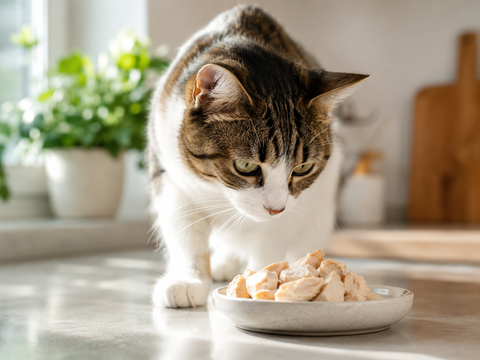
Now pick up a single-ingredient freeze-dried chicken heart.
The pieces aren't perfectly identical.
They shouldn't be.
One began as a formula.
The other began as a chicken heart.
That's a useful starting point for understanding the difference between these two treat categories.
What Is a Freeze-Dried Cat Treat?
Freeze-drying is a preservation method that begins by freezing the food.
Moisture is then removed under controlled conditions through a process called sublimation, where frozen water transitions from ice to vapor.
The result is a lightweight, shelf-stable food that retains much of the original ingredient's shape, structure, and aroma.
Depending on the product, the ingredient list can be remarkably straightforward.
For example:
Instead of constructing a treat from multiple components, freeze-drying can preserve the ingredient itself.
How Are Traditional Cat Treats Different?
"Traditional cat treat" describes a very broad category.
These products may be:
- Baked
- Cooked
- Extruded
- Formulated from multiple ingredients
- Shaped into uniform pieces
A recipe may combine animal proteins with starches, fats, flavoring ingredients, binders, or other components needed to produce the desired texture and consistency.
That doesn't automatically make a traditional treat poor quality.
It simply represents a different approach.
Instead of preserving one whole ingredient, the manufacturer may be building a treat from a recipe.
The Ingredient Lists Can Tell Two Very Different Stories
This is where the distinction becomes especially easy to see.
Imagine comparing two chicken treats.
The first lists chicken along with numerous additional ingredients.
The second says:
Chicken Breast.
Both may legitimately be described as chicken treats.
But they're fundamentally different products.
For pet owners who value ingredient transparency, single-ingredient freeze-dried treats eliminate much of the detective work.
You know what's inside because the ingredient and the treat are essentially the same thing.
The Benefits of Single-Ingredient Freeze-Dried Treats – Raw Paws Pet Food
Texture Is Completely Different
Cats can be remarkably particular about texture.
Traditional crunchy treats often provide a consistent bite from beginning to end.
Freeze-dried foods have a distinctive structure that's typically:
- Lightweight
- Crisp
- Airy
- Easy to break apart
But even within freeze-dried treats, texture varies according to the original ingredient.
Chicken breast doesn't feel exactly like beef liver.
Chicken hearts create another experience.
Whole minnows introduce skin, muscle, and soft bone within the structure of an entire small fish.
That natural variation can make treat rotation more interesting for cats.
Aroma May Be the Biggest Difference Your Cat Notices
Your cat isn't reading the ingredient panel.
They're smelling the bag.
Cats rely heavily on scent when deciding whether food deserves further investigation.
Freeze-dried animal ingredients retain a distinctive natural aroma, which is one reason many cats become interested the moment the package opens.
Beef liver smells different from chicken.
Chicken hearts smell different from minnows.
Each protein creates its own sensory experience without needing to become a completely different recipe.
For selective cats, that can matter enormously.
Freeze-Dried Treats Make Portioning Easy
Cats don't need enormous rewards.
Small pieces are often enough for:
- Training
- Interactive play
- Food puzzles
- Enrichment
- Everyday treating
Many freeze-dried treats can be broken into smaller pieces by hand.
A piece of chicken breast can become several tiny rewards, allowing the treat to remain exciting without turning every successful behavior into a full snack.
This is particularly useful when treats are being used frequently during enrichment or training.
Traditional Treats Can Offer Convenience Too
Freeze-dried treats aren't the only convenient option.
Traditional treats often have advantages of their own.
They're usually easy to portion, widely available, and manufactured to remain highly consistent from piece to piece.
Some cats also simply prefer them.
The goal doesn't need to be declaring one entire category "good" and another "bad."
A more useful approach is understanding what you're buying and deciding whether it fits your priorities.
Where Whole-Food Treats Stand Apart
For pet owners already focused on animal-based nutrition, freeze-dried treats can create a natural extension of that philosophy.
At Raw Paws Pet Food, options such as:
- Freeze-Dried Chicken Breast
- Freeze-Dried Chicken Hearts
- Freeze-Dried Beef Liver
- Freeze-Dried Whole Minnows
keep recognizable animal ingredients at the center of the treat.
That makes them easy to incorporate into a routine built around whole foods, whether they're being offered as rewards or used to add interest to mealtime.
One Important Difference: Treats Aren't Complete Meals
A nutrient-dense ingredient isn't automatically a complete diet.
Freeze-dried beef liver, for example, can make an appealing treat, but liver alone doesn't provide everything a cat requires from its primary diet.
The same applies to chicken breast, hearts, and minnows when they're sold as treats rather than complete and balanced foods.
Treats should complement your cat's complete diet rather than replace it.
That's an important distinction regardless of whether the treat is freeze-dried or traditionally processed.
Which Type Should You Choose?
Instead of asking which category is universally better, consider what matters most to you and your cat.
If you prioritize:
Very simple ingredient lists: Single-ingredient freeze-dried treats may stand out.
Natural variation in texture: Freeze-dried whole foods offer plenty of it.
Uniform size and consistency: Traditional treats often excel here.
Breaking rewards into tiny portions: Many freeze-dried meats make this easy.
Your cat's preferences: The winner is whichever appropriate treat your cat actually enjoys.
There doesn't have to be one answer for every household.
Read the Ingredient List, Then Watch Your Cat
The most useful comparison isn't really:
Freeze-dried vs. traditional.
It's:
What's actually inside each product, how was it made, and does it fit my cat?
Freeze-drying offers something particularly appealing to pet owners who value recognizable foods: it can take an animal ingredient and preserve it without turning it into an entirely different-looking snack.
Traditional treats take a wider range of approaches, from relatively simple recipes to more complex formulations.
Understanding that difference puts you in a much better position to choose.
Then your cat gets the final vote.
And as every cat owner already knows, they're rarely shy about giving it.
Comments (0)
There are no comments for this article. Be the first one to leave a message!