

Pick up two rawhide chews and they may look completely different.
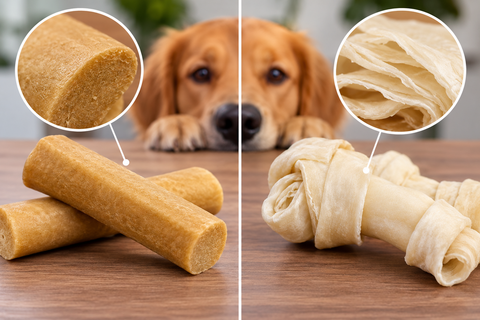
One might be a familiar bone with knots at both ends.
Another could be a tightly formed, solid-looking bone with no visible layers.
Both say rawhide.
So are they basically the same thing?
Not exactly.
Compressed rawhide and regular rawhide begin with the same general type of material, but they're constructed differently.
Traditional rawhide may be rolled, folded, twisted, or knotted into shape. Compressed rawhide takes prepared hide and presses it tightly together to create a dense, solid structure.
That difference in construction affects how the chew feels, how dogs work through it, and how the material changes during a chewing session.
When you're comparing rawhide, the ingredient is only part of the story.
How the chew is built matters too.
First, They're Both Rawhide
Let's start with what these chews have in common.
Rawhide is made from the inner layer of animal hide, most commonly cattle hide.
The hide is cleaned and processed before being formed into a finished dog chew.
From there, manufacturers can take different approaches.
The material may be:
Rolled
Folded
Twisted
Knotted
Compressed
That's why the word rawhide alone doesn't tell you exactly what kind of chew you're buying.
Think of rawhide as the material.
Construction tells you what was done with it.
What Is Regular Rawhide?
"Regular rawhide" isn't one single standardized design.
It's a broad way of describing the traditional rawhide chews many dog owners recognize.
These can include rolled sticks, twists, chips, and classic bone-shaped chews with knots at the ends.
Many are created by forming sheets or pieces of prepared hide into a particular shape.
That construction can create visible layers, folds, seams, or edges throughout the finished chew.
As the dog works on it, saliva gradually softens those areas and changes the texture.
What Is Compressed Rawhide?
Compressed rawhide uses pressure to create a different structure.
Prepared hide material is pressed tightly together into a dense form.
Instead of relying primarily on rolled or folded layers to create the chew, compression packs the hide into a more solid structure.
That gives dogs a different problem to solve.
They have to gradually:
Gnaw.
Scrape.
Soften.
Reposition.
Work through the dense material.
The ingredient category hasn't changed.
The physical construction has.
What Is Compressed Rawhide? Compressed vs. Traditional Rawhide – Raw Paws Pet Food
The Biggest Difference Is Density
If you remember only one thing from this article, make it this:
Compressed rawhide is denser.
Imagine several pieces of material loosely arranged together.
Now imagine taking that same material and pressing it tightly into a solid block.
The second structure requires a different kind of work to break down.
That's the principle behind compressed rawhide.
The dog encounters tightly packed material rather than the more obvious rolled, folded, or layered structure found in many traditional rawhide products.
That density is what creates the characteristic compressed-rawhide chewing experience.
Why Layers Matter During Chewing
Traditional rawhide products can soften as dogs work moisture into the hide.
Depending on how the chew is constructed and how the individual dog chews, layers or pieces may begin separating during use.
Compressed rawhide is designed to reduce the tendency for large layers to separate by pressing the hide tightly together.
That doesn't mean compressed rawhide can never produce loose pieces.
It can.
Dogs should always be supervised, and torn pieces should be removed when appropriate.
Compression changes the structure.
It doesn't eliminate the need to monitor the chew.
They Can Look Different Too
Traditional rawhide often makes its construction relatively obvious.
You may see:
Rolled edges.
Knots.
Folds.
Individual layers.
Compressed rawhide generally has a more solid, uniform appearance because the material has been pressed together.
That visual difference provides a quick clue about how the chew was constructed. But appearance alone doesn't tell you everything.
Sourcing, processing, size, and how the individual dog chews still matter.
How Dogs Work Through Regular Rawhide
With a traditional rawhide chew, a dog may begin working around an edge or end.
Saliva gradually moistens the material.
The hide softens.
The dog continues gnawing and may begin working through individual sections or layers.
Different rawhide shapes encourage different techniques.
A rolled stick behaves differently from a knotted bone.
A chip creates another experience.
That's why even within "regular rawhide," products shouldn't automatically be treated as identical.
How Dogs Work Through Compressed Rawhide
Compressed rawhide generally asks the dog to work through a denser structure.
They may:
Scrape the surface.
Gnaw one section repeatedly.
Allow saliva to soften an area.
Rotate the bone.
Change angles.
Return to a partially softened section.
For dogs that enjoy persistent chewing, this can create an engaging activity because progress happens gradually as the material changes.
The dog isn't simply eating a quick treat.
They're working on a project.
Does Compressed Rawhide Last Longer?
It can provide a longer-lasting chewing experience than some lighter traditional rawhide constructions because of its density.
But no chew-time guarantee applies to every dog.
Duration depends on:
- Size of the rawhide
- Thickness
- Density
- Dog size
- Jaw strength
- Chewing intensity
- Individual technique
A gentle chewer may work on one compressed rawhide bone across multiple sessions.
A determined power chewer may progress much faster.
The construction matters.
The dog still matters more.
What Happens If a Dog Swallows a Piece?
Rawhide behaves differently from highly digestible animal-tissue chews.
Small pieces of rawhide may be swallowed and generally pass through the digestive tract rather than being digested in the same way as a bully stick.
That's one reason the size of separated pieces matters.
With Raw Paws compressed rawhide, the dense construction is designed to reduce large pieces separating compared with less densely constructed rawhide, but supervision is still required.
If pieces become torn, remove them.
And take the chew away once it becomes too small for your dog to continue working on appropriately.
Compressed Doesn't Mean Indestructible
This is an important misconception.
A compressed rawhide chew may be dense.
It's still meant to change as your dog works through it.
The surface softens.
Material wears away.
The chew becomes smaller.
Eventually, the session needs to end.
"Compressed" describes the construction.
It doesn't mean the product is designed to remain permanently intact.
Which Is Better for Power Chewers?
A power chewer may appreciate the density of compressed rawhide, but no category is automatically appropriate for every aggressive chewer.
Watch how your dog interacts with the product.
Does the dog gnaw gradually?
Or immediately attempt to tear and swallow substantial pieces?
Does the chew remain manageable?
Does your dog work methodically or aggressively?
Those behaviors should influence whether a particular rawhide construction is appropriate for that individual dog.
The dog's chewing style matters just as much as the product's density.
Which Is Better for Gentle Chewers?
Gentle chewers may enjoy either style.
A traditional rolled rawhide may provide plenty of chewing activity for a dog that slowly works through treats.
A compressed rawhide chew may last considerably longer because that same dog takes more time to make progress through the dense structure.
Again, the goal isn't automatically maximizing duration.
It's providing an appropriately sized chew that creates a satisfying experience.
Supervision Matters With Both
Whether you choose regular or compressed rawhide, supervision should be part of every chewing session.
Watch for:
- Pieces separating
- Changes in chew size
- Attempts to swallow large portions
- Excessively aggressive chewing
- Any change that makes the product unsuitable for continued use
With compressed rawhide, remove torn pieces and take the chew away once it becomes too small for continued appropriate chewing.
No construction method makes rawhide a completely hands-off product.
Rawhide Isn't One Single Chew
This is ultimately the most useful takeaway.
"Rawhide" describes a broad category.
Within that category, construction can create very different products.
Regular Rawhide: Often rolled, folded, twisted, knotted, or layered.
Compressed Rawhide: Prepared hide pressed tightly together to create a dense structure.
Both begin with animal hide.
But once the dog starts chewing, the difference in construction becomes much easier to understand.
So when you're comparing rawhide chews, don't stop at the ingredient.
Look at the structure.
Because two products can both say rawhide on the package and still give your dog very different things to chew.
Comments (0)
There are no comments for this article. Be the first one to leave a message!