


You've probably seen it a hundred times.
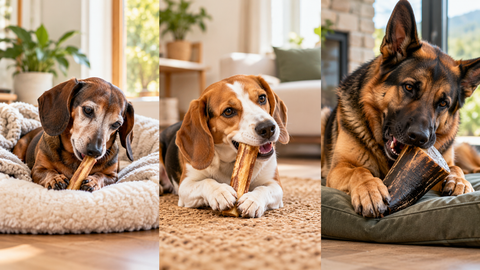
Your dog gets a bully stick, carries it to their favorite spot, lies down, and carefully positions it between their front paws.
One paw holds the chew steady.
The other adjusts the angle.
Then the chewing begins.
Sometimes they look almost like they're holding a tiny tool.
And in a way, they are.
Dogs use their front paws to stabilize, manipulate, and control objects while chewing.
That familiar behavior isn't random. It reflects how dogs coordinate their mouths, paws, and body position to interact with food and other objects.
But there's more to it than simply keeping a bully stick from rolling away.
The way your dog holds a chew can reveal useful information about their chewing style, comfort, and how well the product fits their needs.
Let's take a closer look.
Dogs Don't Have Hands—But Their Paws Help
Humans use their hands to hold food while taking bites.
Dogs rely primarily on their mouths. But their front paws can assist by keeping objects stable.
When a dog places a chew between their paws, they're creating a more controlled chewing position.
Instead of chasing the chew across the floor every time they apply pressure, they can hold it in place.
That makes it easier to:
- Apply controlled chewing pressure
- Adjust the position of the chew
- Work different sections
- Prevent the object from sliding
- Maintain a comfortable body position
It's a practical behavior that helps dogs interact with objects more efficiently.
Why Dogs Often Lie Down to Chew
Notice how many dogs settle into a lying position before beginning a serious chewing session.
There's a practical reason.
When lying down, dogs can use their front legs and paws to stabilize a chew while their head and jaw do the work.
That creates a relatively steady position for longer activities.
A dog standing with a chew may need to reposition frequently.
A dog lying comfortably can often maintain better control.
That's one reason you may see your dog carry a bully stick or collagen stick to a favorite resting spot before getting started.
They're setting up their workspace.
Paw Positioning Helps Dogs Create Leverage
Chewing involves more than repeatedly opening and closing the mouth.
Dogs often adjust the angle of an object to make it easier to work through.
Their paws help with that process.
For example, your dog may hold one end of a bully stick against the floor while positioning the other end between their back teeth.
That gives them greater control over the chewing angle.
If the chew moves, they reposition it.
If one section becomes softer, they may turn it around.
The paws and mouth work together.
Paw positioning is part of how dogs manage the physical challenge of chewing.
Why Dogs Rotate Their Chews
Watch your dog for a few minutes and you may notice how frequently they turn a chew.
One end.
Then the other.
A different side.
Back to the original section.
Why?
Because natural chews don't have identical surfaces throughout.
A bully stick may vary slightly in thickness.
A beef cheek roll has different edges and layers.
An ear has a broad, irregular shape.
Rotating allows dogs to investigate and work different sections.
Their paws help make those adjustments possible.
Different Chew Shapes Encourage Different Paw Movements
This is where the behavior becomes especially interesting.
A dog doesn't necessarily hold every chew the same way.
Bully Sticks: Their narrow shape allows dogs to grip or brace the stick between their paws.
Collagen Sticks: Another stick-shaped product that encourages focused positioning.
Beef Cheek Rolls: Their broader structure may require more repositioning and bracing.
Cow Ears: Their flat shape can encourage dogs to hold down an edge while chewing another section.
Lamb Ears: A smaller ear-style chew that may be easier for some dogs to manipulate.
The shape of the chew influences how the dog physically interacts with it.
That variety can be part of what makes rotating natural chews interesting.
Why Some Dogs Use One Paw More Than the Other
Have you noticed your dog consistently holding a chew with one paw while the other does most of the adjusting?
Dogs can show preferences for using one front paw over the other.
Researchers have studied paw preference in dogs during tasks involving food and objects.
However, paw preference isn't necessarily as consistent or strongly expressed as handedness in humans.
Some dogs favor one paw.
Others switch depending on the task.
And some use both paws equally.
So if your dog seems to have a favorite paw for holding bully sticks, it may reflect an individual preference rather than anything unusual.
Is Your Dog Left-Pawed or Right-Pawed?
This can be a fun behavior to observe.
Next time your dog receives an appropriate chew, watch which paw they use first.
Do they:
Hold the chew with the left paw?
Brace it with the right?
Switch paws repeatedly?
Use both paws together?
Try observing across several different sessions rather than drawing conclusions from one moment.
A dog may use different paws depending on the chew's shape, position, or how they're lying.
The interesting part isn't proving that your dog is permanently left- or right-pawed.
It's noticing how they solve the physical challenge.
Why Dogs Sometimes Hold Chews Upright
Some dogs seem particularly skilled at holding a chew almost vertically between their front paws.
This can be especially noticeable with bully sticks.
The upright position may make it easier to work one end while keeping the rest of the chew stabilized.
Your dog can adjust the angle by moving their paws slightly rather than dropping the entire object.
For stick-shaped chews, that can be a convenient position.
Of course, not every dog does this.
Some prefer holding the chew flat.
Others rotate it constantly.
Different techniques can accomplish the same basic goal.
What Paw Positioning Tells You About Chew Size
This is one of the most useful things owners can learn from watching.
If your dog can comfortably hold, stabilize, and reposition a chew, that's helpful information about how manageable the product is.
But if the chew constantly slips away, seems difficult to grip, or requires awkward positioning, its size or shape may not be ideal.
For example:
A small dog may struggle to manipulate an oversized beef cheek roll.
A large dog may find a very short bully stick difficult to hold safely as it becomes smaller.
Appropriate chew sizing isn't just about whether the dog can fit it in their mouth. It's also about whether they can manage it throughout the session.
What If Your Dog Doesn't Use Their Paws?
Not every dog holds chews between their paws.
Some prefer chewing while standing.
Others hold the product primarily with their mouth.
Some brace a chew against the floor or another surface.
Those differences can reflect individual preferences, body position, mobility, and the type of object being chewed.
A dog doesn't need to use their paws to enjoy an appropriate chew.
The important thing is whether they're interacting comfortably and safely.
Paw Positioning Can Reveal Chewing Style
Watch how your dog approaches a natural chew.
A gentle chewer may carefully stabilize the product and nibble around the edges.
A moderate chewer may hold it firmly while making steady progress.
A persistent chewer may rotate and reposition the object repeatedly.
A power chewer may use their paws to create leverage while applying substantial jaw pressure.
These aren't rigid behavioral categories, but they can help you understand your dog's individual technique.
That information becomes useful when choosing future chews.
Why Some Dogs Push Chews Against Furniture
Not every dog uses only their paws.
Some brace chews against:
Furniture.
The floor.
A favorite bed.
Other stable surfaces.
This may help prevent the object from moving while they chew.
However, owners should pay attention to where the activity takes place.
A chew becoming wedged under furniture or pressed against an unstable object can create frustration or other concerns.
A comfortable, open, easy-to-clean chewing area is generally preferable.
Does Holding a Chew Mean Your Dog Is Enjoying It?
Often, a dog that settles down and begins working on a chew is showing interest in the activity.
But paw positioning alone doesn't prove enjoyment.
Look at the bigger picture.
Does your dog appear relaxed?
Do they voluntarily return to the chew?
Are they making steady progress?
Do they seem comfortable?
Or are they struggling to position it, repeatedly dropping it, or showing signs of discomfort?
Behavior is most useful when interpreted as a whole.
One paw movement doesn't tell the entire story.
Chewing Is Also a Form of Physical Enrichment
We often talk about enrichment as something involving puzzles or training.
But manipulating a chew can also provide a physical activity.
Your dog has to coordinate:
Paws.
Mouth.
Jaw movements.
Body position.
Object rotation.
That interaction can make natural chewing more engaging than simply swallowing a treat.
The chew becomes something your dog actively works with.
Different shapes and textures can create different manipulation challenges.
Why Chew Rotation Can Change the Experience
Imagine offering the same stick-shaped chew every time.
Your dog becomes familiar with how to hold it.
Where to begin. How to position it.
Now introduce a different shape.
A broad cow ear.
A substantial beef cheek roll.
A smaller lamb ear.
Your dog may need to adjust their technique.
That's one reason a varied natural chew rotation can introduce enrichment beyond simply changing flavor.
What If Your Dog Suddenly Stops Holding Chews Normally?
Changes in chewing behavior deserve attention.
If your dog previously held and chewed products comfortably but suddenly begins:
Dropping chews repeatedly.
Favoring one side of the mouth.
Avoiding firm foods.
Pawing at the mouth.
Showing discomfort while chewing.
there may be an underlying dental or oral-health concern.
Discontinue the chew and contact your veterinarian.
Changes in paw use or posture can also reflect discomfort or mobility problems, particularly in older dogs.
A sudden change is more meaningful than a harmless long-standing preference.
Watch for the Final Piece
As an edible chew becomes smaller, your dog may have less material available to hold between their paws.
That's an important point.
A bully stick that was easy to stabilize when it was twelve inches long may become difficult to manage as it shrinks.
Eventually, the remaining portion may be small enough for your dog to attempt to swallow whole.
Remove it before that happens.
Don't assume the chew remains appropriate simply because your dog is still interested.
When Should You Take a Bully Stick Away From Your Dog? – Raw Paws Pet Food
Let Your Dog's Paws Help You Choose
At Raw Paws Pet Food, our natural chew collection includes bully sticks, collagen sticks, beef cheek rolls, cow ears, lamb ears, and other animal-based options.
Each offers a different shape, texture, and physical experience.
But choosing the right chew isn't simply about what the product looks like.
It's about how your dog interacts with it.
Watch how they hold it.
Notice whether they rotate it.
Pay attention to how comfortably they work through different sections.
Choose an appropriate size.
Supervise every session.
And remember that the best chew isn't necessarily the one that lasts the longest.
It's the one your dog can comfortably manage and genuinely enjoy.
Because the next time you see your dog carefully holding a bully stick between their paws, you're watching more than a cute habit.
You're watching your dog use their body to solve a small, everyday problem—and enjoy the process along the way.
Comments (0)
There are no comments for this article. Be the first one to leave a message!