

Your dog has been happily working on a yak chew.
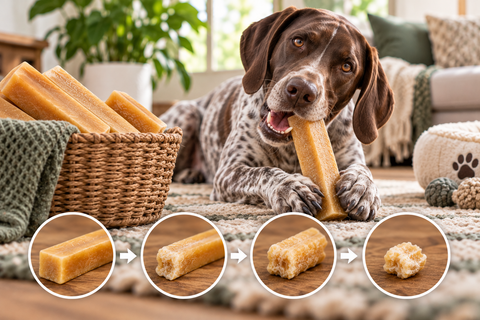
What started as a substantial, solid chew has gradually become smaller.
The edges are worn down.
The shape has changed.
And now you're wondering:
Is it time to take this away?
It's an important question because yak chews are different from many other natural dog chews.
They're made from hardened, milk-based ingredients and are known for their dense, firm texture.
That structure can provide a longer-lasting chewing experience, but it also means owners need to pay attention to how the chew changes during use.
So, when should you take a yak chew away from your dog?
Remove a yak chew before it becomes small enough for your dog to swallow whole, if it breaks into large or sharp pieces, or if your dog begins chewing in a way that could damage their teeth.
The right time depends on your dog's size, chewing behavior, and the condition of the chew—not simply how many minutes they've been working on it.
Why Yak Chews Need Special Attention
Yak chews, also called Himalayan dog chews, are traditionally made from milk that's processed into a dense, hardened cheese.
Unlike softer animal-tissue chews, yak chews are particularly firm.
Dogs often work through them by:
- Gnawing
- Scraping
- Wearing down edges
- Rotating the chew
- Repeatedly working the same area
That hardness is one reason yak chews can last a long time.
But it also introduces considerations that don't apply in exactly the same way to softer chews.
The chew can become smaller.
Pieces can break away.
And some dogs may bite down too forcefully on the hard material.
That's why supervision matters from the first bite to the last.
The Most Important Rule: Don't Let the Final Piece Become a Swallowing Hazard
As a yak chew gets smaller, your dog has less material available to hold between their paws.
Eventually, the remaining piece may become small enough to fit entirely inside their mouth.
That's when the risk of swallowing it whole becomes more concerning.
A large piece of hardened cheese can create choking or gastrointestinal obstruction risks if swallowed without being adequately chewed.
Don't wait until your dog attempts to gulp the remaining piece.
Remove it before that happens.
Is There a Specific Size When You Should Take It Away?
There's no single measurement that's appropriate for every dog.
A piece that appears substantial beside a Chihuahua may be easy for a Labrador to swallow.
The right decision depends on:
- Dog size
- Mouth size
- Chewing style
- Shape of the remaining piece
- Whether your dog tends to gulp treats
Instead of relying on one universal number of inches, ask:
Could my dog reasonably attempt to swallow this remaining piece whole?
If the answer is yes—or you're unsure—the chewing session should end.
Watch for Cracks and Broken Pieces
Yak chews are hard, but they're not indestructible.
Depending on how your dog chews, the material may occasionally crack or break.
Inspect the chew during use.
Look for:
Visible cracks.
Large pieces separating.
Sharp edges.
Fragments your dog could attempt to swallow.
If a substantial piece breaks away, remove it.
Don't assume a broken piece is safe simply because it came from an edible chew.
Size and shape still matter.
Hardness Can Be a Dental Concern
This is one of the most important differences between yak chews and softer natural chews.
Yak chews are extremely firm.
A dog that aggressively bites down on hard objects may risk tooth damage, including fractures.
That means a yak chew can become inappropriate even when it's still large.
The chew doesn't have to be almost finished before you have a reason to remove it.
If your dog is attempting to crack the chew with forceful bites rather than gradually gnawing the surface, stop the session.
A softer, more forgiving chew may be a better choice.
Know the Difference Between Gnawing and Crushing
Watch your dog's technique.
A dog that's gradually scraping and gnawing the surface is interacting differently from one that's repeatedly clamping down in an attempt to snap the chew.
With yak chews, that distinction matters.
Gradual gnawing: The dog slowly wears down the surface.
Forceful crushing: The dog attempts to break the hard chew apart using significant bite pressure.
Forceful crushing creates greater concern for dental injury.
If your dog consistently approaches yak chews this way, consider choosing a different type of chew.
What If Your Dog Has Dental Problems?
Dogs with existing dental disease, damaged teeth, worn teeth, or previous tooth fractures may be poor candidates for very hard chews.
Even dogs with apparently healthy teeth can fracture a tooth on sufficiently hard material.
If your dog has a history of dental problems, ask your veterinarian whether yak chews are appropriate.
And if your dog suddenly stops chewing, cries out, paws at the mouth, or shows discomfort, remove the chew and contact your veterinarian.
Chewing should be enjoyable—not painful.
Power Chewers Need Extra Supervision
It's tempting to assume power chewers are the perfect candidates for yak chews.
After all, they finish softer products quickly.
But power chewing doesn't automatically mean a dog should receive the hardest chew available.
A dog that aggressively crushes chews may face greater dental risk with extremely rigid products.
For these dogs, a thicker bully stick, appropriately sized collagen stick, or another less rigid chew may provide a more suitable experience.
The goal isn't finding something your dog can't break.
It's finding something they can enjoy appropriately.
When the Yak Chew Becomes Too Small, Don't Try to Save One More Bite
This is where owners sometimes hesitate.
The chew still has material left.
Your dog is still interested.
And throwing away the final piece can feel wasteful.
But the purpose of the chew isn't making sure every last bit gets consumed.
It's providing a satisfying activity.
If the remaining piece has become a swallowing concern, the session is finished.
Your dog may disagree.
That doesn't make the decision wrong.
Can You Microwave the Leftover Yak Chew?
Some yak-chew manufacturers recommend turning suitable leftover pieces into puffed treats using a microwave.
The process involves heating the remaining cheese material so it expands into a lighter, crunchy texture.
However, not every yak chew should automatically be microwaved.
Only use this method if the specific manufacturer's instructions permit it.
Follow those directions carefully, allow the puffed piece to cool completely, and inspect it before offering it to your dog.
If the leftover piece is unsuitable for puffing or the product doesn't provide instructions, discard it.
Never microwave the chew simply by guessing at a heating time.
Why Does Puffing Change the Texture?
A traditional yak chew is dense and hard because of how the milk-based material is processed and dried.
When a compatible piece is heated according to the manufacturer's instructions, it may expand into a porous, puffed structure.
That creates a different texture from the original hard chew.
Instead of persistent gnawing, the puffed treat generally provides a lighter, crunchier experience.
But the finished piece still needs to be appropriately sized and offered under supervision.
Puffing isn't a guarantee against choking or other risks.
Should You Take a Yak Chew Away After a Certain Number of Minutes?
Not necessarily.
There's no universal chewing-session duration that makes yak chews appropriate for every dog.
Some dogs may enjoy short sessions.
Others may remain interested longer.
What matters more is the dog's behavior and the condition of the chew.
If your dog is gradually gnawing without concerning changes, the activity may continue under supervision.
If they begin forcefully crushing the chew, show discomfort, or the product becomes damaged, end the session regardless of how little time has passed.
Condition and behavior matter more than the clock.
Can You Save a Yak Chew for Another Day?
If the chew remains appropriately sized, undamaged, and suitable for reuse, it may be possible to offer it during another supervised session.
Follow the manufacturer's storage and handling directions.
Before reintroducing it, inspect the chew for:
- Cracks
- Sharp edges
- Loose fragments
- Changes in condition
- An undersized remaining portion
A chew that was appropriate yesterday isn't automatically appropriate today.
Its size and condition may have changed.
What If Your Dog Doesn't Want to Give It Back?
Yak chews can be highly valued by dogs.
Some may become reluctant to surrender one.
Avoid grabbing the chew unexpectedly or trying to pull it directly from your dog's mouth.
Instead, teach a positive trade behavior.
Offer an appropriate high-value reward in exchange for the chew, then calmly remove it.
Practice trading during low-pressure situations so your dog learns that giving up an object can lead to something positive.
If your dog displays resource guarding or aggression, work with a qualified behavior professional rather than forcing removal.
What If My Dog Swallows a Large Piece?
If your dog swallows a substantial piece of yak chew, contact your veterinarian promptly for guidance, even if your dog initially appears comfortable.
Large swallowed pieces can create choking or gastrointestinal obstruction concerns.
Signs that require urgent veterinary attention include:
- Difficulty breathing
- Repeated gagging or choking
- Persistent vomiting or retching
- Abdominal pain
- Unusual lethargy
- Difficulty passing stool
If your dog is having trouble breathing, seek emergency veterinary care immediately.
Don't attempt to induce vomiting unless a veterinarian specifically instructs you to do so.
How to Choose a Yak Chew That's Easier to Manage
Appropriate sizing can help reduce some chewing concerns.
At Raw Paws Pet Food, yak chews are available in Small, Medium, Large, and Extra-Large sizes.
When choosing, consider:
Body Size: Is the chew appropriate for your dog's overall size?
Mouth Size: Can your dog comfortably hold and manipulate it without easily swallowing it whole?
Chewing Style: Does your dog gnaw gradually or attempt to crush hard objects?
Dental Health: Are your dog's teeth suitable for this level of hardness?
Experience: Has your dog safely handled similar firm chews before?
If you're uncertain about hardness or dental suitability, your veterinarian can help you choose a more appropriate option.
What Are Some Alternatives to Yak Chews?
If your dog enjoys chewing but doesn't handle very hard products appropriately, consider alternatives with different textures.
Bully Sticks: Beef-pizzle chews that gradually soften during use.
Collagen Sticks: Edible collagen-rich chews with a different structure.
Beef Cheek Rolls: Broad rolled chews that create a more substantial chewing project.
Cow Ears: Lighter, crunchy natural chews.
Different chews provide different levels of resistance.
The hardest option isn't necessarily the most appropriate.
Dog Chew Types Explained: Bully Sticks, Rawhide, Collagen & More – Raw Paws Pet Food
The Best Yak Chew Session Has a Clear Ending
It's easy to focus on how long a yak chew lasts.
But responsible chewing also means knowing when the activity should stop.
A yak chew may provide several enjoyable sessions.
It may gradually wear down over time.
Eventually, though, the remaining piece becomes too small, damaged, or otherwise unsuitable for continued use.
That's when the owner needs to step in.
Not because the dog has stopped enjoying it.
Because the chewing experience has reached its appropriate ending point.
Know When to Take the Chew Away
So, when should you take a yak chew away from your dog?
Before the remaining piece becomes small enough to swallow whole, whenever substantial or sharp pieces break away, or when your dog begins chewing in a way that raises dental concerns.
At Raw Paws, we offer yak chews as part of our natural chew collection because they provide a distinctive, dense milk-based chewing experience.
But that experience should always be matched to the individual dog.
Choose an appropriate size.
Supervise every session.
Watch for cracks and changes in shape.
Pay attention to how forcefully your dog bites.
And remove the chew when necessary.
Because a great natural chew isn't defined by whether your dog finishes every last piece.
It's defined by providing an enjoyable chewing experience while knowing when it's time to stop.
Comments (0)
There are no comments for this article. Be the first one to leave a message!