

Indoor cats have everything they need.
But do they have enough to do?
That's the question at the heart of cat enrichment.
A cat living outdoors encounters an environment that's constantly changing. Birds move. Insects appear. New scents travel through the air. There are places to climb, surfaces to scratch, objects to investigate, and potential prey to watch.
Indoor life is much more predictable.
That's safer—but it also means we become responsible for creating opportunities that allow cats to express the behaviors that come naturally to them.
The good news?
Cat enrichment doesn't require turning your home into an amusement park.
Some of the best activities are incredibly simple.
Here are 15 ways to make your indoor cat's world more interesting.
1. Make the Wand Toy Act Like Prey
Owning a wand toy and knowing how to use one are two different things.
Instead of continuously waving it in your cat's face, make it behave like something they might actually hunt.
Drag it away.
Let it disappear behind furniture.
Pause.
Move slowly.
Suddenly dart across the floor.
Give your cat time to watch and stalk before encouraging the chase.
The anticipation is part of the activity.
And most importantly?
Let your cat catch it occasionally.
A hunt that's impossible to win eventually becomes a pretty disappointing game.
2. Create a Treat Hunt
Instead of handing your cat every treat, make a few of them worth finding.
Break appropriate treats into small pieces and hide them in easy locations around a safe room.
Start somewhere obvious.
As your cat learns the game, make the hiding places slightly more challenging.
At Raw Paws Pet Food, single-ingredient options such as Freeze-Dried Chicken Breast, Chicken Hearts, Beef Liver, and Whole Minnows can be broken into smaller rewards for supervised food-search activities.
Now one treat becomes several discoveries.
3. Build Up, Not Just Out
Your floor isn't the only usable space in your house.
Cats often love height.
Cat trees, shelves, window perches, and other appropriate climbing areas allow indoor cats to move vertically while observing their surroundings from different perspectives.
A small room can feel considerably larger when your cat can use three dimensions instead of two.
Vertical spaces also create choices.
And cats tend to appreciate having options.
4. Give Them More Than One Scratching Texture
One scratching post doesn't necessarily satisfy every cat.
Some prefer scratching vertically.
Others stretch across horizontal cardboard.
Some enjoy sisal.
Others gravitate toward different textures.
Experiment with scratching surfaces in multiple locations and orientations.
Scratching isn't bad behavior that needs to disappear.
It's normal feline behavior that needs an appropriate destination.
5. Rotate Toys Instead of Buying More
Your cat may not need another toy.
They may need to forget about the ones they already have.
Leave a few toys available and put the others away.
Several days later, swap them.
That toy mouse your cat ignored last week can suddenly become interesting when it reappears after an absence.
Toy rotation creates novelty without turning your house into a pet store.
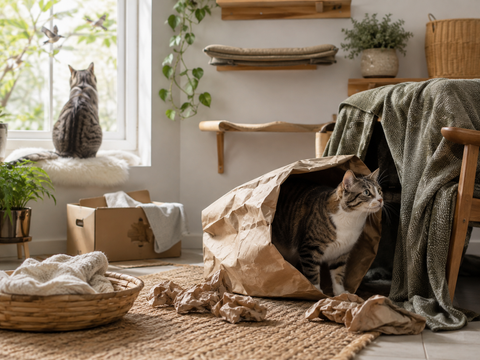
6. Turn a Cardboard Box Into an Event
Cats have spent years proving that the cardboard box is often more interesting than whatever expensive product arrived inside it.
Use that to your advantage.
Try:
- Different box sizes
- Boxes with openings cut into the sides
- Paper packing material to investigate
- Multiple boxes arranged together
- A toy occasionally disappearing behind the box
Boxes provide hiding, observation, exploration, and play opportunities with almost no effort.
Sometimes enrichment arrives with free shipping.
7. Create a Window-Watching Station
For many indoor cats, a good window is basically television.
Birds.
People.
Leaves.
Squirrels.
Changing weather.
Providing a comfortable perch near a secure window creates passive enrichment that can remain interesting for long periods without requiring direct participation from you.
Just make sure windows and screens are secure.
Your cat should be watching the outdoor world—not unexpectedly joining it.
8. Use Food Puzzles
A bowl provides food immediately.
A puzzle creates a problem first.
Food puzzles encourage cats to manipulate objects, use their paws, investigate openings, and figure out how to access a reward.
Start easy.
If the puzzle is immediately frustrating, your cat may simply walk away.
Once they understand the concept, gradually increase the challenge.
The goal isn't making food difficult to obtain.
It's making part of the feeding experience mentally interesting.
9. Finish Play With a Small Food Reward
Interactive play and food enrichment can work together.
Try a short hunting-style sequence:
Watch → Stalk → Chase → Pounce → Catch
Then finish with a small animal-based reward.
A piece of freeze-dried chicken heart or whole minnow can provide a satisfying conclusion to the activity.
The treat isn't the entire enrichment session.
It's the ending.
10. Teach Your Cat Something
Training isn't just for dogs.
Cats can learn behaviors through positive reinforcement too.
Try simple skills such as:
- Coming when called
- Touching a target
- Entering a carrier
- Sitting in a designated spot
- Following a hand target
Keep sessions short and rewards small.
Training gives cats something especially valuable:
A problem they can figure out.
11. Create Safe Hiding Places
Enrichment isn't always about activity.
Sometimes it's about choice.
Cats naturally seek protected areas where they can observe without feeling exposed.
Covered beds, tunnels, boxes, and appropriate furniture arrangements can provide places to retreat.
A good environment allows a cat to choose between:
Engaging with the household
and
Watching the household from somewhere they feel comfortable.
Both are valuable.
12. Make Ordinary Objects Interesting
You don't need specialized equipment for every enrichment activity.
Safe household objects can create novelty.
Paper bags with handles removed.
Cardboard tubes.
Boxes.
Packing paper.
A blanket arranged into a tunnel.
The key is supervision and safety.
Avoid anything your cat could become trapped in, ingest, or become tangled around.
Simple doesn't mean careless.
But simple can be incredibly effective.
13. Change Where the Game Happens
Cats notice changes in location.
A toy that's boring in the middle of the living room may suddenly become fascinating when it disappears around a doorway.
Try moving play sessions between:
- Hallways
- Cat trees
- Safe stair areas
- Different rooms
- Boxes and tunnels
Changing the environment creates novelty without changing the toy.
Sometimes the easiest way to make an old game interesting is to give it a new stage.
14. Let Your Cat Use Their Nose
Cats aren't only visual hunters.
Scent plays an important role in how they investigate their environment and evaluate food.
Food-search games encourage cats to sniff and explore rather than simply waiting beside the bowl.
Try hiding a few small freeze-dried treats in safe, accessible locations.
Start with places your cat can easily discover.
Then gradually increase the challenge.
The search becomes part of the reward.
15. Schedule Short Play Sessions Instead of One Giant One
You don't need an hour-long feline workout every evening.
Cats often engage naturally in shorter bursts.
Try several brief opportunities throughout the day.
Morning: Five to ten minutes of wand play.
Afternoon: Food puzzle or independent enrichment.
Evening: Another interactive hunting game.
Before bed: Short treat search or play session.
This approach fits feline activity patterns while making enrichment much easier to maintain consistently.
The Secret Isn't More Stuff—It's More Experiences
This is where indoor cat enrichment often gets misunderstood.
You don't need:
Thirty toys.
Five cat trees.
A new puzzle every week.
An entire room dedicated to your cat.
You need opportunities for different behaviors.
Think about enrichment as a checklist of experiences:
Can my cat climb?
Can they scratch?
Can they hide?
Can they watch?
Can they stalk?
Can they chase?
Can they catch?
Can they search?
Can they solve something?
Can they explore something new?
If the answer is yes across several of those categories, you're already building a much richer indoor environment.
Follow Your Cat's Interests
Not every enrichment idea will become a hit.
One cat may spend twenty minutes solving a food puzzle.
Another looks at it once and walks away.
One cat loves climbing.
Another prefers staying close to the ground and stalking from behind furniture.
One cat goes wild for Whole Minnows.
Another considers Chicken Hearts the greatest invention in feline history.
That's useful information.
Enrichment works best when it reflects the individual cat rather than a generic checklist.
Pay attention to what repeatedly captures their interest.
Then create more opportunities for those behaviors.
Make Enrichment Part of Everyday Life
The best enrichment routine isn't the most elaborate one.
It's the one you actually maintain.
Five minutes of interactive play every morning is valuable because it happens consistently.
Rotating toys takes seconds.
Hiding several freeze-dried treats turns an ordinary reward into an activity.
Opening a cardboard box creates a new environment to investigate.
Moving a perch near a secure window creates hours of changing visual stimulation.
Small changes can make an indoor cat's world feel considerably bigger.
Because enrichment isn't really about keeping cats entertained.
It's about giving them opportunities to behave like cats.
And once you start looking at your home through that lens, enrichment opportunities are almost everywhere.

Comments (0)
There are no comments for this article. Be the first one to leave a message!