

Open the average cat owner's toy basket and you'll probably find a familiar scene.
Balls nobody touches.
Toy mice that haven't moved in months.
A feather wand that was fascinating for three days.
And somewhere nearby?
Your cat is sitting inside the cardboard box everything arrived in. \
There's a useful lesson hiding in that box.
Cat enrichment isn't really about owning more toys.
It's about creating more opportunities to explore, hunt, climb, scratch, search, observe, and solve problems.
In fact, some of the best ways to enrich an indoor cat's life don't require buying anything new.
Before adding another toy to the basket, try changing the world your cat already has.
Move Something
This sounds almost too simple.
Take something familiar and put it somewhere unexpected.
Move a cardboard box into another room.
Place a cat tunnel at a different angle.
Relocate a scratching pad.
Create a new blanket hideaway.
Cats notice environmental changes that humans barely register.
An object your cat stopped investigating months ago can suddenly become interesting simply because it appears somewhere new.
You haven't added anything.
You've created novelty.
Bring Back the Toys They've Forgotten
If every toy your cat owns is permanently available, none of them ever really feels new.
Try putting most toys away.
Leave only a small selection accessible.
After several days, swap them.
The toy mouse that's been hidden in a closet for two weeks may suddenly deserve another investigation when it returns.
Toy rotation creates novelty through absence.
It's one of the easiest enrichment strategies available—and it costs absolutely nothing.
Turn a Cardboard Box Into Something New
Before recycling your next delivery box, give your cat first refusal.
A cardboard box can become:
A hiding place.
A lookout.
A tunnel.
A stalking location.
A place to nap.
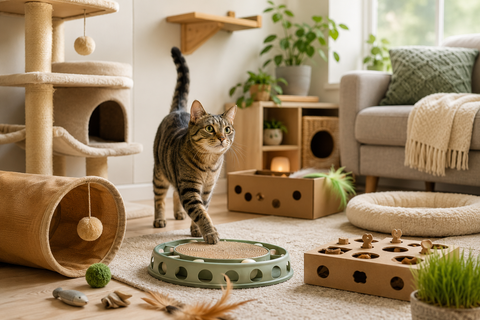
Cut a few appropriately sized openings into the sides and suddenly the box becomes even more interactive.
Move a wand toy past one of the openings and you've created a hunting game.
One box can provide more behavioral opportunities than many toys because your cat gets to decide what it's for.
Stop Giving Every Treat Away for Free
Your cat can still have the treat.
Just make finding it part of the experience.
Break an appropriate treat into small pieces and hide them in easy, safe locations.
Try:
Behind a chair leg.
On an accessible level of the cat tree.
Near a familiar scratching area.
Inside an easy food puzzle you already own.
As your cat understands the game, make the hiding spots slightly more challenging.
At Raw Paws Pet Food, single-ingredient treats such as Freeze-Dried Chicken Breast, Chicken Hearts, Beef Liver, and Whole Minnows can be portioned into small rewards for supervised searching activities.
Same treat.
Completely different experience.
Make Dinner Take a Different Route
Food doesn't always need to travel directly from container to bowl.
If appropriate for the food you're serving, divide part of the meal between several feeding locations or use an enrichment feeder your cat already knows how to use.
The goal isn't making your cat struggle to eat. It's introducing a little exploration into something that normally happens automatically.
Food can provide nutrition and still become part of enrichment.
Those two ideas don't have to compete.
Rearrange the View
Your cat may spend hours looking out the window. That's enrichment.
Outdoor movement provides constantly changing visual information:
Birds.
Squirrels.
Leaves.
People.
Cars.
Weather.
If your cat already has a secure window available, consider whether there's a comfortable place to watch from.
Sometimes moving existing furniture or a cat tree closer to a secure window creates an entirely new observation station without purchasing anything.
A better view can be more valuable than another toy.
Use the Furniture You Already Own
Cats experience rooms vertically as well as horizontally.
A chair isn't just a chair.
It can be a step toward another perch.
A couch can become a stalking barrier.
A table can create a hiding space underneath.
Look around your home from your cat's perspective.
Where can they safely:
- Climb?
- Hide?
- Observe?
- Move between heights?
- Watch household activity?
You may already have more enrichment infrastructure than you realize.
Make Wand Play Less Predictable
You don't necessarily need a new interactive toy.
You may just need to make the old one behave differently.
Instead of waving a wand continuously in front of your cat, make it act more like prey.
Move it away.
Hide it behind furniture.
Pause.
Let your cat watch.
Move slowly.
Then suddenly dart away.
Allow stalking time before the chase.
And let your cat successfully catch the toy throughout the session.
Teach a Skill
Your cat's brain is an enrichment tool too.
Cats can learn through positive reinforcement.
Try teaching simple behaviors such as:
- Coming when called
- Touching your hand
- Entering the carrier
- Going to a particular spot
- Following a target
Keep sessions short.
Use tiny rewards.
Stop while your cat is still interested.
Training provides something toys alone can't:
A challenge that changes as your cat learns.
Build a Blanket Fort
You don't need specialized cat furniture to create temporary exploration spaces.
A blanket draped safely over existing furniture can create a new hideaway or tunnel.
Move it somewhere different next week.
The temporary nature is part of what makes it interesting.
Permanent objects become familiar.
Temporary environments create questions.
What's under there?
Can I go inside?
What's on the other side?
Curiosity is enrichment.
Let Your Cat Sniff Something New
Enrichment isn't exclusively visual.
Cats investigate through scent too.
Safe environmental changes can provide new smells to explore, whether that's a cardboard package from another part of the house or an appropriate food-search activity using an aromatic animal-based treat.
Food can be especially useful because different proteins naturally smell different.
Chicken heart doesn't smell like beef liver.
Beef liver doesn't smell like fish.
Rotating appropriate treats can create sensory variety without requiring another object in the toy basket.
Use Different Rooms
Playtime doesn't always have to happen in the same place.
Take the familiar wand toy into the hallway.
Use a box in another room.
Create a treat search somewhere different.
Changing location alters the experience even when the activity stays exactly the same.
A toy moving around a doorway behaves differently from one moving across an open living-room floor.
Environment changes the game.
Let Your Cat Watch You
Not all enrichment requires direct participation.
Cats often spend considerable time simply observing household activity.
Cooking.
Folding laundry.
Opening packages.
Working at a desk.
Instead of assuming a cat that's watching is doing nothing, recognize observation as part of how they gather information about their environment.
Give them safe places to watch from.
Sometimes being included is enrichment.
Use Play and Food Together
Try creating a simple sequence.
Start with interactive play.
Let your cat:
Watch → Stalk → Chase → Pounce → Catch
Then finish with a small animal-based reward.
A piece of freeze-dried chicken heart or whole minnow can become the conclusion to the activity.
Now you've combined physical movement, mental engagement, natural hunting behavior, and food motivation without buying a single new toy.
Change One Small Thing Every Few Days
You don't need to redesign your cat's environment every morning.
In fact, too much constant change may be overwhelming for cats that value routine.
Instead, create small doses of novelty.
Monday: Move the box.
Wednesday: Rotate two toys.
Friday: Hide several treats.
Saturday: Play in another room.
Sunday: Create a different window perch.
The home stays familiar.
But it never becomes completely predictable.
That's the balance you're looking for.
More Toys Aren't the Same as More Enrichment
This may be the most important distinction.
A house can contain fifty cat toys and still provide relatively little meaningful enrichment if nothing ever changes.
Meanwhile, a cardboard box, a window, several rotated toys, a few freeze-dried treats, and ten minutes of thoughtful interactive play can create dozens of different experiences.
Enrichment isn't measured by possessions.
It's measured by opportunities.
Before You Buy Another Toy, Change the Experience
There's nothing wrong with buying your cat toys.
Great toys can provide excellent enrichment.
But when the toy basket starts overflowing, remember what your cat actually needs.
Not another object.
Another experience.
At Raw Paws, we love using simple whole-food treats like Freeze-Dried Chicken Breast, Chicken Hearts, Beef Liver, and Whole Minnows as part of food searches, training, and interactive enrichment because one small reward can become an entire activity depending on how it's presented.
Move something.
Hide something.
Rotate something.
Teach something.
Play differently.
Let your cat investigate.
You may discover the best enrichment tool in your house isn't sitting in the pet aisle waiting to be purchased.
It's your ability to make an ordinary day feel just a little less ordinary.

Comments (0)
There are no comments for this article. Be the first one to leave a message!