


You ask your dog to sit.
They sit.
You give them a treat.
Then you wait.
And wait.
Because they're still chewing.
By the time they're finished, they've forgotten what you were practicing, spotted something interesting across the room, and decided training can wait.
Sound familiar?
Sometimes the difference between a smooth training session and a frustrating one isn't the command, the environment, or even the treat flavor.
It's the size of the reward.
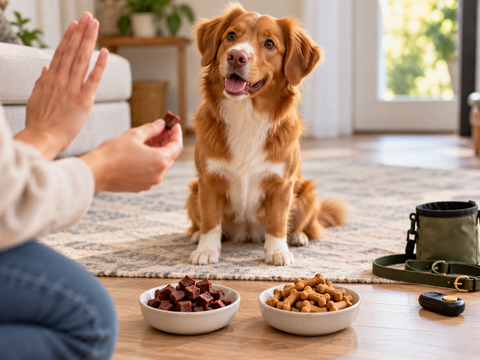
Dog training treats don't need to be large to be motivating. In fact, small, easy-to-eat rewards are often more practical because they allow dogs to finish quickly and return their attention to the next exercise.
But how small is too small?
And does a tiny treat still feel rewarding to your dog?
Let's take a closer look.
How Small Should Dog Training Treats Actually Be?
For many dogs, training treats can be surprisingly small.
A commonly used starting point is a piece approximately the size of a pea or smaller, depending on the dog's size and the treat's texture.
For tiny dogs, even smaller pieces may be appropriate.
For larger dogs, pea-sized rewards can still work well when they're easy to eat and highly motivating.
The goal isn't choosing one exact measurement for every dog.
It's finding a piece that's:
- Easy to pick up
- Comfortable to chew and swallow
- Motivating
- Quick to consume
- Appropriate for the dog's size
A good training treat should reward the behavior without unnecessarily interrupting the session.
Why Smaller Treats Often Work Better
Training frequently involves repetition.
Your dog performs a behavior.
You reward it.
Then you practice again.
If each treat takes a long time to consume, the session can lose momentum.
Small rewards help keep the process moving.
The dog receives the reward, eats it, and is ready for the next opportunity.
This is especially useful when practicing familiar behaviors that require several repetitions.
Think:
Sit.
Down.
Touch.
Heel.
Recall.
Place.
Small treats allow more opportunities for reinforcement without turning every successful behavior into a snack break.
Your Dog Doesn't Measure Rewards With a Ruler
This is one of the most useful things to remember.
Dogs don't necessarily evaluate reward value according to physical size alone.
A tiny piece of something highly desirable may be more motivating than a much larger piece of ordinary food.
For example:
A small piece of freeze-dried beef liver may capture one dog's attention immediately.
A larger, less appealing biscuit may not.
The difference is motivation.
The best reward isn't always the biggest. It's the one your dog genuinely wants.
High-Value Treats Can Be Especially Effective in Small Pieces
Some treats are naturally rich in aroma and flavor.
That can make small portions particularly useful.
At Raw Paws Pet Food, freeze-dried animal treats such as Beef Liver, Chicken Hearts, Chicken Breast, and Whole Minnows provide different animal-based aromas and textures.
For dogs that find these foods motivating, small pieces may be all that's needed during training.
That allows owners to reserve larger portions for other purposes while using tiny rewards for repetitive exercises.
Tiny Treats Help Maintain Training Momentum
Imagine practicing a new behavior twenty times.
If every reward takes five seconds to chew, that's a considerable amount of time spent waiting.
Now imagine using small rewards your dog can consume quickly.
The session moves more smoothly.
Your dog can remain focused on the activity.
You can reinforce successful behaviors more frequently.
And the entire exercise may feel more natural.
This is particularly helpful during short, focused training sessions where timing matters.
Smaller Rewards Make Repetition Easier
Positive reinforcement training often involves rewarding small steps toward a desired behavior.
For example, when teaching a dog to touch your hand with their nose, you might reward:
Looking toward your hand.
Moving closer.
Touching it.
Repeating the behavior.
As the dog learns, you can gradually adjust the criteria.
Small treats make this process practical because you may need to deliver several rewards in a short period.
The reward doesn't have to be substantial every time.
It simply needs to reinforce the behavior effectively.
Tiny Treats Can Help Manage Calories
Here's another major advantage.
Training can involve a surprising number of rewards.
A few during a morning walk.
Several during recall practice.
More during an evening training session.
If every reward is large, treat calories can accumulate quickly.
Smaller pieces help manage the total amount of food consumed.
A commonly used guideline is to keep treats and extras within approximately 10% of a dog's daily calories unless your veterinarian recommends otherwise.
You can also use part of your dog's regular food allowance for training when appropriate.
More training rewards don't necessarily need to mean more food.
Freeze-Dried Treats Are Easy to Portion
One reason freeze-dried treats work well for training is that many can be broken into smaller pieces.
For example:
Freeze-Dried Chicken Breast: Often easy to break into small rewards.
Freeze-Dried Beef Liver: Can provide small, aromatic pieces.
Freeze-Dried Chicken Hearts: May be portioned into smaller pieces depending on the individual treat.
Freeze-Dried Whole Minnows: Can be divided when practical and appropriate for the dog's size.
That flexibility makes it easier to match reward size to the activity.
A single larger piece may become several training rewards.
How Small Is Too Small?
There is such a thing as making treats unnecessarily tiny.
If a piece is so small that your dog can't easily locate or pick it up, it may interrupt training.
Very small crumbs can also create frustration when they scatter across the floor.
The right size should be easy for your dog to recognize and consume.
Consider:
Mouth Size: Can your dog comfortably pick up the reward?
Texture: Does it crumble or remain intact?
Motivation: Does your dog still find the portion rewarding?
Training Activity: Do you need quick repetitions or a more substantial reward?
The ideal size balances convenience with reward value.
Small Dogs Need Especially Small Rewards
For a small dog, an ordinary treat can represent a surprisingly large portion.
That makes breaking treats into smaller pieces particularly useful.
A tiny dog may need only a very small reward during repetitive training.
This helps avoid excessive treat intake while still providing positive reinforcement.
Choose pieces that are easy to handle and don't create swallowing concerns.
Large Dogs Can Work for Small Treats Too
It's tempting to assume a large dog needs a large reward.
But many large dogs are perfectly happy working for tiny pieces of something they love.
A Labrador doesn't necessarily need an entire biscuit every time they sit.
A small piece of beef liver or chicken breast may be plenty motivating.
This can be particularly helpful when training large dogs because their appetite for treats can make portion sizes creep upward quickly.
Dog size matters, but reward preference matters too.
What About Puppies?
Puppies often receive many rewards while learning basic behaviors.
That makes tiny treats especially useful.
Small, easy-to-eat pieces allow frequent reinforcement without replacing meaningful portions of the puppy's complete and balanced growth diet.
Choose soft or easily crumbled treats that are appropriate for the puppy's age and mouth size.
Avoid hard or oversized pieces that may be difficult to manage.
Training should be rewarding without becoming a major source of unbalanced calories.
Senior Dogs May Need a Different Texture
Older dogs sometimes have dental concerns that make certain textures uncomfortable.
For these dogs, small soft rewards may be easier to consume than firm, crunchy pieces.
If your senior dog has difficulty chewing, drops food, or suddenly avoids previously enjoyed treats, consult your veterinarian.
The best training treat should be comfortable as well as motivating.
Treat Texture Changes the Ideal Size
Not every treat behaves the same way.
A soft piece of food may be easy to swallow quickly.
A crunchy freeze-dried treat may require a little more chewing.
A firm jerky piece may take longer.
That's why reward size should be considered alongside texture.
A small crunchy treat may work beautifully for one dog.
Another may prefer a softer reward during rapid training.
When Bigger Rewards May Make Sense
Tiny treats are useful, but they aren't the only option.
Some training situations may benefit from a more substantial reward.
For example:
A difficult new behavior: Your dog may appreciate a particularly valuable reward.
A major training milestone: You may choose to provide several small treats in succession.
A longer enrichment activity: An appropriately sized natural chew or food puzzle may be more suitable than a quick reward.
The goal isn't always using the smallest possible piece.
It's matching the reward to the situation.
Try a "Jackpot" Without One Giant Treat
In training, a jackpot generally refers to an especially valuable reward event.
That doesn't necessarily require one enormous piece of food.
You might deliver several small, highly valued treats in succession.
This can create a more substantial reward experience while allowing your dog to consume each piece comfortably.
For example, several tiny pieces of freeze-dried chicken or beef liver may be easier to manage than one large chunk.
The reward feels special.
The individual pieces remain practical.
How to Make One Bag of Treats Go Further
If you're training frequently, portioning can make a noticeable difference.
Instead of using every freeze-dried piece whole, break appropriate treats into smaller rewards before the session begins.
Store the prepared portions according to the product's instructions.
Now you're ready to reward quickly without stopping to break treats apart after every behavior.
This can also help you better understand how much food you're using during each training session.
Don't Forget About the Rest of the Diet
Training treats are only one part of your dog's daily food intake.
Consider:
Breakfast.
Dinner.
Training rewards.
Meal toppers.
Natural chews.
Other snacks.
All of those contribute calories.
Using smaller training treats can help keep extras under control while allowing the complete and balanced primary diet to remain the nutritional foundation.
A Simple Way to Find the Right Treat Size
Try this during your next training session.
Start with a small piece of a treat your dog enjoys.
Reward a familiar behavior.
Watch what happens.
Does your dog:
Pick it up easily?
Eat it comfortably?
Remain motivated?
Return attention quickly?
If yes, the size may work well.
If your dog struggles to find or consume the piece, adjust.
If the treat takes too long to chew, try a smaller or softer reward.
Your dog's response is more useful than one universal measurement.
Small Rewards Can Make Training More Efficient
At Raw Paws Pet Food, our freeze-dried single-ingredient treats make it easy to experiment with different reward sizes and proteins.
Chicken breast provides familiar muscle meat.
Beef liver offers a rich, aromatic reward.
Chicken hearts introduce another animal tissue.
Whole minnows provide a distinctive fish-based experience.
Each can be used thoughtfully within a training routine.
But regardless of which protein your dog prefers, the same principle applies:
A reward doesn't need to be large to be valuable.
Use appropriately sized pieces.
Keep training moving.
Manage overall treat intake.
And pay attention to what motivates your individual dog.
Because sometimes the smallest change in your training routine—literally making the treats smaller—can make the entire experience work better.
Comments (0)
There are no comments for this article. Be the first one to leave a message!