

Indoor cats have a pretty comfortable arrangement.
Meals arrive on schedule.
The temperature stays predictable.
There are no predators to avoid.
And the best sleeping spots are usually available twenty-four hours a day.
But comfort creates an interesting challenge.
A cat living outdoors encounters movement, changing scents, climbing opportunities, insects, birds, hiding places, and countless reasons to investigate the environment.
Indoor life removes many of those experiences.
That's why play matters.
But how much playtime does an indoor cat actually need?
There's no universal number that works for every cat. Several short, engaging play sessions spread throughout the day are often more natural than trying to convince your cat to participate in one marathon workout.
The goal isn't exhausting your cat.
It's giving their instincts somewhere to go.
Think in Sessions, Not Hours
Cats aren't typically endurance athletes.
Their natural activity pattern often involves short bursts of intense focus followed by rest.
Watch a cat play.
They may stalk a toy for two minutes.
Explode into action.
Pounce.
Run across the room.
Then suddenly decide the session is over and begin grooming.
That's normal.
Rather than expecting thirty or sixty continuous minutes of play, many cats respond better to multiple short sessions throughout the day.
For many households, starting with roughly 10–15 minutes of interactive play a couple of times per day can be a practical baseline, then adjusting according to the individual cat.
Some cats will want considerably more.
Others may prefer shorter sessions.
Your cat's behavior should help guide the routine.
Kittens Play by Different Rules
A kitten may make the idea of "scheduled playtime" seem ridiculous.
Everything is playtime.
A shoelace.
A cardboard box.
A shadow.
Your foot. Young cats generally have more energy and may seek frequent opportunities to run, climb, chase, wrestle, and investigate throughout the day.
Instead of relying only on structured sessions, kittens benefit from an environment that gives them appropriate opportunities to explore and play safely between interactions with you.
Think:
More opportunities, shorter bursts, lots of variety.
Adult Cats Still Need to Hunt Something
Adult cats may appear calmer than kittens, but their natural hunting behaviors haven't disappeared.
They still enjoy opportunities to:
- Watch
- Stalk
- Chase
- Pounce
- Capture
That's why interactive toys are particularly valuable.
A wand toy that disappears behind furniture can create a completely different response than a toy sitting motionless on the floor.
Movement gives the cat something to solve.
Senior Cats Still Benefit From Play
Older cats may not launch themselves across the room with the same enthusiasm they had as kittens.
That doesn't mean play stops being valuable.
The activity simply changes.
A senior cat may prefer:
- Slower-moving toys
- Shorter sessions
- Ground-level play
- Gentle food puzzles
- Easier-to-reach enrichment
The goal should match the cat's physical abilities.
A five-minute session that keeps an older cat curious and engaged can be far more appropriate than trying to recreate the intensity of kitten play.
Your Cat's Favorite Play Style Matters
Not every cat wants the same game.
Some are chasers.
They love anything moving quickly across the floor.
Some are stalkers.
They prefer hiding behind furniture and waiting for the perfect moment.
Others are pouncers.
They'll patiently watch before launching one dramatic attack.
And some cats are highly motivated by food puzzles and treat-searching games.
Pay attention to which behaviors repeatedly appear.
The best play routine isn't necessarily the one with the most expensive toys.
It's the one that matches how your cat naturally likes to engage.
Make the Toy Behave Like Prey
One of the easiest ways to improve playtime is to change how you move the toy.
Don't simply wave it directly in your cat's face.
Prey generally moves away from a predator.
Try:
Moving the toy across the floor.
Stopping suddenly.
Letting it disappear behind a chair.
Moving slowly again.
Then darting away.
Give your cat time to watch and stalk rather than expecting constant chasing.
You're not trying to create nonstop movement.
You're creating anticipation.
Let Your Cat Win
Imagine playing a game every day that you're never allowed to win.
Eventually, it stops being very interesting.
Cats need opportunities to catch their toys.
Let them pounce.
Grab.
Hold.
Celebrate their successful capture for a moment.
Then restart the game.
The chase is exciting, but the capture is part of the experience too.
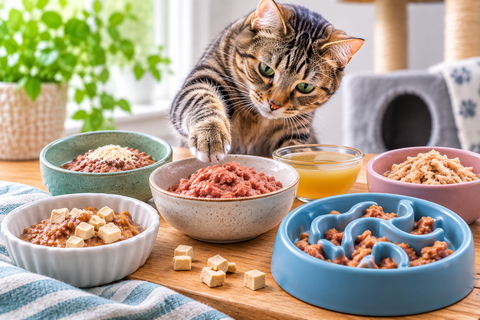
Food Can Become Part of Playtime
Play and food enrichment work beautifully together.
After a hunting-style play session, you can offer a small animal-based reward such as:
- Freeze-Dried Chicken Breast
- Freeze-Dried Chicken Heart
- Freeze-Dried Beef Liver
- Freeze-Dried Whole Minnow
At Raw Paws Pet Food, these single-ingredient treats can also be broken into smaller pieces and hidden in puzzle toys or around safe areas of the home.
Now the cat isn't simply receiving a treat.
They're finding it.
That turns a small amount of food into a much larger enrichment experience.
Independent Play Counts—but It's Different
Your cat doesn't need you participating every time they're awake.
Independent play is valuable too.
Balls.
Toy mice.
Cardboard boxes.
Tunnels.
Cat trees.
Safe climbing spaces.
Window perches.
These give cats opportunities to engage with their environment throughout the day.
But interactive play provides something independent toys can't fully reproduce:
Unpredictability.
You're controlling the movement.
The "prey" changes direction.
It hides.
It pauses.
That's why a combination of independent enrichment and interactive play often creates a richer routine than relying exclusively on either one.
Rotate Toys Instead of Buying More
Cats can lose interest when the same twenty toys remain scattered across the floor every day.
Try putting most of them away.
Leave a few available.
Several days later, swap them.
Suddenly, an old toy can feel surprisingly interesting again.
Toy rotation creates novelty without constantly buying new products.
It also helps you identify which toys your cat genuinely values rather than simply accumulating more clutter.
Watch for Signs Your Cat Wants More Engagement
Your cat can't tell you, "I'd like another enrichment session."
But behavior can provide clues.
A cat seeking more activity may:
- Frequently initiate play
- Chase feet or hands
- Become highly active at certain times
- Repeatedly bring attention to toys
- Investigate cabinets or objects
- Seek interaction around predictable parts of the day
These behaviors don't automatically mean insufficient play, but they can help you understand when your cat naturally wants activity.
Use those patterns when scheduling interactive sessions.
Build Play Into Moments That Already Exist
A good enrichment routine doesn't need to feel like another chore.
Attach play to things you already do.
Before breakfast: Five-minute wand session.
After work: Short chase-and-pounce game.
Evening: Food puzzle or treat search.
Before bed: Another brief interactive session.
Now enrichment becomes part of the household rhythm rather than something you have to remember separately.
Consistency is often more useful than occasionally scheduling one enormous play session.
Don't Measure Success With a Stopwatch
Ten minutes isn't automatically good.
Twenty minutes isn't automatically better.
Watch your cat.
Are they engaged?
Are they stalking?
Chasing?
Investigating?
Do they lose interest?
Walk away?
Lie down?
Those signals tell you much more than the clock.
Some days your cat may want fifteen minutes.
Another day they may decide six minutes was plenty.
Cats are wonderfully inconsistent like that.
The Best Play Routine Is the One Your Cat Wants to Repeat
So, how much playtime does an indoor cat really need?
Enough to regularly provide opportunities for natural behaviors—without turning enrichment into forced exercise.
Start with several short interactive sessions throughout the day.
Experiment with different toys.
Let your cat stalk instead of constantly chase.
Give them opportunities to catch their "prey."
Add climbing, scratching, observation, food puzzles, and independent exploration around those sessions. Then watch what your cat tells you.
Because good enrichment isn't measured by how long you can keep a feather wand moving.
It's measured by whether your cat remains curious enough to come back tomorrow and hunt it all over again.
Comments (0)
There are no comments for this article. Be the first one to leave a message!