

You hand your dog a collagen stick.
They grab it, settle into their favorite spot, and get to work.
Twenty minutes later, one dog may have barely made a dent. Another?
Already looking for the next chew.
If you've ever wondered why collagen sticks last longer for some dogs than others, you're asking the right question.
Collagen sticks can provide a satisfying, longer-lasting chewing experience, but there's no universal amount of time every stick will last.
The answer depends on several factors, including your dog's size, jaw strength, chewing habits, and the actual dimensions of the chew.
And perhaps most importantly, it depends on how your dog approaches chewing.
Understanding those differences can help you choose a collagen stick that provides the right level of challenge without simply buying the biggest chew available.
What Makes Collagen Sticks Long-Lasting?
Collagen sticks are made from collagen-rich animal tissue, commonly sourced from cattle.
Collagen is a structural protein naturally found in connective tissues, including skin, tendons, and cartilage.
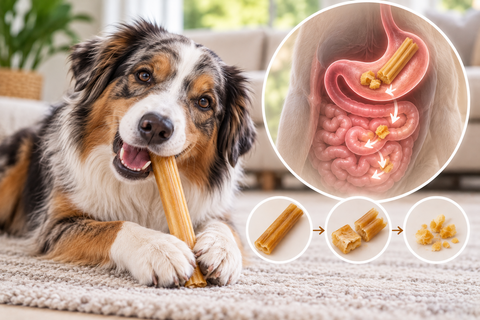
When processed into dog chews, collagen-rich material creates a firm structure that dogs gradually soften and work through.
Unlike a small biscuit that disappears after a few bites, collagen sticks encourage repeated gnawing.
Your dog may:
- Hold the stick between their paws
- Work through one end
- Rotate the chew
- Change chewing angles
- Soften sections with saliva
- Continue working through the material
That gradual process is part of what makes collagen sticks appealing to dogs that genuinely enjoy chewing.
The Biggest Factor? Your Dog's Chewing Style
Two dogs can receive nearly identical collagen sticks and finish them at dramatically different speeds.
That's because dogs don't all chew the same way.
Some nibble.
Some gnaw steadily.
Some take breaks.
Others attack every chew like they're racing against a clock.
Recognizing your dog's chewing personality is one of the easiest ways to estimate how a collagen stick might perform.
Gentle Chewers: The Slow and Steady Approach
Gentle chewers tend to take their time.
They may spend several minutes investigating a chew before making much progress. Some carry it around.
Others settle down, nibble occasionally, and take frequent breaks.
For these dogs, even a moderately sized collagen stick may provide a substantial chewing experience.
What to look for:
- Appropriately sized collagen sticks
- Manageable thickness
- A texture your dog can comfortably work through
A gentle chewer doesn't necessarily need the thickest product available.
Sometimes a standard collagen stick provides plenty of engagement.
Moderate Chewers: Consistent Progress
Moderate chewers usually approach natural chews with steady determination.
They don't rush.
But they don't spend the entire afternoon deciding where to begin either.
These dogs may work through a collagen stick gradually, maintaining consistent progress throughout the session.
For moderate chewers, both length and thickness can influence how substantial the activity feels.
A thinner stick may provide a lighter chewing experience.
A thicker option offers more material to work through.
The goal is finding the right balance between resistance and enjoyment.
Persistent Chewers: The Dogs Who Don't Give Up
Some dogs aren't especially aggressive chewers.
They're simply committed.
Once they settle down with a collagen stick, they keep working.
They may rotate the chew repeatedly, soften different sections, and return to areas they've already worked on.
For these dogs, collagen sticks can become an engaging activity because the texture changes as chewing progresses.
A more substantial stick may provide additional material for them to work through, although chew duration still varies.
Power Chewers: When Collagen Sticks Disappear Quickly
Then there are the power chewers.
You know the type.
They don't casually nibble.
They immediately figure out where to position the chew for maximum leverage.
These dogs may use considerable jaw pressure and work through lighter collagen sticks much faster than expected.
If that sounds familiar, consider whether a thicker collagen stick might provide a more substantial challenge.
But remember:
A power chewer doesn't automatically need the hardest chew available.
Extremely hard products can create dental concerns, especially for dogs that bite down aggressively.
Appropriate resistance matters more than maximum hardness.
Thickness Can Make a Major Difference
Imagine two collagen sticks that are both six inches long.
One is relatively thin.
The other is substantially thicker.
Even though the lengths are identical, the thicker stick contains more material across its diameter.
That gives your dog more to work through at each section.
For dogs that finish thin sticks quickly, increasing thickness may create a more substantial chewing experience.
However, thicker doesn't automatically guarantee a specific duration.
Density, processing, and your dog's technique still influence the outcome.
Length Matters—but Differently
Length and thickness solve different problems.
Length determines how much chew is available from end to end.
Thickness determines how much material your dog encounters across the chew.
A longer collagen stick may provide more total chewing material.
A thicker stick may change how much work is required at each section.
When choosing between different sizes, consider both measurements rather than assuming the longest option is automatically the most durable.
Density and Processing Influence Chew Time
Not every collagen stick is manufactured identically.
Different products can vary in:
- Tissue composition
- Moisture content
- Density
- Thickness
- Drying methods
- Finished structure
These differences can influence how quickly a stick softens during chewing.
Even products that look similar may behave differently once your dog begins working through them.
That's why chew-time estimates should never be treated as guarantees.
Saliva Changes the Chewing Experience
A collagen stick doesn't remain exactly the same throughout the session.
At first, the material is dry and firm.
As your dog chews, saliva gradually moistens the surface.
The worked areas may soften and become easier to manipulate.
Your dog might spend considerable time on one section before suddenly making faster progress.
That changing texture helps explain why chew time isn't always consistent from beginning to end.
The chew evolves as your dog interacts with it.
Does Dog Size Determine How Long Collagen Sticks Last?
Dog size matters, but it isn't the entire answer.
A larger dog may have greater jaw strength and a larger mouth, allowing them to work through a collagen stick more efficiently.
But a small, determined chewer may finish the same product faster than a much larger gentle chewer.
That's why breed and body weight should help guide chew sizing, while actual chewing behavior helps determine which texture and thickness may work best.
A dog's chewing style can be surprisingly different from what their size suggests.
Collagen Sticks vs. Bully Sticks: Which Lasts Longer?
This is a common comparison because both are popular stick-shaped natural chews.
But they begin with different animal tissues.
Collagen Sticks: Made from collagen-rich animal tissue.
Bully Sticks: Made from beef pizzle.
Those differences create distinct textures and chewing experiences.
A thick collagen stick may outlast a thin bully stick for one dog.
A substantial bully stick may last longer for another.
Rather than assuming one category always wins, compare the actual size and structure of each product.
Bully Sticks vs. Collagen Sticks: Which Is Better for Dogs? – Raw Paws Pet Food
What About Beef Cheek Rolls?
If your dog finishes stick-shaped chews quickly, changing the shape may introduce another challenge.
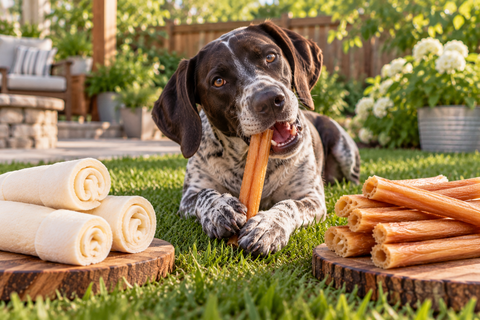
Beef cheek rolls offer a broader, rolled structure that dogs can work from several angles.
Collagen sticks provide a narrower, more focused chewing experience.
Neither is guaranteed to last longer.
But rotating between different shapes can create variety for dogs that enjoy chewing.
Beef Cheek Rolls vs. Collagen Sticks: Which Is Better for Dogs? – Raw Paws Pet Food
Can One Collagen Stick Last Multiple Sessions?
For some dogs, yes.
A gentle chewer may work through part of a collagen stick, take a break, and return later.
Other dogs will continue chewing until the entire product is gone unless the owner ends the session.
You don't necessarily need to let your dog finish every collagen stick in one sitting.
If the product remains suitable for reuse, follow the manufacturer's instructions for handling and storing partially chewed products.
Remember that saliva introduces moisture, which changes how a partially consumed chew should be handled.
How to Tell Whether Your Collagen Stick Is the Right Size
Start by watching your dog with their current chew.
Ask yourself:
Can my dog comfortably hold it?
Are they gradually gnawing or attempting to swallow large pieces?
Does the thickness seem appropriate for their mouth?
Does the chew provide the type of engagement I'm looking for?
Does my dog seem comfortable while chewing?
If your dog handles the chew appropriately but finishes it quickly, adjusting thickness or size may be worth considering.
If the product seems too difficult or your dog tries to gulp pieces, choose a different option.
The right chew is about suitability—not simply duration.
Don't Confuse Long-Lasting With Better
It's tempting to judge every dog chew by the clock.
But a chew lasting longer doesn't automatically mean it's more valuable.
A shorter session where your dog is engaged, comfortable, and safely working through an appropriate chew can still provide worthwhile enrichment.
Think beyond minutes.
Look at:
- Engagement
- Chewing technique
- Appropriate resistance
- Enjoyment
- Size and suitability
- How the product changes during use
The best chewing experience isn't always the longest one.
Collagen Sticks Still Count as Treats
Because collagen sticks are edible animal-based chews, the amount your dog consumes contributes to overall food intake.
A dog that finishes a collagen stick quickly has still consumed that material.
Don't automatically provide another simply because the chewing activity ended sooner than expected.
Consider collagen sticks alongside training rewards, meal toppers, other chews, and your dog's complete and balanced primary diet.
Treat frequency and portion size still matter.
When Should You Take a Collagen Stick Away?
Always supervise your dog while they're chewing.
Remove the chew if:
- Your dog attempts to swallow a large piece
- A substantial section separates
- The remaining portion becomes small enough to swallow whole
- The chew develops sharp or otherwise concerning pieces
- Your dog appears uncomfortable or has difficulty managing it
There isn't one universal remaining length that works for every dog.
Evaluate the chew relative to your dog's mouth and behavior.
Establish Your Dog's Personal Chew-Time Baseline
Instead of relying on a generic duration estimate, observe your dog's first few supervised collagen-stick sessions.
Pay attention to:
How long they actively chew.
How much material they consume.
Whether they take breaks.
How quickly the surface softens.
Whether they focus on one end or rotate the stick.
Now you have a reference point.
When you try another size or thickness, you can compare it against your dog's actual experience.
That's much more useful than relying on someone else's chew-time estimate.
The Best Collagen Stick Fits the Chewer
At Raw Paws Pet Food, collagen sticks are part of our natural dog chew collection because they provide a different chewing experience from bully sticks, beef cheek rolls, ears, and other animal-based chews.
For gentle chewers, a standard collagen stick may provide plenty of activity.
For moderate chewers, length and thickness can help shape the experience.
For persistent chewers, a more substantial option may offer additional material to work through.
And for power chewers, understanding jaw strength and technique is especially important.
So, how long do collagen sticks last?
As long as the combination of chew size, thickness, density, and your dog's chewing style allows.
There's no universal stopwatch.
Start with an appropriate size.
Observe your dog.
Adjust the thickness when needed.
Supervise every session.
And remember that the goal isn't simply making a chew last as long as possible.
It's giving your dog something they genuinely enjoy working through.
Comments (0)
There are no comments for this article. Be the first one to leave a message!