

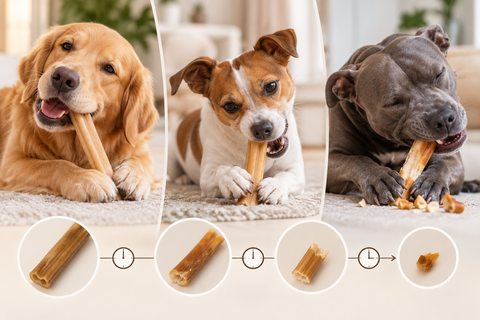
Your dog has been happily chewing on a collagen stick.
The stick gets shorter.
The edges soften.
Eventually, much of it disappears.
Which raises a reasonable question:
Where does all that collagen actually go?
Unlike a rubber chew toy or recreational bone, collagen sticks are designed to be gradually chewed and consumed.
But does that mean they're digestible?
Yes. Collagen is an animal protein that dogs can digest, and properly manufactured collagen sticks are intended to be edible chews.
However, there's an important distinction between a chew being digestible and a dog being able to safely swallow large pieces of it.
Understanding that difference can help you choose a more appropriate natural chew and recognize when it's time to end a chewing session.
What Exactly Are Collagen Sticks?
Collagen sticks are natural dog chews made from collagen-rich animal tissue, commonly sourced from cattle.
Collagen is a structural protein found throughout an animal's body, particularly in connective tissues such as:
- Skin
- Tendons
- Ligaments
- Cartilage
- Other connective tissues
For dog chews, collagen-rich material is processed and formed into a firm, stick-shaped product.
The result gives dogs something they can hold between their paws, gnaw, soften, and gradually consume.
At Raw Paws Pet Food, collagen sticks are part of our natural dog chew collection, offering a different chewing experience from bully sticks, beef cheek rolls, and other animal-based chews.
What Does Digestible Actually Mean?
The word digestible gets used frequently in pet food marketing.
But what does it really mean?
Digestibility refers to how much of a food or nutrient can be broken down and absorbed or otherwise utilized by the body.
When a dog eats protein, the digestive system uses stomach acid and enzymes to begin breaking it into smaller components.
Those components are further processed in the small intestine, where amino acids and small peptides can be absorbed.
Collagen is a protein, so it can undergo this digestive process.
That makes collagen fundamentally different from materials that aren't intended to be eaten, such as rubber or nylon chew toys.
But digestibility isn't an all-or-nothing guarantee.
The amount and rate of digestion can vary depending on the product's processing, structure, and the individual dog.
What Happens When a Dog Eats Collagen?
Imagine your dog gradually chewing through a collagen stick.
As small pieces are swallowed, they enter the digestive tract.
Here's what generally happens:
First: The Stomach
Stomach acid and digestive enzymes begin breaking down the collagen-rich material.
Next: The Small Intestine
Additional enzymes continue breaking proteins into smaller peptides and amino acids.
Finally: Nutrient Absorption
The digestive system absorbs usable components that can contribute to the dog's overall nutrient intake.
The important point is that collagen is animal protein.
It's not an indestructible material that simply passes through the body unchanged.
Collagen Is Different From Ordinary Muscle Meat
Here's where the nutrition becomes interesting.
Chicken breast and beef muscle meat contain proteins associated with muscle tissue. Collagen is a structural protein.
Its amino acid profile is different, with relatively high amounts of glycine, proline, and hydroxyproline.
That makes collagen nutritionally distinct from ordinary muscle meat.
However, collagen is not considered a complete protein source for dogs because it doesn't provide all essential amino acids in sufficient proportions.
That's why collagen sticks belong in the treat and chew category, not as replacements for complete and balanced meals.
Are Collagen Sticks More Digestible Than Rawhide?
This is one of the most common questions.
Collagen sticks and rawhide can both originate from cattle-derived skin tissues, but their manufacturing methods and finished structures may differ.
Rawhide is made from processed animal hide.
Collagen sticks are made from collagen-rich material that's processed into an edible chew.
Here's the important distinction:
Collagen is itself a major component of animal hide.
That means rawhide and collagen chews aren't made from completely unrelated materials.
Their digestibility can differ depending on how they're processed, dried, compressed, or otherwise manufactured.
It's reasonable to expect collagen-based chews designed for consumption to be digestible, but that doesn't mean every collagen stick is automatically proven more digestible than every rawhide product.
Product-specific digestibility testing provides a stronger basis for that comparison.
Collagen Sticks vs. Rawhide: What's the Difference for Dogs? – Raw Paws Pet Food
Digestible Doesn't Mean Safe to Swallow Whole
This is probably the most important point in the entire article.
A collagen stick may be made from digestible animal protein.
But that doesn't mean your dog should swallow a large section without chewing.
Think about a piece of steak.
Dogs can digest beef.
That doesn't mean swallowing an enormous piece of steak whole is risk-free.
The same principle applies to collagen sticks.
Large swallowed pieces can create choking or gastrointestinal obstruction risks before digestion has an opportunity to break them down.
The goal is gradual chewing and consumption—not gulping.
Why Collagen Sticks Soften During Chewing
A fresh collagen stick is generally firm and dry.
As your dog chews, saliva begins moistening the surface.
Repeated gnawing changes the material's texture, making some sections softer and easier to work through.
You may notice your dog:
- Concentrating on one end
- Rotating the stick
- Changing chewing angles
- Working through softened sections
- Returning to areas they've already chewed
That evolving texture is part of the natural chewing experience.
It also means owners should monitor how the chew changes throughout the session.
Are Collagen Sticks Good for Dogs That Love to Chew?
Collagen sticks can provide an engaging chewing activity for dogs that enjoy gradually working through edible natural chews.
Their stick shape allows dogs to hold and manipulate the product while gnawing.
For some dogs, a collagen stick may provide a substantial chewing session.
For others, particularly determined power chewers, the same product may disappear much faster.
That's why selecting an appropriate size and thickness matters.
A chew should match the dog's mouth, chewing intensity, and ability to work through the material appropriately.
How Long Do Collagen Sticks Take to Digest?
There's no reliable universal digestion time for collagen sticks.
Digestion depends on several factors, including:
- Amount consumed
- Product composition
- Processing method
- Size of swallowed pieces
- Individual digestive function
- Other food in the stomach
A small, thoroughly chewed portion isn't necessarily processed at the same rate as a large swallowed piece.
Rather than relying on a specific number of hours, focus on appropriate chewing behavior and monitoring your dog's response.
Can Collagen Sticks Upset a Dog's Stomach?
Yes, they can.
Even digestible foods may cause digestive upset in some dogs.
A dog that's new to collagen sticks may experience loose stool or other digestive changes, particularly after consuming a large amount.
Individual tolerance varies.
When introducing a new chew, start conservatively and observe your dog.
If vomiting, diarrhea, discomfort, or other concerning symptoms develop, discontinue the chew and contact your veterinarian.
Persistent vomiting, abdominal pain, or difficulty passing stool after swallowing a large piece warrants prompt veterinary attention.
Are Collagen Sticks Appropriate for Puppies?
Puppies naturally explore the world through chewing.
However, their teeth, jaws, and digestive systems are still developing.
A collagen stick may be appropriate for some puppies, but age, size, chewing behavior, and the specific product all matter.
Choose puppy-appropriate chews and supervise closely.
If you're uncertain whether a collagen stick is suitable for your puppy, ask your veterinarian.
Remember that puppies require complete and balanced nutrition formulated for growth.
Edible chews should never displace substantial portions of that diet.
Do Collagen Sticks Have Nutritional Benefits?
Collagen sticks provide animal-derived protein with an amino acid profile associated with connective tissue.
However, it's important to distinguish between containing collagen and proving a specific health benefit.
You may see collagen products marketed for:
Joint support.
Skin health.
Coat health.
Connective tissue support.
But eating a collagen chew doesn't automatically establish that it will improve any particular health condition.
Those claims depend on the amount consumed, the type of collagen, product processing, and available research.
The clearest everyday value of a collagen stick is providing an edible animal-based chew that encourages natural chewing behavior.
Collagen Sticks vs. Bully Sticks: Does Digestibility Differ?
Both are animal-based edible chews, but they begin with different tissues.
Bully Sticks: Made from beef pizzle.
Collagen Sticks: Made from collagen-rich animal tissue.
Both contain proteins that dogs can digest.
However, their structures, processing methods, and protein composition differ.
That can influence how dogs chew and digest the products.
Neither should be offered with the assumption that a large swallowed piece is automatically safe.
Bully Sticks vs. Collagen Sticks: Which Is Better for Dogs? – Raw Paws Pet Food
Collagen Sticks Still Count as Treats
Because collagen sticks are edible, they contribute to your dog's overall food intake.
That's easy to overlook when a chew is being used primarily for enrichment.
Consider collagen sticks alongside:
- Training treats
- Meal toppers
- Other natural chews
- Everyday snacks
A commonly used guideline is to keep treats and extras within approximately 10% of a dog's daily calories, unless your veterinarian recommends otherwise.
The remaining nutrition should come from a complete and balanced primary diet.
When Should You Take a Collagen Stick Away?
Always supervise your dog during chewing.
Remove the stick when:
- The remaining portion becomes small enough to swallow whole
- Your dog attempts to gulp large sections
- Substantial pieces break away
- The chew develops concerning damage
- Your dog appears uncomfortable
There's no universal remaining length that works for every dog.
A piece that's manageable for one dog may be a swallowing hazard for another.
Use your dog's size and behavior to guide the decision.
How to Choose a Collagen Stick Your Dog Can Handle
Start with the individual dog.
Consider:
Size: Is the chew appropriately sized for your dog's mouth and body?
Thickness: Does it provide manageable resistance?
Chewing Style: Does your dog gnaw gradually or attempt to swallow large pieces?
Experience: Has your dog handled similar edible chews appropriately?
Duration: Are you looking for a lighter or more substantial chewing session?
The right collagen stick isn't necessarily the thickest or longest one.
It's the one your dog can work through appropriately while enjoying the experience.
Collagen Sticks Can Be Part of a Natural Chew Rotation
Collagen sticks don't have to replace every other chew.
They can provide one type of texture and structure within a varied routine.
For example:
Bully Sticks: Beef-pizzle chewing experience.
Collagen Sticks: Collagen-rich edible chew.
Beef Cheek Rolls: Broader rolled structure.
Cow Ears: Lighter, crunchy texture.
Compressed Rawhide: Dense hide-based gnawing.
Different materials and shapes encourage different chewing techniques.
That variety can help make enrichment more interesting without requiring one product to do everything.
So, Are Collagen Sticks Digestible?
Yes. Collagen is a digestible animal protein, and collagen sticks are generally intended to be gradually chewed and consumed.
But digestibility isn't the same as guaranteed safety.
The finished product's composition and processing matter.
The size of swallowed pieces matters. And your dog's chewing behavior matters.
At Raw Paws Pet Food, we offer collagen sticks as part of our natural chew collection because they provide a different animal-based chewing experience from bully sticks, beef cheek rolls, ears, and other chews.
Choose an appropriate size.
Supervise every session.
Allow gradual chewing.
Remove the remaining piece before it becomes a swallowing concern.
And remember:
A digestible chew is still a chew that needs responsible handling.
Because the best natural chew isn't simply one your dog can eat.
It's one they can enjoy appropriately from the first bite until you decide the session is finished.
Comments (0)
There are no comments for this article. Be the first one to leave a message!