


You ask your dog to sit.
They sit
You offer a treat.
They accept it.
Easy enough.
Now imagine asking that same dog to come back to you at the park while another dog runs past.
Suddenly, your everyday treat doesn't seem nearly as interesting.
Your dog looks at you.
Looks at the other dog.
And makes a decision.
That's where high-value dog treats become important.
Not every reward carries the same level of motivation, and what works beautifully in your living room may not be exciting enough in a distracting environment.
But what actually makes one dog treat more valuable than another?
Is it the protein?
The smell?
The texture?
Or simply how much your dog likes it?
The answer is a combination of factors—and the most important one is your individual dog's preference.
Understanding how dogs respond to different rewards can help you make training more effective without simply handing out bigger treats.
What Are High-Value Dog Treats?
High-value dog treats are rewards that a dog finds especially motivating compared with other available options.
They're often used during:
- Recall training
- Learning difficult behaviors
- Training around distractions
- Introducing new environments
- Positive reinforcement exercises
- Rewarding especially challenging tasks
The important distinction is that high value isn't a fixed characteristic printed on the package.
It's determined by the dog.
One dog may consider beef liver the ultimate reward.
Another may prefer chicken hearts.
A third may become incredibly excited about fish.
The best high-value treat is the one your dog is genuinely motivated to earn.
Why Some Treats Are More Motivating Than Others
Dogs experience food through multiple senses.
A treat isn't simply a source of calories.
It has:
Aroma.
Taste.
Texture.
Temperature.
Size.
Familiarity.
All of these characteristics can influence how appealing a reward becomes.
And because dogs have individual preferences, the same treat may produce completely different reactions from different dogs.
That's why identifying high-value treats involves more observation than guessing.
1. Aroma: Your Dog's Nose Makes the First Decision
Dogs rely heavily on their sense of smell when evaluating food.
That means aroma can be one of the strongest influences on treat motivation.
Consider the difference between:
A mild, dry biscuit.
And a piece of freeze-dried beef liver.
Both may be edible rewards.
But they provide very different scent experiences.
Rich animal-based aromas can be particularly interesting to many dogs.
At Raw Paws Pet Food, options such as Freeze-Dried Beef Liver, Chicken Hearts, and Whole Minnows provide distinctive natural aromas without requiring elaborate flavor combinations.
For some dogs, the smell alone is enough to capture attention.
2. Taste: The Reward Has to Be Worth Earning
A treat can smell interesting and still fail to become your dog's favorite.
Taste matters too.
Some dogs strongly prefer poultry.
Others love beef.
Some are especially enthusiastic about fish.
That's why there isn't one universal high-value protein.
You may find that your dog prefers:
Chicken Breast: Familiar poultry flavor.
Beef Liver: Rich organ-meat flavor.
Chicken Hearts: A different animal-tissue experience.
Whole Minnows: Distinctive fish flavor.
The only reliable way to learn which one your dog values most is to try appropriate options and observe their response.
3. Texture: Soft, Crunchy, or Chewy?
Texture can influence how useful a treat is during training.
Some dogs enjoy crunchy rewards.
Others prefer softer pieces that can be consumed quickly.
Freeze-dried treats often provide a lightweight texture that can be broken into smaller rewards.
Jerky-style treats may provide a chewier experience.
Natural chews such as bully sticks or collagen sticks serve a different purpose because they require much more time to consume.
For repetitive training, a treat that's easy to eat quickly is often more practical than one that requires extended chewing.
The right texture depends on the activity—not simply the dog's favorite flavor.
4. Novelty: A Different Treat Can Renew Interest
Imagine receiving the exact same reward every time you completed a task.
Eventually, it might become predictable.
Dogs can also become less responsive to familiar rewards after repeated exposure.
This doesn't happen to every dog.
Some remain enthusiastic about the same treat indefinitely.
But for others, introducing a different protein or texture can make the reward more interesting.
You might rotate between:
Chicken breast.
Beef liver.
Chicken hearts.
Whole minnows.
The amount of food doesn't necessarily change.
The sensory experience does.
5. The Environment Changes the Value of a Treat
This is one of the most important training concepts.
A treat that works perfectly at home may not be motivating enough outdoors.
Why?
Because the environment changes what your dog is paying attention to.
At home, there may be few distractions.
At the park, your dog may encounter:
Other dogs.
People.
Wildlife.
Interesting smells.
Moving objects.
Unfamiliar sounds.
Now the treat is competing with the environment.
A higher-value reward may help capture attention, but training difficulty should also be adjusted so your dog can succeed.
6. Hunger and Timing Influence Motivation
A dog that's just finished a full meal may respond differently to treats than one that's ready for food.
That doesn't mean owners should withhold meals to increase training motivation.
It simply means appetite and timing can influence how rewarding food feels.
If you're planning a training session, consider your dog's normal feeding schedule.
You can also use part of their regular food allowance as training rewards when appropriate.
The goal is maintaining balanced nutrition while making rewards meaningful.
7. Individual Preference Is the Final Deciding Factor
You can read every treat comparison available.
You can study ingredient lists.
You can choose the most aromatic product on the shelf.
But your dog still gets the final vote.
Some dogs will do almost anything for liver.
Others are completely uninterested.
One dog may love fish.
Another may prefer chicken.
That's why high-value treats should be identified through your dog's actual behavior rather than broad assumptions.
How to Find Your Dog's Highest-Value Treat
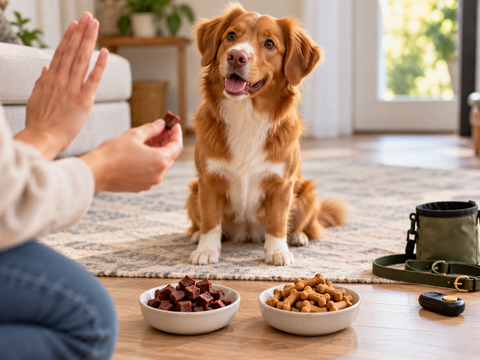
Try a simple reward-preference test.
Choose three appropriate treats with different characteristics.
For example:
Offer small samples during separate, low-distraction moments.
Watch your dog's response.
Do they approach immediately?
Take the treat enthusiastically?
Look for more?
Remain interested after several repetitions?
Repeat the test across different sessions, varying the order, to get a better sense of preference.
Remember that excitement alone isn't a perfect measurement, but it can provide useful clues.
High-Value Treats vs. Everyday Treats
Not every behavior requires your dog's favorite reward.
For familiar tasks in quiet environments, an everyday treat may work perfectly.
For more difficult situations, a more motivating reward may be useful.
Think of treats in three general levels.
Everyday Rewards: Familiar treats for routine behaviors.
High-Value Rewards: Especially motivating treats for challenging training.
Special Rewards: Occasional favorites used strategically for particularly important moments.
These aren't official product categories.
They're a practical way to organize your dog's rewards.
Why Beef Liver Is Often Considered a High-Value Treat
Beef liver is naturally rich in aroma and flavor.
That makes it especially appealing to many dogs.
Freeze-dried beef liver also offers convenient portioning, allowing owners to break larger pieces into smaller training rewards.
Because liver is nutrient dense, moderation matters.
You don't need a large piece to create a meaningful reward.
Can Dogs Eat Beef Liver? Benefits, Serving Tips & Safety – Raw Paws Pet Food
Chicken Hearts: A Different Kind of Reward
Chicken hearts provide another interesting option.
They're muscular organs with a different nutritional profile from secreting organs such as liver.
They also have a distinctive animal-based aroma and texture.
For dogs that enjoy poultry, chicken hearts may provide a more exciting alternative to ordinary chicken breast.
Freeze-dried chicken hearts can be portioned into smaller rewards when appropriate.
That makes them useful for training sessions where you want a different animal-tissue experience.
Whole Minnows: When Fish Gets Their Attention
Whole minnows provide one of the most distinctive sensory experiences among single-ingredient treats.
They're entire small fish.
That means they retain recognizable animal structure rather than being ground into a manufactured shape.
The natural fish aroma may be especially motivating for some dogs.
Because minnows can vary in size, choose appropriately sized portions for your dog and the training activity.
Can Dogs Eat Whole Minnows? Benefits of Fish Treats for Dogs – Raw Paws Pet Food
Why Smaller Treats Often Work Better for Training
A high-value treat doesn't need to be large.
In fact, smaller pieces are often more practical.
During training, you may reward a dog many times.
If every reward is substantial, treat intake can increase quickly.
Small pieces allow you to:
Reward frequently.
Maintain training momentum.
Avoid unnecessary chewing delays.
Manage overall calorie intake.
The goal is delivering a reward your dog values—not maximizing the size of every bite.
When Should You Use High-Value Dog Treats?
High-value rewards can be especially useful when the behavior requires more effort or the environment contains more distractions.
Examples include:
Recall Training: Rewarding your dog for returning when called.
New Behaviors: Encouraging progress while learning unfamiliar skills.
Outdoor Training: Competing with interesting environmental distractions.
Veterinary Handling Practice: Rewarding calm cooperation during gradual, positive handling exercises.
Confidence-Building Activities: Reinforcing successful engagement with manageable new experiences.
The reward should support training—not replace thoughtful training methods.
High-Value Treats Aren't a Shortcut Around Training
Even the most exciting treat can't automatically overcome fear, anxiety, or overwhelming distractions.
If your dog is too stressed to eat, simply offering a richer reward may not solve the problem.
Reduce the difficulty.
Increase distance from distractions.
Return to a more manageable environment.
Then gradually build skills.
High-value treats work best when they're part of a thoughtful positive-reinforcement training approach.
Can Natural Chews Be High-Value Rewards?
Yes, but they serve a different purpose.
A bully stick or beef cheek roll may be extremely valuable to a dog.
However, those products aren't usually practical for rapid, repetitive training because they take time to consume.
Instead, natural chews can serve as rewards for longer activities.
For example, an appropriately sized chew may be offered during a supervised enrichment session.
The distinction is between:
Quick Rewards: Small treats delivered immediately during training.
Extended Rewards: Appropriate chews or food-enrichment activities that last longer.
Both can be valuable in different contexts.
Rotate Rewards Without Increasing Calories
High-value training doesn't have to mean feeding more food.
Instead, change how you use the existing treat allowance.
You might use:
Chicken breast for everyday training.
Beef liver for recall practice.
Chicken hearts for new behaviors.
Whole minnows for occasional scent games.
Keep pieces appropriately sized and account for all treats within the daily diet.
A commonly used guideline is to keep treats and extras within approximately 10% of daily calories unless your veterinarian recommends otherwise.
Single-Ingredient Treats Make Reward Selection Simple
One advantage of single-ingredient treats is that the protein source is easy to identify.
Chicken breast is chicken breast.
Beef liver is beef liver.
A whole minnow is a fish.
That makes it easier to compare which animal proteins your dog prefers.
It can also simplify treat selection for owners who want to avoid complicated ingredient combinations.
However, dogs with diagnosed food allergies or prescribed diets should receive only treats appropriate for their veterinary feeding plan.
Best Single-Ingredient Dog Treats: How to Choose the Right Protein – Raw Paws Pet Food
What If Your Dog Suddenly Stops Caring About Treats?
A change in treat enthusiasm isn't always a sign of boredom.
Your dog may be full.
Distracted.
Stressed.
Or simply less interested in a particular reward.
But a sudden or persistent loss of appetite can also indicate a medical concern.
If your dog refuses food generally, shows digestive symptoms, or behaves unusually, consult your veterinarian.
Don't assume every change in food motivation can be solved by opening a different treat bag.
The Best High-Value Treat Is the One Your Dog Chooses
At Raw Paws Pet Food, our freeze-dried animal treats provide several ways to explore different reward preferences.
Freeze-Dried Chicken Breast offers familiar muscle meat.
Freeze-Dried Beef Liver provides rich organ-meat aroma.
Freeze-Dried Chicken Hearts introduce another animal tissue.
Freeze-Dried Whole Minnows bring an entirely different fish-based experience.
Each can be useful.
But none is automatically the highest-value reward for every dog.
That's what makes treat selection interesting.
Your dog may love liver during recall training.
Prefer chicken during everyday practice.
And become completely fascinated by fish during scent games.
The goal isn't finding one treat that works for every situation.
It's understanding what your dog values—and using those rewards thoughtfully.
Because the secret to high-value dog treats isn't necessarily what's printed on the front of the bag.
It's how much the reward matters to the dog earning it.
Comments (0)
There are no comments for this article. Be the first one to leave a message!