


You give your dog a treat.
They take it.
Swallow it.
And look at you like they're ready for the next one.
The entire experience lasts approximately three seconds.
Sound familiar?
Treats are a wonderful way to reward dogs, but they don't always provide much of an activity on their own.
What if you could take that same treat and turn it into something more interesting?
Something your dog has to sniff out.
Search for.
Work toward.
Or figure out how to retrieve.
That's the idea behind food enrichment for dogs.
Instead of simply offering more treats, food enrichment changes how dogs interact with the food they're already receiving.
And sometimes, the difference between a three-second reward and a ten-minute activity isn't the treat itself.
It's what your dog gets to do before eating it.
What Is Food Enrichment for Dogs?
Food enrichment involves presenting food in ways that encourage dogs to engage in natural behaviors.
Rather than simply placing every reward directly in front of them, food enrichment creates opportunities for:
- Sniffing
- Searching
- Licking
- Chewing
- Problem-solving
- Manipulating objects
- Exploring different textures
The food becomes part of an activity.
That doesn't mean every meal or treat needs to become a complicated puzzle.
Sometimes a quick reward is exactly what you want.
But introducing food enrichment throughout the week can add variety to your dog's routine.
Why Making Treat Time Last Longer Matters
Imagine two situations.
In the first, you hand your dog five small treats.
They're gone in seconds.
In the second, you hide those same five treats around a safe room and encourage your dog to find them.
The amount of food hasn't changed.
But the experience has.
Your dog now has to use their nose, investigate the environment, and locate each reward.
That creates an opportunity for mental engagement without automatically increasing food intake.
More time interacting with food doesn't have to mean more food.
That's one of the biggest advantages of food enrichment.
Start With Smaller Treat Pieces
Here's one of the simplest ways to make treats go further.
Break them into smaller pieces.
Many freeze-dried treats are especially useful for this because they can be portioned into tiny rewards.
For example, a larger piece of Raw Paws Freeze-Dried Chicken Breast may become several smaller training rewards.
The same principle can apply to appropriately portioned beef liver or chicken hearts.
Instead of giving one large reward, you can create multiple opportunities for interaction.
This works particularly well for:
Training.
Scent games.
Food puzzles.
Reward-based enrichment.
The dog still receives the food.
You're simply using it more intentionally.
Turn Treats Into a Scent-Searching Game
Dogs experience the world heavily through smell.
Food enrichment gives them opportunities to use that ability.
Start with a few small treats.
Place them in easy-to-find locations around a safe room.
Let your dog watch you hide the first few.
Then encourage them to search.
As your dog learns the game, gradually make the hiding places more interesting.
Try placing treats:
Beside a chair leg.
Near a familiar toy.
Along the edge of a rug.
Inside an open, dog-safe container.
The goal is creating a manageable challenge.
Why it works: Your dog gets to use their nose to locate food instead of simply waiting for it to appear.
Use Freeze-Dried Treats for High-Value Searches
Some treats are particularly useful for scent-based enrichment because of their natural aroma.
At Raw Paws Pet Food, freeze-dried animal treats such as:
can provide different aromas and textures for food games.
For example, a small piece of beef liver may be especially motivating for a dog that loves rich animal-based scents.
Whole minnows introduce a completely different fish aroma.
You don't need to use large quantities.
A few appropriately sized pieces can provide several opportunities for searching and rewarding.
Try the Towel Treat Puzzle
You don't need an expensive puzzle feeder to create a food-enrichment activity.
A clean towel can work.
Lay the towel flat.
Place a few small treats along its length.
Roll it loosely.
Then allow your dog to investigate and unroll it.
Your dog may use their nose, paws, and mouth to locate the treats.
Start with an easy roll so the rewards are accessible.
As your dog becomes more comfortable, you can make the folds slightly more challenging.
Always supervise and remove the towel if your dog begins chewing or swallowing fabric.
The goal is finding food—not eating the puzzle.
Food Puzzles Make Ordinary Meals More Interesting
Food enrichment doesn't have to involve extra treats.
You can use part of your dog's regular meal.
Puzzle feeders and slow feeders encourage dogs to interact with their food differently.
Instead of consuming everything directly from a bowl, they may need to:
Move pieces.
Investigate compartments.
Use their nose.
Work around obstacles.
For dogs eating frozen raw food, thaw and handle the food according to its instructions and choose food puzzles designed for moist foods.
Clean all surfaces thoroughly after use.
This allows you to introduce enrichment while keeping the meal itself consistent.
Licking Activities Offer Another Experience
Not every food-enrichment activity needs to involve chewing or searching.
Licking can provide a different type of interaction.
Appropriately designed lick mats and food-stuffable toys allow dogs to work gradually to access food spread across a surface or placed inside an opening.
You might use a small portion of an appropriate food your dog already eats.
The dog has to lick repeatedly to retrieve it.
That can extend the eating experience compared with placing the same food directly into a bowl.
Choose products appropriate for your dog's size and chewing habits, supervise use, and clean them thoroughly afterward.
Natural Chews Turn Treat Time Into an Activity
Some food-enrichment experiences are built directly into the treat.
Natural chews are a good example.
Instead of disappearing after one bite, an appropriately selected chew gives dogs something they can physically work through.
Different products provide different experiences.
Bully Sticks: Gradually softening beef-based chewing.
Collagen Sticks: Another edible animal-based texture.
Beef Cheek Rolls: A broader, rolled chewing project.
Cow Ears: Lighter, crunchy chewing.
Lamb Ears: Smaller ear-style chewing.
The right choice depends on your dog's size, dental health, and chewing style.
Natural Dog Chew Rotation: 7 Chews to Keep Dogs Interested – Raw Paws Pet Food
Why Chew Shape Changes the Experience
A natural chew isn't simply food that takes longer to eat.
Its shape influences what the dog has to do.
A bully stick can be held between the paws.
A beef cheek roll may require more repositioning.
A cow ear provides a broad, flat surface.
Those differences encourage different physical interactions.
Your dog may:
Hold.
Rotate.
Gnaw.
Change angles.
Work different sections.
That makes chewing a more involved activity than simply swallowing a quick treat.
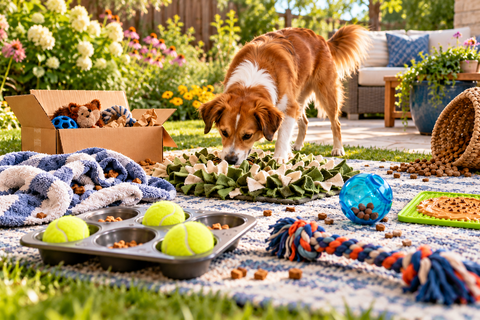
Try a Simple Muffin Tin Puzzle
A muffin tin can become an easy food-enrichment activity.
Place small treats into several compartments.
Cover some with appropriately sized, dog-safe balls.
Let your dog investigate and move the balls to access the rewards.
Start with only one or two covered compartments.
Increase the challenge gradually.
Make sure the balls are too large to swallow and cannot easily be torn apart.
Supervise the activity.
Why it works: The dog has to manipulate objects to access food rather than simply eating it immediately.
Make Training Part of Treat Time
Training is another form of food enrichment.
Instead of handing over treats randomly, use them to reward learning.
Practice:
Touching your hand with their nose.
Going to a mat.
Coming when called.
Offering a paw.
Learning a new trick.
Keep sessions short and positive.
Small freeze-dried rewards can be particularly useful because they're easy to portion.
Now the treat becomes part of an interactive experience between you and your dog.
Use Treats to Encourage Exploration
Some dogs enjoy investigating new objects and environments.
You can incorporate treats into supervised exploration games.
For example, place a few treats in different dog-safe containers.
Allow your dog to investigate each one.
Or create a simple cardboard-box search using clean paper and small rewards.
Avoid staples, tape, plastic packaging, or other materials that could be swallowed.
Remove the activity if your dog begins eating the containers or packaging.
The goal is encouraging investigation—not destruction.
Don't Make Every Puzzle Difficult
One of the easiest mistakes with food enrichment is increasing difficulty too quickly.
A puzzle that's too challenging may create frustration rather than enjoyment.
Start simple.
Let your dog succeed.
Then gradually make the activity more interesting.
For example:
Beginner: Treats clearly visible inside a towel fold.
Intermediate: Treats hidden inside several loose folds.
Advanced: Treats placed in different safe locations for a scent search.
The challenge should match your dog's experience and abilities.
Rotate Enrichment Activities Throughout the Week
You don't need to use the same food puzzle every day.
Try changing the experience.
Monday: Treat-searching game.
Tuesday: Food puzzle at mealtime.
Wednesday: Supervised natural chew.
Thursday: Five-minute training session.
Friday: Lick mat or food-stuffable toy.
Weekend: A new scent game or supervised DIY puzzle.
This introduces variety without requiring a completely different treat for every activity.
Choose Treats Based on the Activity
Different foods work better for different enrichment experiences.
For example:
| Enrichment Activity | Treat or Food Option |
| Training | Small pieces of freeze-dried chicken breast |
| High-value scent games | Small pieces of beef liver |
| Food puzzles | Appropriate portions of regular food |
| Meal topping | Crumbled freeze-dried animal treats |
| Supervised chewing | Appropriately sized bully sticks or collagen sticks |
| Licking activities | Suitable moist food or approved spreadable treats |
The goal is matching the food's size, texture, and aroma to the activity.
Don't Forget About Treat Calories
Food enrichment can make treats last longer as an activity.
But it doesn't make the calories disappear.
A large bully stick still contributes to overall food intake.
So does beef liver.
So do chicken hearts.
So does food placed inside a puzzle.
A commonly used guideline is to keep treats and extras within approximately 10% of daily calories unless your veterinarian recommends otherwise.
Using part of your dog's regular meal for enrichment can help prevent unnecessary extra calories.
More engagement doesn't have to mean more eating.
Watch for Signs Your Dog Enjoys the Activity
Food enrichment should be rewarding.
Watch how your dog responds.
Do they willingly investigate?
Use their nose?
Work through the puzzle?
Return to the activity?
Remain engaged without becoming frustrated?
Those behaviors can help you determine which activities your dog prefers.
If your dog loses interest or becomes frustrated, simplify the challenge or try another activity.
Not every dog enjoys every type of enrichment.
That's normal.
Safety Matters With Food Enrichment
Whether you're using treats, natural chews, or household items, supervision is important.
Consider:
Swallowing Hazards: Could your dog swallow part of the toy or chew?
Dental Safety: Is the chew too hard for your dog's teeth?
Food Safety: Is the food appropriate and handled correctly?
Materials: Could fabric, paper, or plastic be consumed?
Portions: Does the food fit the overall diet?
Remove damaged toys, undersized chew remnants, and unsafe materials.
Enrichment should provide an enjoyable challenge—not unnecessary risk.
You Don't Need Expensive Equipment
Some of the best food-enrichment activities use things already in your home.
A towel.
A cardboard box.
A muffin tin.
A familiar toy.
A few small treats.
An appropriately selected natural chew.
The value doesn't come from the price of the equipment.
It comes from giving your dog opportunities to engage in natural behaviors.
The Best Food Enrichment Starts With What Your Dog Enjoys
Some dogs love searching.
Others prefer licking.
Some are happiest learning new behaviors.
Others enjoy settling down with a natural chew.
At Raw Paws Pet Food, our freeze-dried treats and natural chews provide different ways to build those experiences into everyday routines.
Freeze-dried chicken breast can become tiny training rewards.
Beef liver can add excitement to scent games.
Chicken hearts and whole minnows introduce different animal-based aromas.
Bully sticks, collagen sticks, and beef cheek rolls provide opportunities for supervised chewing.
But the most important ingredient isn't necessarily what's inside the treat bag.
It's the activity you create around it.
Because making treat time last longer doesn't always require a longer-lasting treat.
Sometimes it simply requires giving your dog something interesting to do before the reward disappears.
Comments (0)
There are no comments for this article. Be the first one to leave a message!