

Put a compressed rawhide bone and a bully stick in front of a dog that loves to chew and you'll probably get enthusiasm for both.
But once chewing begins, the similarities start disappearing.
A bully stick gradually softens as the dog works through the beef tissue.
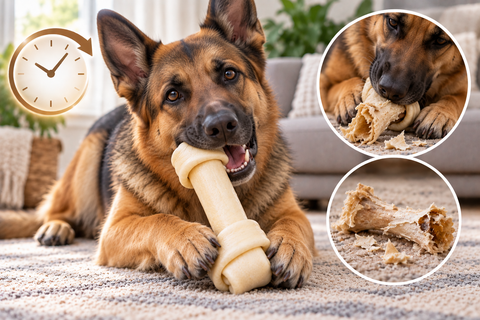
Compressed rawhide provides a dense structure that requires persistent gnawing, scraping, and softening.
Both can keep dogs engaged.
Both come from animal-based materials.
But they're not the same type of chew.
So instead of asking:
"Which one is better?"
Try asking:
"Which kind of chewing experience fits my dog?"
That question leads to a much more useful comparison.
Start With What They're Made From
The biggest difference is the material itself.
Bully sticks are made from beef pizzle.
Compressed rawhide is made from prepared animal hide that's pressed tightly together into a dense structure.
So even though both are commonly grouped under natural dog chews, they originate from different animal tissues.
That difference affects:
Texture.
Density.
How the chew softens.
How dogs work through it.
What happens when pieces are swallowed.
Understanding the ingredient is the first step toward understanding the experience.
A Bully Stick Is Designed to Be Gradually Consumed
A bully stick begins relatively firm.
Your dog starts chewing.
Saliva moistens the surface.
The tissue gradually softens.
Your dog continues working through it until the stick becomes smaller and is eventually consumed.
Because bully sticks are made from beef pizzle, they're digestible animal-tissue chews.
That makes them fundamentally different from hide-based products.
For dogs that enjoy steadily working from one end of a chew toward the other, bully sticks provide a straightforward and satisfying experience.
Compressed Rawhide Is About Dense, Persistent Gnawing
Compressed rawhide behaves differently.
Prepared hide is pressed tightly together under pressure to create a dense structure.
Rather than simply progressing through a stick of digestible animal tissue, the dog has to gradually work the hide.
That may involve:
Gnawing.
Scraping.
Softening.
Rotating.
Changing angles.
Returning to previously softened areas.
For dogs that enjoy persistent chewing and working on a substantial object, that density can become part of the attraction.
Think "Stick" vs. "Project"
Here's a simple way to picture the difference.
A bully stick often creates a relatively linear experience.
Your dog grabs the stick.
Chooses an end.
Works through it.
Repositions.
Keeps going.
A compressed rawhide bone can feel more like a project.
Your dog may work one surface.
Flip the bone.
Gnaw an edge.
Move to another section.
Return later.
That's not a scientific classification.
But it captures the practical difference many owners notice when watching dogs interact with the two products.
Which One Lasts Longer?
There's no universal answer.
A dense compressed rawhide bone may last considerably longer than a lighter bully stick for some dogs.
But bully sticks also come in different lengths and thicknesses, and a substantial jumbo bully stick can provide a much different experience from a thin one.
Then there's the biggest variable:
Your dog.
Chew time depends on:
- Product size
- Thickness
- Density
- Dog size
- Jaw strength
- Chewing intensity
- Individual technique
A gentle chewer can make almost anything last.
A power chewer can make almost anything look temporary.
Bully Sticks Give You More Length and Thickness Choices
One advantage of bully sticks is how easily you can adjust the experience through dimensions.
At Raw Paws Pet Food, bully sticks are available across different sizes and thicknesses.
A thin 6-inch stick creates one experience.
A standard version creates another.
A thicker or jumbo bully stick gives determined chewers considerably more material to work through.
Longer 12-inch options add additional length.
That allows owners to fine-tune the chew according to the dog rather than simply choosing "bully stick" as one universal size.
Thin vs. Thick Bully Sticks: Which Size Is Best for Your Dog? – Raw Paws Pet Food
Compressed Rawhide Gets Its Challenge From Density
Compressed rawhide achieves its substantial chewing experience differently.
The hide is packed tightly together.
That density creates resistance.
The dog has to gradually soften and work through the material rather than quickly consuming a lighter treat.
That's one reason compressed rawhide can provide longer engagement for dogs that chew methodically.
Digestibility Is an Important Difference
This is one of the biggest practical distinctions between the two.
Bully sticks are digestible animal tissue.
Rawhide doesn't digest in the same way.
As dogs work through compressed rawhide, small pieces may be swallowed and generally pass through the digestive tract rather than breaking down like a bully stick.
That's why owners need to pay particular attention to how a dog works through rawhide.
Small pieces and large torn sections aren't the same thing.
If your dog separates a piece that concerns you, remove it.
Compressed Construction Helps Change How Rawhide Separates
Traditional rawhide may be rolled, folded, layered, twisted, or knotted.
Compressed rawhide takes prepared hide and presses it tightly together.
That construction is designed to reduce the tendency for large layers to separate compared with less densely constructed rawhide products.
It doesn't make the chew indestructible.
Pieces can still become torn during use.
Supervision remains necessary.
But compression creates a different physical structure from the traditional rolled rawhide many owners picture.
Which Is Better for a Power Chewer?
It depends on how the dog power chews.
A dog that quickly works through thin bully sticks may benefit from a thicker bully stick.
More diameter means more digestible beef tissue to work through at each section.
Another dog may particularly enjoy the dense resistance of a substantial compressed rawhide bone.
Watch the technique.
Does your dog gnaw methodically?
Or try to tear and swallow pieces?
A persistent gnawer may be a better candidate for compressed rawhide than a dog that aggressively attempts to remove large sections.
Bully Sticks for Power Chewers: Does Thickness Matter? – Raw Paws Pet Food
Which Is Better for a Dog That Likes to Finish the Chew?
Some dogs apparently believe leaving leftovers is unacceptable.
For these dogs, a bully stick may provide the more intuitive experience because it's an edible chew designed to be gradually consumed.
Compressed rawhide isn't meant to become a challenge to see how quickly the dog can swallow the entire product.
It's better suited to dogs that gradually gnaw and work the material.
Again, chewing behavior matters.
What About Odor?
Bully sticks can have a noticeable natural animal aroma because they're made from real beef tissue.
The odor may become stronger as saliva rehydrates the chew.
Compressed rawhide has its own characteristic scent, but the experience isn't identical because the material and processing are different.
For households particularly sensitive to bully-stick aroma, compressed rawhide may provide a noticeably different experience.
But odor can vary among natural products, so individual chews won't necessarily be identical.
Bully Sticks Contribute Calories
Because bully sticks are consumed as edible animal tissue, they contribute calories to the dog's daily intake.
That matters when deciding:
How frequently to offer them.
What size to choose.
How many other treats the dog receives.
A bully stick used for enrichment is still food.
If your dog finishes one quickly, that doesn't mean you should automatically hand over another because the activity ended sooner than expected.
The calories still count.
Both Need Supervision—For Different Reasons
Supervision matters with both chews.
With Bully Sticks
Monitor the remaining piece as the stick becomes shorter.
Remove it before it becomes small enough for your dog to attempt to swallow whole.
With Compressed Rawhide
Monitor how the material changes.
Remove torn pieces when appropriate.
Take the chew away once it becomes too small or if your dog attempts to swallow substantial portions rather than gradually gnawing.
Different chew.
Different behavior.
Same rule:
Stay involved.
You Don't Have to Choose Only
One This may be the easiest answer.
A dog that enjoys both products doesn't necessarily need an exclusive commitment.
They can serve different roles within a chew rotation.
For example:
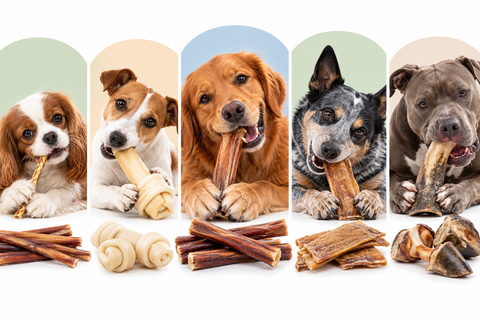
Bully Stick: Digestible, gradually consumable beef chew.
Compressed Rawhide: Dense hide-based gnawing experience.
Collagen Stick: Another beef-based texture.
Beef Cheek Roll: Broader layered chewing project.
Ear: Lighter crunchy option.
Now your dog isn't repeating exactly the same chewing activity every time.
Different structures create different challenges.
Let Your Dog's Technique Make the Decision
The best comparison happens on the floor, not on the package.
Watch your dog with each appropriately sized chew during separate supervised sessions.
With the bully stick:
Do they work steadily from one end?
How quickly do they consume it?
Would more thickness improve the experience?
With compressed rawhide:
Do they gnaw gradually?
Rotate the bone?
Work patiently?
Or immediately attempt to tear away substantial pieces?
Those observations tell you which product better matches your dog's natural chewing style.
Two Natural Chews With Very Different Jobs
Bully sticks and compressed rawhide don't need a winner.
They're too different for that comparison to be especially useful.
A bully stick provides a digestible beef-pizzle chew that gradually softens and is consumed.
A compressed rawhide bone provides a dense hide-based structure designed for persistent gnawing and a different style of engagement.
At Raw Paws, we offer both because dogs don't all want the same chewing experience.
Some want the stick.
Some want the project.
Plenty want whatever you're currently holding.
The important part is understanding what you're giving them, choosing an appropriate size, supervising the session, and watching how your individual dog responds.
Because the right chew isn't determined by which product wins on paper.
It's determined by which chewing experience fits the dog.
Comments (0)
There are no comments for this article. Be the first one to leave a message!