

If you asked another pet owner whether they’d ever switch to a raw food diet, chances are you’d hear hesitation before anything else.
Not because they’ve tried it and it didn’t work—but because of what they’ve heard.
Raw feeding tends to come with strong opinions, and many of those opinions are built on outdated assumptions rather than on how dogs and cats are actually designed to eat. That creates confusion, and for many pet parents, confusion turns into avoidance.
So instead of adding more noise, let’s simplify things by clearing up some of the most common misconceptions.
Myth 1: Dogs Can Only Get Proper Nutrition from Dry Food
Dry food is often positioned as the “complete” option, but completeness on a label doesn’t always reflect how food functions in the body.
Many commercial diets rely on heavily processed ingredients and fillers to meet nutritional targets. While they may check the boxes on paper, they don’t always align with what a dog’s system naturally expects to process.
A more useful way to think about nutrition is this: it’s not just about hitting numbers—it’s about where those nutrients come from and how easily the body can use them.
Understanding Guaranteed Analysis on Pet Food Labels
Myth 2: Raw Meat Is Unsafe Because of Bacteria
This is probably the most common concern—and it usually comes from comparing human digestion to canine digestion.
They’re not the same.
Dogs have:
- Shorter digestive tracts
- Higher stomach acidity
- Faster digestion timelines
These factors work together to help them process raw foods efficiently.
That said, raw feeding still requires the same level of care you’d use in your own kitchen—clean surfaces, proper storage, and good handling habits. When approached that way, it becomes a very manageable and straightforward process.
Myth 3: Dogs Are True Omnivores and Need a High-Carb Diet
Dogs can handle a variety of foods, but their biology tells a clearer story.
Their teeth, jaw movement, and digestive system are all structured around processing animal-based foods first and most efficiently.
That’s why raw feeding approaches tend to center around:
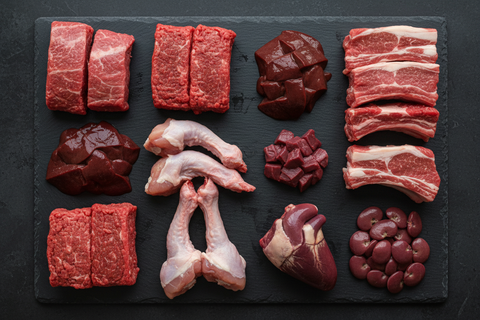
- Meat
- Bone
- Organ
Some feeding styles incorporate additional ingredients, while others keep things closer to a whole prey model.
There’s flexibility in how people feed—but the foundation stays the same.
Myth 4: Raw Bones Are Dangerous
The concern around bones usually comes from experiences with cooked bones, which behave very differently.
Cooked bones can become brittle and lose their natural structure.
Raw bones, on the other hand, maintain their integrity. They’re designed to be worked through—providing resistance without breaking apart unpredictably.
When the size matches the dog, raw bones become a natural extension of chewing behavior rather than a hazard.
They also provide added benefits through the act of chewing itself - supporting teeth, jaw engagement, and overall interaction.
Myth 5: Cooking Food Makes It Better for Dogs
Cooking feels like an upgrade - but nutritionally, it’s a trade-off.
Heat changes the structure of proteins, reduces certain vitamins, and alters how fats behave. That doesn’t make cooked food “bad,” but it does mean the food is no longer in its original state.
To compensate, many cooked diets require added ingredients or careful balancing to maintain nutritional integrity.
Raw feeding takes a different approach - it starts with food that’s already in its natural form.
Most of these myths come from trying to fit dogs into a human-centered way of thinking about food. But dogs don’t need food to be reworked to make sense. They’re already built to process it. When you shift the perspective from “what seems right to us” to “what works for them,” things become much clearer.
Raw feeding isn’t complicated—it’s just unfamiliar to many people.
Once you move past the myths, what’s left is a feeding approach that focuses on real food, natural structure, and how a dog’s body actually functions.
And sometimes, the most effective way to feed your dog isn’t about improving the food.
It’s about not overcomplicating it in the first place.
Comments (0)
There are no comments for this article. Be the first one to leave a message!