

Pet food labels look precise.
Protein. Fat. Fiber. Moisture. Clean numbers, easy to compare.
But here’s the shift most people never make:
Guaranteed analysis isn’t telling you exactly what’s in the food—it’s telling you the limits the food must fall within.
Once you see that, the label reads completely differently.
What Guaranteed Analysis Is Actually Showing
Every pet food label includes:
- Minimum protein
- Minimum fat
- Maximum fiber
- Maximum moisture
“Minimum” means at least that amount is present.
“Maximum” means it won’t exceed that number.
That’s it.
It’s not an exact measurement—it’s a range.
Think of it like guardrails on a road.
They show where the edges are, but not exactly where the car is driving.
Why Two Labels Can Look the Same—but Be Completely Different
You can place two pet foods side by side with nearly identical guaranteed analysis numbers… and still be looking at two very different products.
Why?
Because the label doesn’t tell you:
- where the nutrients come from
- how the food is processed
- how the body will actually use those nutrients
This is where ingredient quality and food structure matter more than percentages alone.
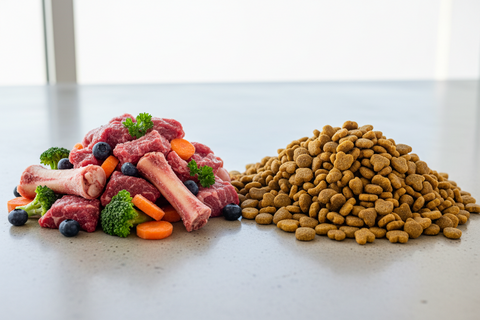
Foods that stay closer to their original state tend to behave differently in the body than heavily processed options—even if the label numbers look similar.
Moisture: The Detail That Changes Everything
Moisture is the hidden variable behind every guaranteed analysis panel.
Dry foods often show higher protein percentages simply because water has been removed.
Raw or fresh foods may show lower percentages—not because they contain less protein, but because water is part of the food itself.
It’s the difference between:
- something concentrated
- and something complete
When you compare foods, you’re not just comparing nutrients—you’re comparing how those nutrients are presented.
Fiber and Fat: What You’re Really Looking At
Fiber and fat are listed as limits, not exact values.
That means:
- Fiber won’t exceed the number shown
- Fat won’t drop below the number shown
But the actual amount could sit anywhere within that range.
So again—you’re seeing boundaries, not specifics.
When Guaranteed Analysis Is Useful
Despite its limits, guaranteed analysis still has a role.
It helps you:
- confirm that essential nutrients are present
- compare similar types of food
- ensure baseline nutrition is met
It’s a checkpoint—not a full evaluation.
Reading Beyond the Label
Instead of relying only on the numbers, step back and ask:
- What ingredients are creating these values?
- How much of this food is water?
- Does this resemble real, whole food?
Because your dog isn’t interpreting percentages—they’re responding to the actual structure of the food.
Final Thought
Guaranteed analysis feels like a clear answer.
But it’s really just a framework.
It defines the limits, not the full picture.
The real understanding comes from looking beyond the label—at ingredients, moisture, and how the food behaves once it’s served.
Shop natural dog food and treats here!
Because in the end, your dog isn’t eating numbers.
They’re eating what’s actually there.
Comments (0)
There are no comments for this article. Be the first one to leave a message!