

Your cat just finished dinner.
The bowl is empty.
They're satisfied.
Then something moves across the floor.
Suddenly, your well-fed house cat crouches low, eyes widen, back legs prepare to spring—and the hunt is on.
Maybe the target is a feather wand.
Maybe it's a toy mouse.
Maybe it's your foot moving underneath a blanket.
Whatever caught their attention, one thing seems strange:
Why would a cat want to hunt when they're not hungry?
Because hunting and hunger aren't the same thing.
Cats don't hunt only because they need calories. The behaviors involved in hunting are deeply rooted instincts that can be triggered by movement, sound, scent, and opportunity—even when a cat has just eaten.
For an indoor cat, understanding that difference can completely change the way we think about play.
The Hunt Begins Before Food Ever Enters the Picture
Imagine a cat watching a small object move across the floor.
Their body changes almost instantly.
The head lowers.
The eyes lock onto the target.
Movement becomes slower and more deliberate.
The cat isn't stopping to ask:
"Am I hungry enough for this?"
The movement itself has triggered something.
Cats evolved as hunters, and responding quickly to potential prey was important. Waiting until they were extremely hungry before showing interest in prey would have been a poor survival strategy.
The instinct to investigate an opportunity can therefore exist independently from the immediate desire to eat.
Hunting Is Actually a Sequence of Behaviors
We often use the word hunt as though it's one action.
For cats, it's more like a chain.
A typical hunting-style sequence can include:
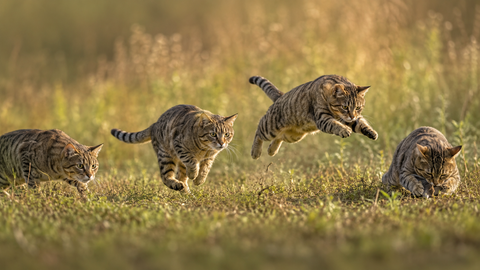
Notice → Watch → Stalk → Chase → Pounce → Grab
Not every play session includes every step.
Sometimes your cat watches for several minutes and never moves.
Sometimes they immediately chase.
Sometimes the most exciting part is the pounce.
Understanding this sequence helps explain why interactive play can be so engaging.
The cat isn't simply exercising.
They're moving through behaviors their body already knows how to perform.
Movement Can Flip the Switch
Have you ever bought your cat an expensive toy only to watch them ignore it?
Then you move it.
Everything changes.
A stationary object may not provide much information.
An object that darts behind a chair, disappears around a corner, pauses, and suddenly moves again feels completely different.
Unpredictable movement resembles the kind of visual stimulus that naturally captures a predator's attention.
That's why the way you use a toy can matter more than the toy itself.
A feather wand lying on the floor is an object.
A feather wand disappearing behind the couch can become prey
The Stalk Is Part of the Fun
People naturally focus on the chase.
Cats often spend just as much time preparing for it.
Watch your cat carefully during interactive play.
They may:
- Freeze in place
- Lower their body
- Watch intensely
- Move forward slowly
- Hide behind furniture
- Wait for the perfect moment
Nothing dramatic appears to be happening.
But mentally, your cat is fully engaged.
The stalking phase allows them to observe, predict movement, and decide when to act.
That's one reason cat enrichment doesn't always need to involve nonstop running.
Sometimes the quietest part of play is where the most concentration happens.
Indoor Cats Still Have Outdoor Instincts
Living indoors changes a cat's environment.
It doesn't erase the cat.
Indoor cats still possess natural drives to:
- Climb
- Scratch
- Explore
- Hide
- Watch
- Stalk
- Chase
- Pounce
The difference is that opportunities to express those behaviors have to come from the environment we create for them.
That's where enrichment becomes so valuable.
Cat trees create climbing opportunities.
Scratchers provide appropriate scratching surfaces.
Window perches encourage observation. Interactive toys provide something to stalk and chase.
The goal isn't recreating the outdoors inside your living room.
It's giving natural behaviors somewhere appropriate to go.
Play Can Become a Miniature Hunt
Interactive toys work particularly well because you control the movement.
Instead of waving a wand continuously in front of your cat's face, think more like prey.
Move it away from the cat.
Let it disappear.
Pause.
Make it dart across an open area.
Hide it behind furniture.
Then let your cat catch it.
Those changes create a much richer experience than constant random movement.
Your cat gets opportunities to observe, predict, chase, and succeed.
Why Interactive Cat Toys Are Essential for Indoor Cats – Raw Paws Pet Food
Catching Matters Too
Imagine playing a game you could never win.
Eventually, you'd probably stop playing.
Cats need opportunities to successfully capture the toy during interactive play.
Let them pounce.
Let them grab it.
Give them a moment with their "catch."
Then begin another round.
That success completes more of the hunting-style experience and prevents the activity from becoming an endless chase with no payoff.
Food Can Add a Rewarding Finish
Hunting behavior and hunger are separate, but that doesn't mean food can't become part of enrichment.
A small animal-based treat after interactive play can provide a rewarding conclusion to the activity.
For example, a cat might:
Stalk a wand toy.
Chase it.
Pounce.
Capture it.
Then receive a small piece of Freeze-Dried Chicken Heart, Chicken Breast, Beef Liver, or Whole Minnow.
Now the activity connects movement, problem-solving, and a food reward without requiring a large amount of food.
For cats that enjoy food-based enrichment, this can make interactive sessions even more engaging.
Whole-Fish Treats Create an Interesting Connection
Freeze-Dried Whole Minnows are particularly interesting within hunting-style enrichment because they retain the recognizable structure and aroma of a small fish.
They can be offered after interactive play or incorporated into supervised food-search activities.
The goal isn't pretending your indoor cat needs to hunt for survival.
They don't.
It's allowing food and play to become tools for expressing behaviors that are already naturally present.
Can Cats Eat Minnows? A Guide to Whole-Fish Treats for Cats – Raw Paws Pet Food
Not Every Cat Hunts the Same Way
One cat may launch across the room after anything that moves.
Another prefers hiding beneath a chair and waiting.
A third may watch a toy intensely for several minutes before making one perfectly timed pounce.
All three can be expressing hunting behavior.
Age, personality, experience, physical ability, and individual preference influence how cats play.
That's why enrichment works best when you watch the cat rather than follow a rigid formula.
Your cat will show you which part of the hunt they enjoy most.
Hunting Doesn't Mean Your Cat Is Still Hungry
This is the important takeaway.
If your cat finishes dinner and immediately chases a toy, that doesn't necessarily mean the meal wasn't satisfying.
The food addressed one need.
The activity addressed another.
Nutrition and enrichment overlap, but they aren't interchangeable.
A full stomach doesn't eliminate curiosity.
It doesn't eliminate play.
And it certainly doesn't eliminate millions of years of feline hunting instinct.
Feed the Cat. Enrich the Hunter.
Your indoor cat may never need to catch a meal.
That's a wonderful thing.
But the behaviors that once helped cats obtain those meals are still very much alive.
The focused stare.
The slow stalk.
The sudden chase.
The perfectly timed pounce.
Those behaviors aren't signs that something is missing from the food bowl.
They're signs that there's still a hunter living inside the house cat.
Give that hunter appropriate opportunities to come out.
Move the toy.
Let them stalk.
Let them chase.
Let them catch.
And don't be surprised when it happens five minutes after dinner.
Your cat may be completely full.
Their instincts aren't.

Comments (0)
There are no comments for this article. Be the first one to leave a message!