

Spend a few minutes looking at today's pet food options, and you'll quickly notice one word appearing again and again:
Processed.
Some foods are baked.
Some are extruded.
Some are air-dried.
Some are freeze-dried.
Others are served frozen.
Every pet food undergoes some level of processing. After all, food has to be prepared, packaged, and preserved before it reaches your home.
The real question isn't whether a food is processed.
It's how much it's processed.
That's where minimally processed pet food stands apart.
Rather than transforming ingredients into something entirely new, minimally processed foods aim to preserve as much of the original ingredient as possible while making it practical to feed every day.
Processing Isn't Automatically Good or Bad
The word processed often creates confusion.
Many people assume all processing is harmful.
Others assume processing doesn't matter at all.
The truth is much more balanced.
Every preservation method changes food to some degree.
The important question becomes:
How closely does the finished product still resemble the ingredient it started as?
Minimally processed foods prioritize preserving the ingredient instead of completely rebuilding it.
That philosophy shapes everything from appearance to texture and overall feeding experience.
The Ingredient Stays the Star
Imagine holding a piece of freeze-dried chicken breast.
It still looks like chicken.
It still smells like chicken.
It still feels like chicken.
That's intentional.
Minimally processed foods allow recognizable ingredients to remain recognizable.
Instead of hiding the ingredient inside a complex formula, the ingredient becomes the focus.
For many pet owners, that transparency creates confidence because it's immediately clear what they're feeding.
Less Transformation, More Preservation
One of the defining characteristics of minimally processed pet food is its emphasis on preserving rather than reinventing.
Depending on the product, preservation methods may include:
- Freezing
- Freeze-drying
- Gentle air-drying
Each method is designed to extend freshness while helping maintain much of the ingredient's natural structure.
Freeze-Dried vs. Dehydrated Treats: What's the Difference? – Raw Paws Pet Food
The goal isn't to manufacture a completely new food.
It's to help preserve the one that already exists.
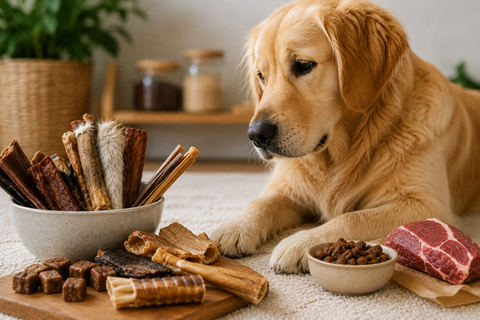
Whole Foods Stay Recognizable
One of the easiest ways to identify minimally processed food is simply by looking at it.
Many products still resemble:
- Muscle meat
- Organ meat
- Whole fish
- Raw meaty bones
The ingredient hasn't disappeared beneath layers of manufacturing.
It remains visible.
That visual connection reinforces the idea that nutrition begins with real food rather than a collection of isolated ingredients.
Simplicity Extends to the Ingredient List
Many minimally processed foods also share another characteristic:
Short ingredient panels.
Instead of relying on lengthy formulations, they often begin with whole animal ingredients that naturally provide protein, fats, vitamins, and minerals together.
The emphasis shifts away from creating complexity and toward preserving simplicity.
Why Whole Foods Matter More Than Highly Processed Ingredients – Raw Paws Pet Food
For many pet owners, understanding the food becomes much easier when the ingredient list reflects the food itself.
Texture Changes the Feeding Experience
Minimally processed foods don't simply look different.
They feel different.
A freeze-dried chicken heart has a different texture than a heavily manufactured biscuit.
A frozen raw recipe offers a different eating experience than a dry pellet.
Texture influences how dogs and cats:
- Smell food
- Chew food
- Interact with meals
- Experience rewards
These differences help explain why many pets respond so enthusiastically to minimally processed foods.
Different Preservation Methods, Shared Philosophy
Not every minimally processed product looks identical.
Frozen raw recipes.
Freeze-dried treats.
Air-dried foods.
Each follows its own preservation method.
What connects them is the underlying philosophy:
Maintain as much of the original ingredient as possible.
Rather than asking how much the ingredient can be changed, minimally processed feeding asks how much can be preserved.
Why More Pet Owners Are Choosing This Approach
Many people are paying closer attention to ingredient labels than ever before.
They want foods that are:
- Easy to recognize.
- Easy to understand.
- Built around real ingredients.
- Consistent with a whole-food philosophy.
Minimally processed foods naturally align with those goals because they emphasize ingredient integrity rather than ingredient transformation.
That doesn't make them the only option.
But it does explain why they're becoming increasingly popular among pet owners seeking greater transparency.
Sometimes Less Really Is More
Minimally processed pet food isn't defined by what gets added.
It's often defined by what doesn't have to be changed.
The ingredient remains recognizable.
The food stays closer to its original form.
The nutritional story begins with the ingredient itself rather than the manufacturing process.
At its core, minimally processed feeding isn't about chasing trends.
It's about preserving the value that already exists in real food.
Because sometimes the best way to improve nutrition isn't creating something new.
It's protecting what nature already created.
Comments (0)
There are no comments for this article. Be the first one to leave a message!