

You buy a dog chew labeled "long-lasting."
Your dog grabs it.
Runs to their favorite spot.
And fifteen minutes later?
It's gone.
Meanwhile, another dog owner claims the exact same type of chew lasts their dog for days.
So what gives?
Is one chew better?
Is your dog simply too strong?
Or is there something else determining how long a natural dog chew actually lasts?
The truth is that chew duration isn't determined by one thing.
The material, thickness, density, construction, and the dog doing the chewing all influence how long a product lasts.
And while some chews are naturally more substantial than others, no product can guarantee the same chewing time for every dog.
Here are six factors that actually matter—and how understanding them can help you choose a better chew.
1. The Material: What Is the Chew Made From?
This is the first major difference.
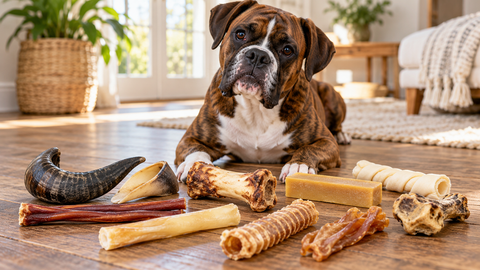
Natural dog chews come from a wide variety of animal tissues, and those tissues don't behave identically.
Consider a few examples.
Bully Sticks: Made from beef pizzle.
Collagen Sticks: Made from collagen-rich animal tissue.
Beef Cheek Rolls: Made from prepared beef cheek tissue.
Cow Ears: Made from cattle ear tissue.
Compressed Rawhide: Made from prepared animal hide pressed into a dense structure.
Yak Chews: Made from hardened milk-based ingredients.
Each material has different physical characteristics.
A thin ear doesn't behave like a dense collagen stick.
A bully stick doesn't soften like a hardened yak chew.
And a broad beef cheek roll creates a different experience from a narrow stick.
The ingredient determines the starting structure of the chewing experience.
Why Material Matters More Than the Product Name
Sometimes dog chews look similar from the outside.
Two sticks may be nearly identical in length.
But if one is made from beef pizzle and the other from collagen-rich tissue, the chewing experience can be completely different.
That's because the material influences:
Texture.
Flexibility.
Resistance.
How moisture changes the chew.
How the dog works through it.
So before comparing prices or sizes, start by understanding what the product actually contains.
Dog Chew Types Explained: Bully Sticks, Rawhide, Collagen & More – Raw Paws Pet Food
2. Thickness: How Much Material Is There to Work Through?
Thickness is one of the easiest factors to overlook.
Imagine two bully sticks.
Both are six inches long.
One is thin.
The other is jumbo.
They're the same length.
But they don't contain the same amount of material.
The thicker bully stick gives your dog more to work through across its diameter.
That can create a more substantial chewing challenge.
The same general principle applies to collagen sticks and other similarly shaped chews.
Length tells you how far the chew extends. Thickness tells you how much material your dog encounters across it.
Why Increasing Thickness Can Be More Useful Than Increasing Length
Suppose your dog finishes a thin six-inch bully stick quickly.
You replace it with a thin twelve-inch stick.
Now your dog has more total length.
But the diameter hasn't necessarily changed.
Your dog may still work through each section using the same efficient technique. Increasing thickness changes how much material is present at each section.
For some enthusiastic chewers, that's a more meaningful adjustment.
Thin vs. Thick Bully Sticks: Which Size Is Best for Your Dog? – Raw Paws Pet Food
3. Density: How Tightly Packed Is the Material?
Two chews can be similar in size but feel completely different.
One may be relatively light.
Another may be much denser.
Density influences how much material is contained within a given volume and how the product responds to chewing.
Compressed rawhide is a useful example.
Prepared hide is pressed tightly together to create a dense structure rather than relying primarily on rolled or folded layers.
That density can create more resistance as dogs gradually work through the material.
However, density isn't the same thing as safety.
An extremely hard, dense chew may create dental concerns for dogs that bite down aggressively.
The goal isn't maximum density.
It's appropriate resistance.
Why Harder Doesn't Always Mean Longer-Lasting Value
Yak chews, horns, hooves, and recreational bones are known for their firmness.
Some can remain intact through multiple chewing sessions.
But extremely hard products can increase the risk of tooth fractures.
That means a chew lasting longer isn't automatically a better purchase.
A more forgiving edible chew may provide a shorter session while being a more appropriate match for the individual dog's teeth and chewing behavior.
Durability should never be evaluated separately from dental safety.
4. Construction: How Is the Chew Put Together?
Material and construction aren't the same thing.
Two products can begin with similar animal tissues and still behave differently because they're formed in different ways.
Consider rawhide.
Traditional rawhide may be:
- Rolled
- Folded
- Twisted
- Knotted
- Layered
Compressed rawhide uses pressure to create a tighter, denser structure.
Beef cheek rolls introduce another construction style through their broad rolled shape.
Collagen sticks are processed into a narrower stick format.
Those differences influence how dogs hold, soften, and work through each product.
Shape Can Change the Entire Chewing Technique
Think about the difference between a stick and a roll.
A stick often encourages dogs to begin at one end and work along its length.
A broad roll gives them more surface area.
They can work an edge.
Rotate the product.
Switch sides.
Return to another section.
That physical manipulation can influence how long the chewing session lasts.
It can also change how engaged the dog remains.
Sometimes the best way to introduce a new challenge isn't buying a harder chew.
It's changing the shape.
5. Dog Size and Jaw Strength: Who's Doing the Chewing?
Now we get to the dog.
A small dog and a large dog may have very different experiences with the same natural chew.
Larger dogs often have greater jaw strength and larger mouths, allowing them to apply more force to substantial chews.
But body size isn't the entire story.
A large gentle chewer may spend hours with a product that a smaller determined chewer finishes much faster.
That's why choosing chews exclusively by breed or weight can be misleading.
Dog size helps determine appropriate chew dimensions. Jaw strength helps influence how quickly the material can be worked through.
Small Dogs Aren't Always Gentle Chewers
Some small dogs are surprisingly determined.
Terriers are a good example of dogs that may approach chewing with considerable persistence.
Meanwhile, a large senior dog may carefully nibble.
The lesson?
Don't assume your dog's chewing style based only on appearance.
Watch what happens when they receive a chew.
How quickly do they make progress?
How much force do they use?
Do they take breaks?
Those observations help predict chew time far better than weight alone.
6. Chewing Style: The Biggest Wild Card
This may be the most important factor of all.
Dogs don't approach chewing identically.
Some nibble.
Some gnaw steadily.
Some scrape.
Some soften one section before moving forward.
Others immediately position the chew between their back teeth and apply significant pressure.
Even two dogs of similar size can finish identical chews at dramatically different speeds.
That's why chewing style is often the biggest variable in real-world durability.
Gentle Chewers vs. Power Chewers
A gentle chewer may take frequent breaks and work through small amounts at a time.
A power chewer may remain focused until the entire chew is finished.
Consider the difference.
Gentle Chewer: Nibbles, rotates, rests, returns later.
Moderate Chewer: Makes steady progress.
Persistent Chewer: Works continuously but methodically.
Power Chewer: Applies substantial pressure and may finish lighter chews quickly.
The same product can create completely different durations across those four styles.
Best Natural Dog Chews by Chewing Style: Gentle to Power Chewers – Raw Paws Pet Food
Saliva Changes the Chew During Use
There's another factor worth understanding.
Many natural chews don't remain exactly the same throughout a session.
Saliva gradually moistens the material.
The surface softens.
The dog begins making more progress.
This is particularly noticeable with edible animal-tissue chews such as bully sticks, collagen sticks, and beef cheek rolls.
A dog may spend considerable time softening one area before suddenly working through it more quickly.
That changing texture helps explain why chew time isn't always consistent from beginning to end.
Why One Dog's "Three-Day Chew" May Be Another Dog's Thirty-Minute Treat
Online reviews often describe chew duration.
One owner says:
"Lasted three days!"
Another says:
"Gone in half an hour."
Both experiences may be accurate.
But they don't necessarily mean the products performed inconsistently.
The dogs may differ in:
Size.
Jaw strength.
Chewing intensity.
Technique.
Break-taking behavior.
The individual chews may also differ in thickness or density.
That's why chew-time reviews are useful as general context—not guarantees.
Longer-Lasting Doesn't Always Mean Better Enrichment
It's tempting to judge every chew by how many minutes it lasts.
But duration isn't the only measure of value.
A chew that lasts forty minutes and keeps your dog actively engaged may provide a more satisfying experience than one that lasts several days because your dog barely touches it.
Look for signs of engagement.
Does your dog:
Settle down with the chew?
Hold it between their paws?
Work different sections?
Remain interested?
Return to it during an appropriate supervised session?
Those behaviors help you understand whether the chew is actually enjoyable.
How to Choose a Longer-Lasting Chew Without Guessing
Start with your dog's current favorite.
Ask:
What material is it made from?
How thick is it?
How dense is it?
What shape does it have?
How large is my dog?
How aggressively does my dog chew?
Now you have a useful starting point.
If your dog loves a thin bully stick but finishes it quickly, try a thicker option.
If your dog is extremely efficient with stick-shaped chews, consider a different structure such as an appropriately sized beef cheek roll.
If your dog struggles with very hard products, choose something more forgiving rather than increasing hardness.
Don't Forget That Edible Chews Count as Food
A longer-lasting chew may feel like a toy.
But if your dog gradually consumes it, the material contributes to overall food intake.
That includes products such as:
Bully sticks.
Collagen sticks.
Beef cheek rolls.
Ears.
Other edible natural chews.
If your dog finishes one quickly, don't automatically hand over another simply because the activity ended sooner than expected.
The calories still count.
Treats should complement a complete and balanced primary diet.
Supervision Matters Regardless of Durability
A chew labeled long-lasting isn't automatically safe to leave with your dog unattended.
As chewing continues, the product may:
Become smaller.
Soften.
Break into pieces.
Develop sharp edges.
Change shape.
Remove the chew if substantial pieces separate, your dog attempts to swallow large portions, or the remaining piece becomes small enough to swallow whole.
For extremely hard chews, also watch for forceful crushing behavior that could damage teeth.
The product's condition can change throughout the session.
Supervision allows you to respond.
Build Variety Instead of Chasing Maximum Durability
Sometimes owners become focused on finding one chew that lasts longer than everything else.
But a varied chew rotation can provide different kinds of engagement.
For example:
Bully Stick: Familiar gradually softening chew.
Collagen Stick: Different animal-tissue texture.
Beef Cheek Roll: Broad rolled chewing project.
Cow Ear: Lighter crunchy activity.
Lamb Ear: Smaller natural chew.
Compressed Rawhide: Dense hide-based gnawing for dogs that handle it appropriately.
Different products provide different textures and physical challenges.
That variety can be more interesting than relying on one extremely hard product.
The Six Factors Work Together
So what actually makes a dog chew long-lasting?
It's not one secret ingredient.
It's the combination of six factors:
1. Material: What animal tissue or ingredient is used.
2. Thickness: How much material exists across the chew.
3. Density: How tightly packed or resistant the material is.
4. Construction: How the chew is formed and shaped.
5. Dog Size & Jaw Strength: How much physical force the dog can apply.
6. Chewing Style: How efficiently and persistently the dog works.
Change any one of those variables and the chewing experience may change.
That's why the same product can perform so differently from dog to dog.
The Best Long-Lasting Chew Fits the Dog
At Raw Paws Pet Food, our natural chew collection includes bully sticks, collagen sticks, beef cheek rolls, ears, compressed rawhide, yak chews, and other options designed to provide different chewing experiences.
Some are lighter.
Some are thicker.
Some are denser.
Some are gradually consumed.
Others are primarily recreational gnawing products.
But the best chew isn't necessarily the hardest, thickest, or most expensive.
It's the one that matches your dog's size, chewing style, dental health, and preferred level of engagement.
Start by understanding the material. Look at thickness and construction. Consider your dog's jaw strength.
Watch how they chew.
Then adjust.
Because when it comes to long-lasting natural dog chews, the secret isn't finding one chew that lasts forever. It's finding the right combination of chew and dog.
Comments (0)
There are no comments for this article. Be the first one to leave a message!