

Bully sticks get plenty of attention.
So do pig ears.
Cow ears are easy to recognize.
But sitting quietly in the natural-chew world is another option that deserves a closer look:
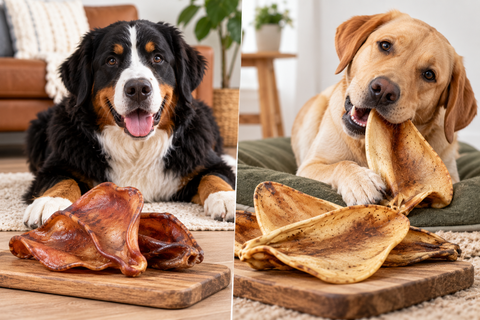
Lamb ears offer many of the qualities owners appreciate about natural animal-based chews, but in a naturally smaller, lighter format.
That can make them especially interesting for smaller dogs, gentle chewers, or owners looking for a chew that doesn't need to become an hour-long project.
They're also made from lamb, which introduces a different animal protein into a treat cabinet often dominated by beef, chicken, and pork.
So what exactly makes lamb ears worth knowing?
Quite a bit.

What Are Lamb Ear Dog Chews?
A lamb ear chew is exactly what the name suggests.
It's a prepared and dried ear from a lamb.
Rather than grinding the animal tissue and combining it with other ingredients to create a manufactured treat, the recognizable ear remains the chew.
That creates a naturally:
- Thin
- Lightweight
- Crunchy
- Irregularly shaped
product.
For owners interested in simple animal-based treats and chews, that straightforward format is part of the appeal.
Lamb Ears Are Naturally Smaller
This is probably the most obvious distinction.
Compare the ear of a lamb with the ear of a cow.
They're simply not the same size.
That translates directly into the finished chew. Lamb ears generally provide a smaller chewing experience than larger cow ears and many pig ears, making them particularly interesting when a full-size cattle ear feels like more chew than you need.
Small doesn't mean uninteresting.
It simply gives owners another portion and size option.
Smaller Dogs Finally Get an Ear That Makes Sense
Natural chews are sometimes designed around medium and large dogs.
For small dogs, that can make shopping frustrating.
A huge cow ear may look more like a blanket.
A thick jumbo bully stick may be unnecessary.
A substantial beef cheek roll can become an enormous project.
Lamb ears help fill the gap.
Their naturally smaller dimensions can make them easier for small dogs to:
Hold.
Reposition.
Crunch.
Work around.
That doesn't mean every lamb ear is automatically appropriate for every small dog.
Sizing and supervision still matter.
But the natural scale can be a particularly good starting point.
They're Not Just for Small Dogs
Don't let the size create another misconception.
A large dog can enjoy a lamb ear too.
It simply becomes a lighter, shorter chewing experience.
That's useful when you don't necessarily want to give your dog the most substantial chew in the cabinet.
Think of lamb ears as one option within a range.
Lamb Ear: Smaller, lighter chew.
Cow Ear: Broader ear-style chew.
Bully Stick: More substantial stick-style activity.
Beef Cheek Roll: Larger chewing project.
Different occasions can call for different products.
Lamb Introduces Another Animal Protein
Many dogs receive a lot of:
Chicken.
Beef.
Pork.
There's nothing wrong with those proteins.
But lamb creates another option.
A lamb ear allows you to introduce a different animal source without needing a complicated multi-ingredient recipe.
That can make lamb ears particularly useful for owners intentionally building more variety into their dog's treat and chew rotation.
Protein rotation doesn't need to happen only at mealtime.
Treats and chews can contribute variety too.
The Crunch Is Part of the Appeal
Lamb ears don't chew like bully sticks.
They don't behave like collagen sticks.
They don't provide the dense resistance of compressed rawhide.
They're relatively thin, which creates a lighter, crunchier experience.
For dogs that enjoy texture, that's the point.
Not every chew needs maximum density.
Sometimes the satisfaction comes from:
Holding.
Crunching.
Repositioning.
Working through the edges.
Finishing the chew.
A lighter product can still provide meaningful chewing activity.
Lamb Ears vs. Cow Ears
These two products share the same basic concept but exist at different scales.
Lamb Ears: Generally smaller and lighter.
Cow Ears: Generally larger and broader.
That can make lamb ears particularly convenient for smaller dogs or shorter chewing sessions, while cow ears may provide more material for larger dogs.
Both offer a relatively light, crunchy experience compared with denser natural chews.
Lamb Ears vs. Pig Ears
The comparison with pig ears introduces another difference.
Pig ears are generally known for being richer and fattier.
Lamb ears create a smaller alternative with a different animal protein and physical structure.
For an owner building a chew rotation, the distinction might look something like:
Lamb Ear: Smaller lamb-based chew.
Pig Ear: Richer pork-based chew.
Cow Ear: Larger beef-based chew.
Now "ear chew" isn't one single category.
You have several experiences to choose from.
Are Lamb Ears Long-Lasting?
"Long-lasting" depends entirely on the dog.
For a small gentle chewer, a lamb ear may provide a meaningful chewing session.
For a large power chewer?
It may disappear relatively quickly.
Duration depends on:
- Ear size
- Dog size
- Jaw strength
- Chewing intensity
- Individual technique
Lamb ears aren't intended to compete with the densest natural chews for maximum duration.
Their strength is providing a lighter chewing option.
That's Actually a Good Thing
Dog-chew shopping sometimes becomes obsessed with one question:
Which product lasts longest?
But duration isn't the only thing that matters.
Imagine having only one type of snack because it takes the longest to eat.
Variety has value too.
A lighter chew can work when:
You want a shorter activity.
Your dog doesn't need heavy resistance.
You're rotating between different textures.
You want to introduce another animal protein.
Your smaller dog needs a more manageable product.
The shortest-lasting chew isn't automatically the least useful.
What About Gentle Chewers?
Lamb ears can be especially interesting for gentle chewers.
These dogs don't need extreme density to make a chew last.
A lighter product may already provide plenty of activity.
If your dog slowly nibbles, takes breaks, and methodically works around natural chews, a lamb ear may provide a much longer experience than you'd expect from its size.
This is why chew selection should always begin with the dog—not simply the product.
What About Power Chewers?
A power chewer may finish a lamb ear quickly.
If you're specifically looking for extended engagement, consider a more substantial chew such as:
- Thick Bully Sticks
- Collagen Sticks
- Beef Cheek Rolls
- Compressed Rawhide
But lamb ears can still have a place.
They simply become the lighter option within the rotation rather than the long-duration chew.
Best Natural Dog Chews by Chewing Style: Gentle to Power Chewers – Raw Paws Pet Food
Lamb Ears Add Shape Variety Too
Protein isn't the only thing you can rotate.
Shape matters.
A stick encourages one type of interaction.
A roll creates another.
An ear provides a broad, flat surface.
Dogs have to hold and manipulate those shapes differently.
A chew rotation that includes:
Lamb ears.
Bully sticks.
Collagen sticks.
Beef cheek rolls.
isn't simply rotating ingredients.
It's changing the physical activity.
That's another form of enrichment.
Are Lamb Ears Edible?
Lamb ears are animal-based chews that dogs gradually consume.
That means they count as treats within the overall diet.
Natural doesn't mean nutritionally invisible.
Consider lamb ears alongside everything else your dog receives during the day:
Training treats.
Toppers.
Other chews.
Snacks.
The complete and balanced primary diet should remain the nutritional foundation.
Chews are extras.
Can Puppies Have Lamb Ears?
An appropriately sized lamb ear may be suitable for some puppies depending on their age, size, chewing development, and individual needs.
Supervision is especially important.
Puppies are still learning how to interact with chews, and their mouths and teeth are developing.
Choose age-appropriate products and talk with your veterinarian if you're uncertain whether a particular chew is suitable for your puppy.
Natural Variation Is Part of the Product
Lamb ears aren't molded in a factory to identical dimensions.
Expect natural differences in:
Shape.
Size.
Thickness.
Color.
Texture.
That's normal for recognizable animal tissue.
One ear may be slightly larger than another.
Another may have a different contour.
Natural variation is part of choosing a minimally transformed animal-based chew.
Always Supervise
The smaller size that makes lamb ears convenient also makes supervision particularly important as the chew gets smaller.
Watch how your dog interacts with it.
Are they:
Gradually crunching?
Working around the edges?
Trying to swallow large sections?
As the remaining piece becomes small enough that your dog could attempt to swallow it whole, remove it.
No natural chew should become a gulping contest.
Give Lamb Ears a Job in the Chew Rotation
At Raw Paws Pet Food, we offer a wide variety of natural chews because different products can serve different purposes.
Lamb ears don't need to outperform bully sticks.
They don't need to last as long as compressed rawhide.
They don't need to be as large as cow ears.
Their value comes from being something different:
Smaller.
Lighter.
Crunchy.
Lamb-based.
That makes them especially useful for smaller dogs, gentle chewers, shorter chewing sessions, and owners looking to expand beyond the usual beef, chicken, and pork options.
Sometimes the best addition to the chew cabinet isn't another massive chewing project.
It's something simple enough to fill the space between them.
Comments (0)
There are no comments for this article. Be the first one to leave a message!