

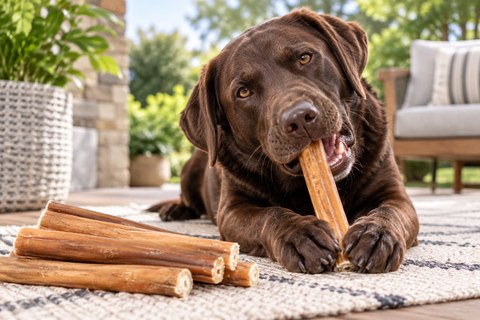
Your dog finishes a bully stick.
Looks at the tiny piece that's left.
Looks at you.
Then gives you the unmistakable expression:
"I'll have another."
Dogs aren't particularly helpful when it comes to determining appropriate treat frequency.
If they were making the schedule, bully sticks might become breakfast, lunch, dinner, and the occasional midnight snack.
For owners, the answer requires a little more thought.
So, how often can dogs have bully sticks?
There's no single schedule that's right for every dog.
Bully sticks are edible, animal-based chews that contribute calories to your dog's daily intake. How frequently they fit depends on the size of the chew, your dog's size and calorie needs, how much is consumed during each session, and what else your dog eats throughout the day.
The better question isn't simply, "How many bully sticks?"
It's:
"How does this bully stick fit into everything else my dog is eating?"
Start by Remembering That Bully Sticks Are Food
Bully sticks provide a longer chewing experience, which can make them feel more like toys than treats.
But unlike a rubber chew toy, a bully stick is gradually consumed.
Bully sticks are made from beef pizzle, making them an animal-based edible chew.
That means every portion your dog consumes contributes to overall food intake.
This distinction matters because it's easy to think:
"My dog only had one chew today."
But the nutritional impact of that chew depends heavily on its size.
A thin 6-inch bully stick and a thick 12-inch bully stick are clearly not equivalent portions.
There's No Universal "One Per Day" Rule
Dog sizes vary dramatically.
So do bully sticks. So does the amount dogs actually consume during a chewing session.
That's why a recommendation like "one bully stick every day" isn't particularly useful without context.
A small dog eating an entire substantial bully stick is experiencing something very different from a large dog chewing part of one and having the remainder removed for another day.
Frequency should be considered alongside portion size.
Sometimes the better approach isn't changing how often the bully stick comes out.
It's controlling how much is consumed each time.
Treat Calories Still Count
A commonly used guideline is that treats and extras should make up no more than about 10% of a dog's daily calories, with the majority coming from a complete and balanced diet.
Bully sticks belong in that treat-and-extra category.
And because their size and weight can vary, the calorie content can vary too.
Check the nutritional information provided for the specific bully stick you're feeding whenever available.
Then consider all the other extras your dog receives.
Training treats.
Meal toppers.
Dental chews.
Table scraps.
Natural chews.
They all share the same daily calorie budget.
Your Dog's Size Makes a Big Difference
A 10-pound dog and an 80-pound dog don't have identical calorie requirements.
That means the same bully stick can represent dramatically different portions of their daily intake.
For smaller dogs, portion awareness becomes especially important.
A smaller or thinner bully stick may be a better fit, or the dog may enjoy only part of a chew during one supervised session.
Larger dogs may comfortably handle more substantial bully sticks, but that still doesn't make calories irrelevant.
Dog size changes the math.
It doesn't eliminate it.
The Bully Stick's Size Matters Too
When deciding frequency, consider both:
Length
and
Thickness
A 6-inch thin bully stick contains less total material than a thick 12-inch option.
That means asking only, "How many bully sticks does my dog get?" can be misleading.
Two dogs could each receive one bully stick and consume very different amounts.
The actual amount consumed matters more than simply counting sticks.
Your Dog Doesn't Have to Finish It
This is one of the simplest ways to manage bully-stick intake.
A chewing session doesn't have to continue until nothing remains.
Your dog can enjoy the chew for a supervised period, then you can put it away if the product remains suitable for later use and is stored according to its directions.
Now one bully stick may provide more than one chewing session.
This can be especially useful for:
- Smaller dogs
- Gentle chewers
- Dogs receiving several other treats
- Owners trying to manage total treat intake
The experience still happens.
The entire portion doesn't necessarily happen at once.
Think About the Whole Treat Day
Imagine your dog has already received:
Several freeze-dried treats during morning training.
A topper at breakfast.
Rewards during an afternoon walk.
Then a bully stick in the evening.
Each individual item may seem small.
Together, they can add up.
A better treat routine considers the entire day rather than evaluating every reward independently.
On bully-stick days, you may decide to use smaller training rewards or reduce other extras.
You don't need to remove enjoyment.
You're simply balancing where it comes from.
How to Build a Better Treat Routine for Your Dog
Chewing Frequency and Chew Quantity Aren't the Same Thing
Suppose your dog benefits from having regular opportunities to chew.
That doesn't necessarily mean they need to consume an entire edible chew every time.
A balanced enrichment routine can include different activities.
One day might feature a bully stick.
Another could involve a food puzzle.
Another might include scent work or training.
Natural chewing can be part of the routine without becoming the only enrichment activity your dog receives.
The goal is providing appropriate outlets for chewing—not maximizing edible-chew consumption.
Power Chewers Need the Same Portion Awareness
Power chewers introduce another challenge:
They can consume bully sticks quickly.
A chew that lasts another dog several sessions may disappear much faster.
That doesn't necessarily mean the power chewer should receive another one immediately.
Instead, consider whether a thicker bully stick provides a more substantial chewing experience.
More appropriate sizing may help extend the activity without turning multiple bully sticks into one session.
Puppies Require Extra Consideration
Puppies naturally love chewing, but their nutritional needs and chewing abilities change quickly as they grow.
Choose bully sticks appropriately sized for the puppy and supervise every session.
Because puppies require complete nutrition formulated for growth, treats and chews shouldn't crowd out meaningful amounts of their primary diet.
If you're unsure whether bully sticks are appropriate for your puppy's age, size, or chewing stage, talk with your veterinarian.
What About Dogs Managing Their Weight?
Treat frequency becomes particularly important when calorie intake needs tighter control.
If your dog needs to lose or maintain weight, don't assume natural means calorie-free.
A bully stick may still fit the routine. It simply needs to fit within the overall calorie plan.
Your veterinarian can help determine an appropriate daily calorie target and how much room that leaves for treats and edible chews.
Sometimes portioning one bully stick across multiple sessions provides the chewing experience without adding an entire chew's worth of calories at once.
Watch How Your Dog Responds
Food isn't only about calorie calculations.
Pay attention to the individual dog.
After introducing bully sticks, watch for:
- Stool changes
- Digestive upset
- Changes in appetite
- Changes in weight
- How quickly the chew is consumed
If bully sticks don't agree with your dog, reduce or discontinue them and discuss concerns with your veterinarian when appropriate.
A popular chew isn't automatically the right chew for every individual dog.
Supervision Belongs in Every Bully-Stick Routine
Whether bully sticks appear once in a while or more regularly, supervision should remain consistent.
Watch how your dog works through the chew.
As the bully stick becomes shorter, remove the remaining piece when it becomes small enough that swallowing it whole could become a concern.
Supervision also helps you understand:
How quickly your dog chews.
Whether the thickness is appropriate.
How much they're consuming.
Whether the product should be portioned across sessions.
Those observations make future treat decisions much easier.
A Practical Way to Decide Frequency
Instead of starting with a calendar, work through these questions:
How large is my dog?
How large and calorie-dense is the bully stick?
How much of it does my dog actually consume?
What other treats are being fed that day?
Is my dog's weight stable and appropriate?
Does the chew agree with their digestion?
Am I using bully sticks as one part of a varied enrichment routine?
Those answers will tell you much more than a generic recommendation like "three bully sticks per week."
Bully Sticks Should Fit the Routine, Not Become the Routine
At Raw Paws Pet Food, bully sticks are one of our favorite ways to give dogs a satisfying, animal-based chewing experience.
But even a great natural chew works best when it has a clear place within the bigger feeding picture.
Choose an appropriate size.
Consider thickness.
Account for calories.
Supervise.
Portion the chew when needed.
Balance it against other treats.
And remember that your dog doesn't need to finish every bully stick in one sitting just because they'd happily volunteer.
So, how often can your dog have bully sticks?
The answer isn't hiding on a weekly calendar.
It's in the combination of portion, calories, dog size, chew size, diet, and individual response.
Your dog may still vote for "constantly."
Fortunately, you're the one holding the treat cabinet key.
Comments (0)
There are no comments for this article. Be the first one to leave a message!