

Look around your house.
How many cat toys can you see?
A mouse underneath the couch.
Three balls near the cat tree.
A feather toy on the floor.
Another mouse beside the food bowl.
Maybe an entire basket overflowing with toys your cat hasn't touched in months.
Here's the strange part:
Your cat might not need another toy.
They may actually need fewer toys available at once.
When the same objects remain in the same places day after day, they become part of the background. But take a favorite toy away for a while and bring it back later?
Suddenly, it's worth investigating again.
That's the idea behind cat toy rotation—a remarkably simple enrichment strategy that uses novelty without requiring you to continually buy something new.
Why Toys Stop Feeling Interesting
Imagine walking into your living room every morning and seeing the exact same objects in the exact same places.
Eventually, you stop consciously noticing most of them.
Cats experience familiarity too.
A toy that's permanently lying in the middle of the floor doesn't provide much surprise.
Your cat already knows:
What it looks like.
What it smells like.
Where it is.
How it moves.
Once an object becomes completely predictable, there's simply less information left to investigate.
That doesn't necessarily mean your cat dislikes the toy.
It may simply be too familiar.
Rotation Creates Novelty Through Absence
Toy rotation works because some toys temporarily disappear.
Instead of keeping twenty toys available, you might leave out four or five.
The rest go into storage.
After several days or a week, swap some of them.
Now something interesting happens.
The fuzzy mouse your cat ignored last month suddenly returns to the environment.
It isn't truly new.
But it hasn't been part of the everyday landscape.
Your cat may sniff it again.
Bat it.
Carry it.
Chase it.
Sometimes absence is enough to restore curiosity.
Start by Dividing Toys Into Small Groups
You don't need a complicated rotation schedule.
Gather your cat's toys and divide them into a few groups.
For example:
Group A
Toy mouse
Ball
Crinkle toy
Small kicker
Group B
Different mouse
Spring toy
Soft ball
Another kicker
Group C
Other safe favorites
Keep one group available.
Store the others somewhere your cat can't access them.
Later, swap. That's it.
No spreadsheet required.
Your cat doesn't need to know they're participating in an enrichment program.
Don't Rotate Everything at the Same Time
If your cat has one toy they absolutely adore, there's no rule saying it has to disappear.
Some objects can remain permanent favorites.
Rotate the toys that receive occasional interest while leaving especially meaningful comfort or play items available.
The goal isn't creating deprivation.
It's creating enough change that the environment doesn't become completely predictable.
Think:
Familiar favorites + rotating novelty.
That combination works beautifully for many cats.
Different Toy Types Create Better Rotation
If every toy in the rotation is basically the same mouse in a different color, the experience may not change very much.
Try rotating between different types of play.
One group might include:
- A rolling toy
- A kicker
- A crinkle toy
- A lightweight batting toy
Another might introduce:
- A spring
- A textured toy
- A different rolling object
- A catnip toy
Now you're not simply changing colors.
You're changing movement, texture, sound, and interaction.
That creates much richer sensory variety.
Interactive Toys Should Feel Different Too
Wand toys can be rotated just like independent toys.
Different attachments create different experiences.
Feathers may flutter.
Fabric may slither.
A mouse-like attachment may stay close to the ground.
But remember:
How you move the toy matters just as much as which toy you're using.
An old wand can feel completely different when you change the game.
Move it around furniture.
Let it disappear.
Pause.
Make it dart away.
Allow your cat to stalk before chasing.
Sometimes rotating your play style is just as valuable as rotating the toy itself.
Change the Location Too
Here's another easy way to make something familiar feel different.
Move it.
A toy that's been sitting beside the couch may become interesting when it appears inside a cardboard box.
A ball normally used in the living room might roll differently down a hallway.
A toy mouse placed near a tunnel creates another opportunity for stalking.
The toy hasn't changed.
The context has.
And context matters.
Pair Old Toys With New Games
Suppose your cat has completely lost interest in a toy mouse.
Don't immediately retire it.
Use it differently.
Hide it partially behind a box.
Move it with a wand.
Place it somewhere your cat has to discover it.
Incorporate it into a hunting-style game.
An object that isn't interesting by itself may become interesting when it becomes part of an activity.
That's one of the central principles of enrichment:
The experience matters more than the object.
Catnip Can Give an Old Toy Another Life
For cats that respond to catnip, scent can add another layer of novelty.
A catnip-compatible toy that hasn't been available for a while may become especially interesting when reintroduced with fresh catnip.
Your cat may:
Sniff.
Rub.
Roll.
Kick.
Bat.
Carry.
Not every cat responds to catnip, and responses vary widely, but for cats that enjoy it, scent can become another tool within the rotation.
What Is Catnip? The Science Behind Why Cats Love It – Raw Paws Pet Food
Silvervine Can Add Another Sensory Experience
If your cat doesn't respond strongly to catnip—or you simply want another option—silvervine can provide a different scent-based enrichment experience.
Some cats respond to both.
Some prefer one.
Others may show little interest.
The goal isn't determining which plant is universally "better." It's discovering what your individual cat finds engaging.
Rotating scent-based toys occasionally can add another dimension without filling the house with more objects.
Food Can Become Part of the Rotation
Enrichment doesn't need to stay separated into "toys" and "treats."
Combine them.
Hide a small piece of Freeze-Dried Chicken Breast, Chicken Heart, Beef Liver, or Whole Minnow near an appropriate toy.
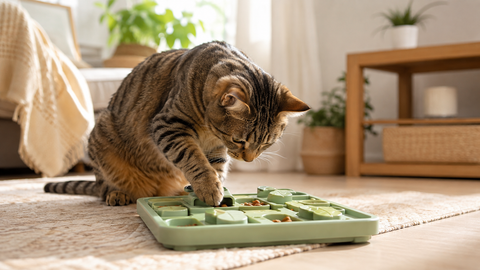
Place small rewards inside compatible food puzzles.
Use a treat at the end of a hunting-style play session.
Now the toy creates the activity and the food provides another layer of motivation.
At Raw Paws Pet Food, single-ingredient freeze-dried treats work particularly well for this because they can often be divided into small pieces for supervised enrichment.
How Often Should You Rotate Cat Toys?
There's no universal calendar.
Some households rotate every few days.
Others change selections weekly.
Instead of focusing on an exact schedule, watch your cat.
If the available toys are still generating regular play, there's no urgent reason to change them.
If they've become invisible pieces of household décor, it may be time for a swap.
The goal is maintaining interest—not following a timetable.
Clean and Inspect Toys During Rotation
Toy rotation creates a perfect opportunity for a quick safety check.
Before storing or reintroducing toys, inspect them for:
- Loose strings
- Detached pieces
- Damaged seams
- Exposed stuffing
- Broken components
- Excessive wear
Discard anything that can no longer be used safely.
Follow the manufacturer's cleaning instructions where applicable.
Rotation isn't only about novelty.
It's also a convenient way to keep track of what condition your cat's toys are actually in.
Some Toys Should Only Come Out With You
Not every toy belongs on the floor unattended.
Interactive wand toys and products with strings, ribbons, feathers, or components that could create entanglement or ingestion risks may require supervision.
Those toys can have their own rotation:
They appear when you do.
That can actually make them more exciting.
Your cat learns that when a particular toy comes out, an interactive play session is about to begin.
The toy becomes associated with the experience rather than simply existing in the room.
Watch Which Toys Keep Winning
Rotation gives you another benefit:
It reveals preferences.
Maybe your cat ignores almost every ball but immediately attacks anything feathered.
Perhaps mouse-shaped toys aren't interesting, but springs are irresistible. Maybe catnip toys consistently win.
Those patterns tell you something about your cat's preferred play style.
Use that information when deciding what stays in the rotation—and before buying anything new.
Your cat may already be telling you exactly what they want.
You Don't Need More Toys—You Need More Novelty
It's easy to confuse enrichment with accumulation.
Another toy.
Another gadget.
Another package arriving at the door.
But enrichment isn't measured by how full the toy basket becomes.
It's measured by whether your cat has interesting opportunities to interact with their environment.
Sometimes that means introducing something new.
But often it simply means making something familiar feel less predictable.
Put toys away.
Bring them back.
Change locations.
Change the game.
Add scent.
Combine toys with food searches or interactive play.
Suddenly, the toy your cat hasn't touched in months has a second life.
And you didn't need to buy a thing.

Comments (0)
There are no comments for this article. Be the first one to leave a message!